. 1999 Feb;103(4):563-9.
doi: 10.1172/JCI5212.

GM-CSF-deficient mice are susceptible to pulmonary group B streptococcal infection

Affiliations

GM-CSF-deficient mice are susceptible to pulmonary group B streptococcal infection

A M LeVine et al. J Clin Invest. 1999 Feb.

Abstract

Granulocyte-macrophage colony-stimulating factor (GM-CSF) gene-targeted mice (GM-/-) cleared group B streptococcus (GBS) from the lungs more slowly than wild-type mice. Expression of GM-CSF in the respiratory epithelium of GM-/- mice improved bacterial clearance to levels greater than that in wild-type GM+/+ mice. Acute aerosolization of GM-CSF to GM+/+ mice significantly enhanced clearance of GBS at 24 hours. GBS infection was associated with increased neutrophilic infiltration in lungs of GM-/- mice, while macrophage infiltrates predominated in wild-type mice, suggesting an abnormality in macrophage clearance of bacteria in the absence of GM-CSF. While phagocytosis of GBS was unaltered, production of superoxide radicals and hydrogen peroxide was markedly deficient in macrophages from GM-/- mice. Lipid peroxidation, assessed by measuring the isoprostane 8-iso-PGF2alpha, was decreased in the lungs of GM-/- mice. GM-CSF plays an important role in GBS clearance in vivo, mediated in part by its role in enhancing superoxide and hydrogen peroxide production and bacterial killing by alveolar macrophages.


Figures

Figure 1
Figure 1
Increased GBS in lung homogenates from GM–/– mice. Concentration of GBS was determined by quantitative cultures of lung homogenates. Colony counts were significantly greater 6, 24, and 48 h after administration of 104 CFU GBS in GM–/– (solid bars) compared with GM+/+ (hatched bars) mice. Six hours after GBS infection, clearance of GBS from the lung was enhanced in SP-C-GM (open bars) mice compared with GM+/+ mice. Data were not obtained for SP-C-GM mice at 48 h. Data are mean ± SEM with n = 10 mice per group. *P < 0.05 compared with GM+/+ mice. GBS, group B streptococcus; GM–/–, GM-CSF gene-targeted mice; SP-C-GM, human surfactant protein C (SP-C) gene promoter expressing GM-CSF.
Figure 2
Figure 2
Decreased 8-iso-PGF in lung homogenates and BAL fluid from GM–/– mice. Concentrations of 8-iso-prostaglandin F (8-iso-PGF) were assessed in lung homogenates (a) and BAL fluid (b) from GM–/– (solid bars), and GM+/+ (hatched bars) mice. Prostaglandin F2–like compounds are formed by free radical–catalyzed peroxidation of arachidonic acid, independent of cyclooxygenase enzyme. Decreased concentrations of 8-iso-PGF were found in lung homogenates and BAL fluid from the GM –/– mice 18 h after GBS infection. Data are expressed as ng/ml for the lung homogenates and pg/ml for BAL fluid and represent mean ± SEM with n = 8 mice per group. *P < 0.05 compared with GM+/+ mice. BAL, bronchoalveolar lavage.
Figure 3
Figure 3
Increased TNF-α, IL-6, and MIP-2 in lung homogenates from GM–/– mice after GBS infection. Concentrations of TNF-α, IL-6, and MIP-2 were assessed in lung homogenates from GM–/– (solid bars), GM+/+ (hatched bar), and SP-C-GM (open bars) mice. Increased concentrations of the proinflammatory cytokines TNF-α, IL-6, and MIP-2 were found in lung homogenates from the GM–/– mice at 24 h. TNF-α levels were increased in lung homogenates from SP-C-GM compared with GM+/+ mice at 24 h. Data are expressed as pg/ml and represent mean ± SEM with n = 10 mice per group. *P < 0.05 compared with GM+/+ mice. IL-6, interleukin-6; MIP-2, macrophage inflammatory protein-2; TNF-α, tumor necrosis factor-α.
Figure 4
Figure 4
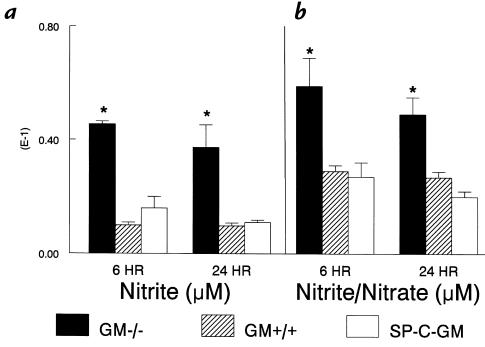
Increased nitrite concentrations in BAL fluid from GM–/– mice after GBS infection. Nitrite in the BAL fluid was measured by the Griess reaction as described in Methods. Six and 24 h after intratracheal inoculation of 104 CFU GBS, nitrite (a) and nitrite/nitrate (b) levels in BAL fluid from GM–/– mice (solid bars) were increased compared with GM+/+ (hatched bars) and SP-C-GM (open bars) mice. Data represent mean ± SEM with n = 5 mice per group. *P < 0.05 compared with GM+/+ mice.
Figure 5
Figure 5
Exogenous GM-CSF enhances GBS clearance from the lung. Concentration of GBS was determined by quantitative cultures of lung homogenates. Colony counts were significantly decreased 24 h after administration of 104 CFU GBS to wild-type mice (solid) treated with three doses of aerosolized recombinant mouse GM-CSF (4 ng/mouse) compared with untreated controls (hatched bars). Data are mean ± SEM with n = 15 mice per group. *P < 0.05 compared with untreated wild-type mice.

References

    1. Tarr PE. Granulocyte-macrophage colony-stimulating factor and the immune system. Med Oncol. 1996;13:133–140. - PubMed
    1. Smith SM, Lee DKP, Lacy J, Coleman DL. Rat tracheal epithelial cells produce granulocyte/macrophage colony-stimulating factor. Am J Respir Cell Mol Biol. 1990;2:59–68. - PubMed
    1. Morrissey PJ, Bressler L, Park LS, Alpert A, Gillis S. Granulocyte-macrophage colony-stimulating factor augments the primary antibody response by enhancing the function of antigen-presenting cells. J Immunol. 1987;139:1113–1119. - PubMed
    1. Collins HL, Bancroft GJ. Cytokine enhancement of complement-dependent phagocytosis by macrophages: synergy of tumor necrosis factor-α and granulocyte-macrophage colony-stimulating factor for phagocytosis of Cryptococcus neoformans. Eur J Immunol. 1992;22:1447–1454. - PubMed
    1. Weiser WY, van Niel A, Clark SC, David JR, Remold HG. Recombinant human granulocyte/macrophage colony-stimulating factor activates intracellular killing of Leishmania donovani by human monocyte-derived macrophages. J Exp Med. 1987;166:1436–1446. - PMC - PubMed

Publication types

MeSH terms