


Effects of the Chinese traditional medicine mao-bushi-saishin-to on therapeutic efficacy of a new benzoxazinorifamycin, KRM-1648, against Mycobacterium avium infection in mice
- PMID: 10049260
- PMCID: PMC89153
- DOI: 10.1128/AAC.43.3.514
Effects of the Chinese traditional medicine mao-bushi-saishin-to on therapeutic efficacy of a new benzoxazinorifamycin, KRM-1648, against Mycobacterium avium infection in mice
Abstract
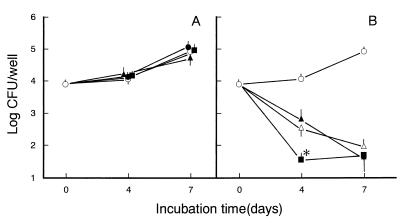
The Chinese traditional medicine mao-bushi-saishin-to (MBST), which has anti-inflammatory effects and has been used to treat the common cold and nasal allergy in Japan, was examined for its effects on the therapeutic activity of a new benzoxazinorifamycin, KRM-1648 (KRM), against Mycobacterium avium complex (MAC) infection in mice. In addition, we examined the effects of MBST on the anti-MAC activity of murine peritoneal macrophages (M phi s). First, MBST significantly increased the anti-MAC therapeutic activity of KRM when given to mice in combination with KRM, although MBST alone did not exhibit such effects. Second, MBST treatment of M phi s significantly enhanced the KRM-mediated killing of MAC bacteria residing in M phi s, although MBST alone did not potentiate the M phi anti-MAC activity. MBST-treated M phi s showed decreased levels of reactive nitrogen intermediate (RNI) release, suggesting that RNIs are not decisive in the expression of the anti-MAC activity of such M phi populations. MBST partially blocked the interleukin-10 (IL-10) production of MAC-infected M phi s without affecting their transforming growth factor beta (TGF-beta)-producing activity. Reverse transcription-PCR analysis of the lung tissues of MAC-infected mice at weeks 4 and 8 after infection revealed a marked increase in the levels of tumor necrosis factor alpha, gamma interferon (IFN-gamma), IL-10, and TGF-beta mRNAs. KRM treatment of infected mice tended to decrease the levels of the test cytokine mRNAs, except that it increased TGF-beta mRNA expression at week 4. MBST treatment did not affect the levels of any cytokine mRNAs at week 8, while it down-regulated cytokine mRNA expression at week 4. At week 8, treatment of mice with a combination of KRM and MBST caused a marked decrease in the levels of the test cytokines mRNAs, especially IL-10 and IFN-gamma mRNAs, although such effects were obscure at week 4. These findings suggest that down-regulation of the expression of IL-10 and TGF-beta is related to the combined therapeutic effects of KRM and MBST against MAC infection.
Figures


References
-
- Akaki T, Sato K, Shimizu T, Sano C, Kajitani H, Dekio S, Tomioka H. Effector molecules in expression of the antimicrobial activity of macrophages against Mycobacterium avium complex: the roles of reactive nitrogen intermediates, reactive oxygen intermediates, and free fatty acids. J Leukocyte Biol. 1997;62:795–804. - PubMed
-
- Ashman R B, Bolitho E M, Fulurija A. Cytokine mRNA in brain tissue from mice that show strain-dependent differences in the severity of lesions induced by systemic infection with Candida albicans yeast. J Infect Dis. 1995;172:823–830. - PubMed
-
- Benson C A. Treatment of disseminated Mycobacterium avium complex disease: a clinician’s perspective. Res Microbiol. 1996;147:16–24. - PubMed
-
- Benson C A, Ellner J J. Mycobacterium avium complex infection in AIDS: advances in theory and practice. Clin Infect Dis. 1993;17:7–20. - PubMed
Publication types
MeSH terms
Substances
LinkOut - more resources
Full Text Sources
Other Literature Sources
Medical
