. 1999 Mar;43(3):530-6.
doi: 10.1128/AAC.43.3.530.

Cloning, expression, and enzymatic characterization of Pseudomonas aeruginosa topoisomerase IV

Affiliations

Cloning, expression, and enzymatic characterization of Pseudomonas aeruginosa topoisomerase IV

T Akasaka et al. Antimicrob Agents Chemother. 1999 Mar.

Abstract

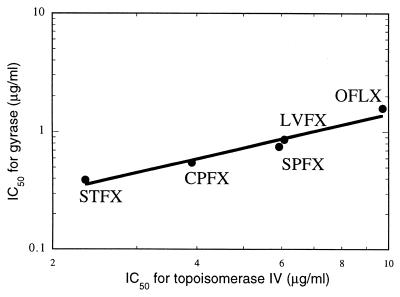
The topoisomerase IV subunit A gene, parC homolog, has been cloned and sequenced from Pseudomonas aeruginosa PAO1, with cDNA encoding the N-terminal region of Escherichia coli parC used as a probe. The homolog and its upstream gene were presumed to be parC and parE through sequence homology with the parC and parE genes of other organisms. The deduced amino acid sequence of ParC and ParE showed 33 and 32% identity with that of the P. aeruginosa DNA gyrase subunits, GyrA and GyrB, respectively, and 69 and 75% identity with that of E. coli ParC and ParE, respectively. The putative ParC and ParE proteins were overexpressed and separately purified by use of a fusion system with a maltose-binding protein, and their enzymatic properties were examined. The reconstituted enzyme had ATP-dependent decatenation activity, which is the main catalytic activity of bacterial topoisomerase IV, and relaxing activities but had no supercoiling activity. So, the cloned genes were identified as P. aeruginosa topoisomerase IV genes. The inhibitory effects of quinolones on the activities of topoisomerase IV and DNA gyrase were compared. The 50% inhibitory concentrations of quinolones for the decatenation activity of topoisomerase IV were from five to eight times higher than those for the supercoiling activities of P. aeruginosa DNA gyrase. These results confirmed that topoisomerase IV is less sensitive to fluoroquinolones than is DNA gyrase and may be a secondary target of new quinolones in wild-type P. aeruginosa.


Figures
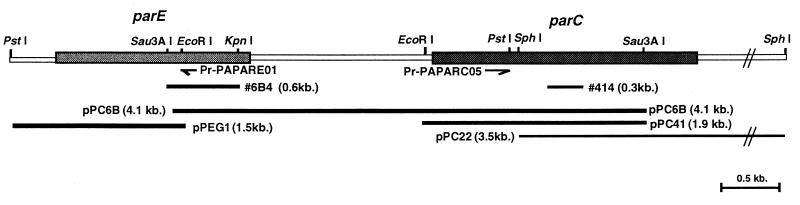
FIG. 1
FIG. 1
Restriction map of the parC and parE genes in P. aeruginosa PAO1 and alignment of plasmid clones. The parC and parE genes are indicated by shaded regions. Plasmid pPC6B (3.8-kb insert in pUC19) and plasmid pPC41 (2.0-kb insert in pUC19) were obtained by colony hybridization with the 0.6-kb probe encoding the N-terminus of E. coli parC. Plasmid pPC22, containing a 3.5-kb SphI insert, was isolated from a size-selected library with a 0.3-kb fragment (no. 414) as probe. Plasmid pPEG1 was obtained by PCR of a 4.7-kb PstI fragment.
FIG. 2
FIG. 2
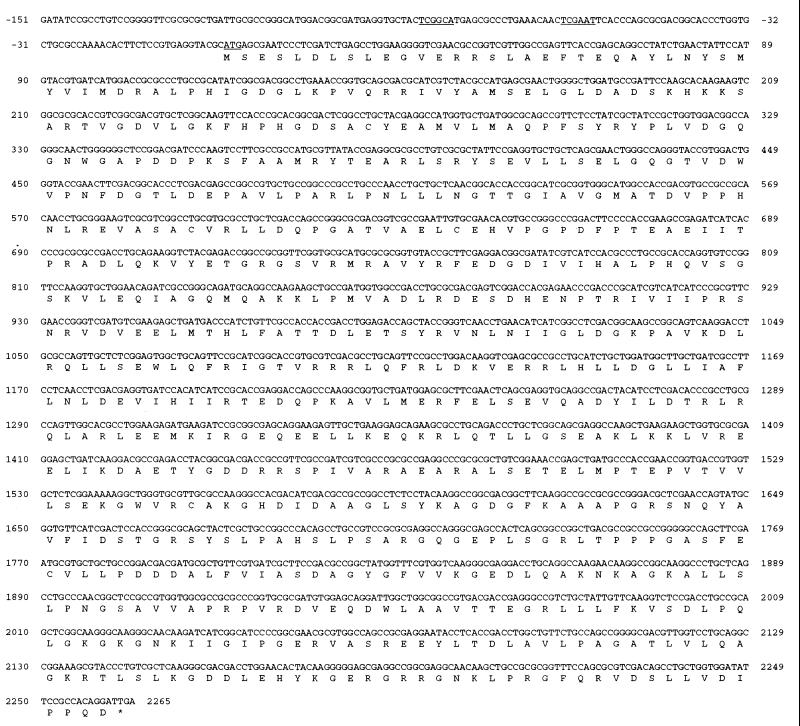
Nucleotide sequence and deduced amino acid sequence of the P. aeruginosa parC region. A methionine initiation codon and putative −10 and −35 regions are shown by underlining. An asterisk indicates the translation stop codon.
FIG. 3
FIG. 3
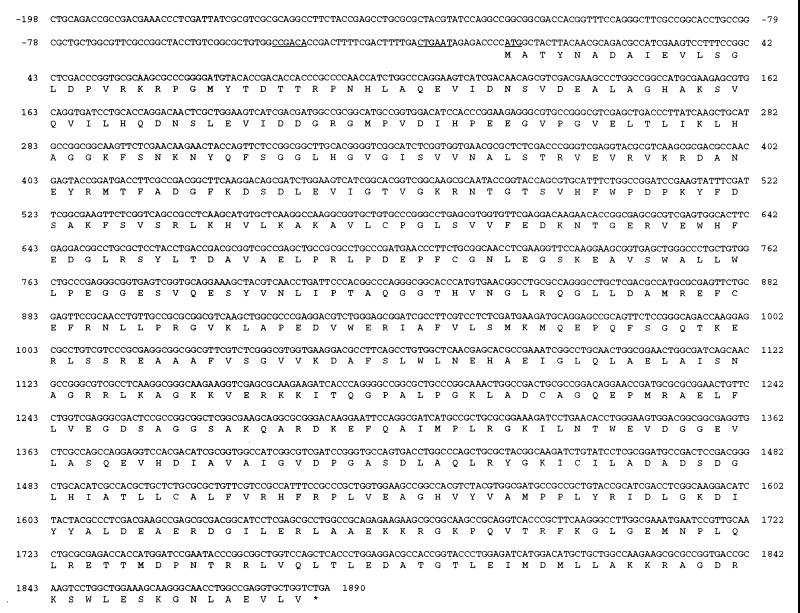
Nucleotide sequence and deduced amino acid sequence of the P. aeruginosa parE region. The P. aeruginosa parE nucleotide sequence is shown along with the predicted amino acid sequence. Symbols are the same as those defined for Fig. 2.
FIG. 4
FIG. 4
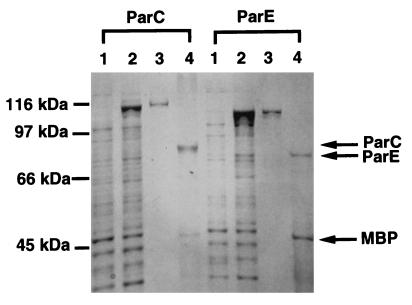
SDS-polyacrylamide gel electrophoresis analysis of ParC and ParE. Proteins at various purification steps were electrophoresed in an SDS–12.5% polyacrylamide gel and stained with Coomassie brilliant blue. Lanes 1, soluble extracts from uninduced cells; lanes 2, soluble extracts from IPTG-induced cells, lanes 3, affinity-purified MBP-ParC or MBP-ParE protein; lanes 4, factor Xa digest of MBP-ParC or MBP-ParE.
FIG. 5
FIG. 5
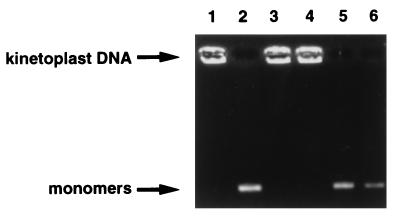
Topoisomerase IV activities of ParC and ParE proteins. Lane 1, P. aeruginosa ParC (1 U); lane 2, P. aeruginosa ParC (1 U) and P. aeruginosa ParE (1 U); lane 3, P. aeruginosa ParE (1 U); lane 4, P. aeruginosa ParC (1 U) and P. aeruginosa ParE (1 U) but with ATP omitted; lane 5, P. aeruginosa ParC (1 U) and E. coli ParE (1 U); lane 6, E. coli ParC (1 U) and P. aeruginosa ParE (1 U).
FIG. 6
FIG. 6
Correlation between inhibition of topoisomerase IV and that of DNA gyrase. Abbreviations: STFX, sitafloxacin; CPFX, ciprofloxacin; SPFX, sparfloxacin; LVFX, levofloxacin; OFLX, ofloxacin.

References

    1. Adachi T, Mizuuchi M, Robinson E, Appella E, O’Dea M, Gellert M, Mizuuchi K. DNA sequence of the E. coli gyrB gene: application of a new sequencing strategy. Nucleic Acids Res. 1987;15:771–783. - PMC - PubMed
    1. Akasaka T, Kurosaka S, Uchida Y, Tanaka M, Sato K, Hayakawa I. Antibacterial activities and inhibitory effects of sitafloxacin (DU-6859a) and its optical isomers against type II topoisomerases. Antimicrob Agents Chemother. 1998;42:1284–1287. - PMC - PubMed
    1. Belland R J, Morrison S G, Ison C, Huang W M. Neisseria gonorrhoeae acquires mutations in analogous regions of gyrA and parC in fluoroquinolone-resistant isolates. Mol Microbiol. 1994;14:371–380. - PubMed
    1. Blanche F, Cameron B, Bernard F X, Maton L, Manse B, Ferrero L, Ratet N, Lecoq C, Goniot A, Bisch D, Crouzet J. Differential behaviors of Staphylococcus aureus and Escherichia coli type II DNA topoisomerases. Antimicrob Agents Chemother. 1996;40:2714–2720. - PMC - PubMed
    1. Cambau E, Perani E, Dib C, Petinon C, Trias J, Jarlier V. Role of mutations in DNA gyrase genes in ciprofloxacin resistance of Pseudomonas aeruginosa susceptible or resistant to imipenem. Antimicrob Agents Chemother. 1995;39:2248–2252. - PMC - PubMed

MeSH terms

LinkOut - more resources