. 1999 Mar;65(3):929-35.
doi: 10.1128/AEM.65.3.929-935.1999.

Role of the Trichoderma harzianum endochitinase gene, ech42, in mycoparasitism

Affiliations

Role of the Trichoderma harzianum endochitinase gene, ech42, in mycoparasitism

C Carsolio et al. Appl Environ Microbiol. 1999 Mar.

Abstract

The role of the Trichoderma harzianum endochitinase (Ech42) in mycoparasitism was studied by genetically manipulating the gene that encodes Ech42, ech42. We constructed several transgenic T. harzianum strains carrying multiple copies of ech42 and the corresponding gene disruptants. The level of extracellular endochitinase activity when T. harzianum was grown under inducing conditions increased up to 42-fold in multicopy strains as compared with the wild type, whereas gene disruptants exhibited practically no activity. The densities of chitin labeling of Rhizoctonia solani cell walls, after interactions with gene disruptants were not statistically significantly different than the density of chitin labeling after interactions with the wild type. Finally, no major differences in the efficacies of the strains generated as biocontrol agents against R. solani or Sclerotium rolfsii were observed in greenhouse experiments.


Figures
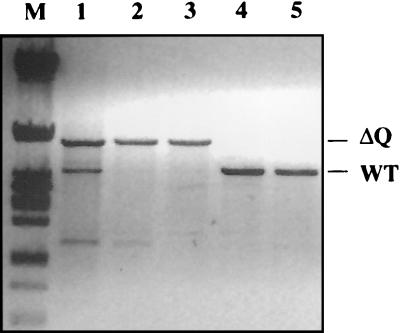
FIG. 1
FIG. 1
DNA analysis of the gene disruption candidates: PCR-amplified products. Samples (100 ng) of total DNA from different transformants were subjected to PCR and agarose gel electrophoresis. Lane 1, ΔQ-3; lane 2, ΔQ-1; lane 3, ΔQ-2; lane 4, another ΔQ transformant not carrying an ech42 disruption; lane 5, wild type; lane M, molecular size standards. The expected sizes of the bands corresponding to wild type ech42 (WT) and disrupted ech42 (ΔQ) are indicated on the right.
FIG. 2
FIG. 2
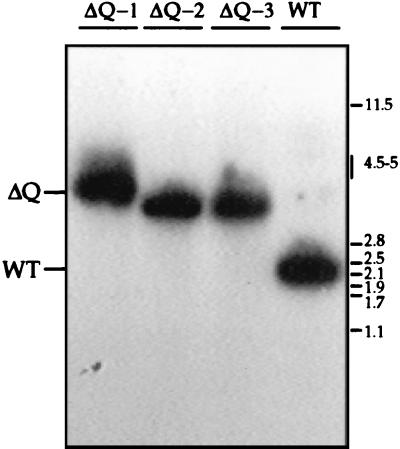
Southern analysis. Total DNA was extracted, digested with SalI, and probed with a HindIII fragment from the ech42 coding region. The expected sizes of the bands corresponding to wild type ech42 (WT) and disrupted ech42 (ΔQ) are indicated on the left, and the positions of molecular size standards are indicated on the right.
FIG. 3
FIG. 3
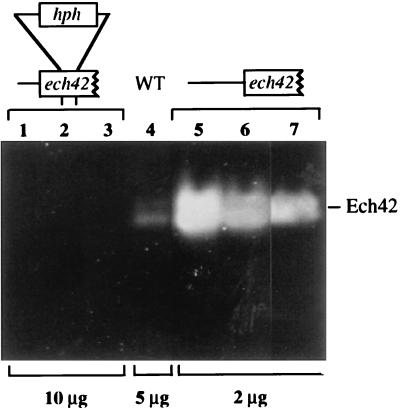
Chitinase expression in transformed Trichoderma sp.: detection of extracellular chitinolytic activity from T. harzianum transformed strains. Protein samples were subjected to SDS-PAGE and renatured, and the activity was revealed by using 4-methylumbelliferyl β-d-N,N′,N"-triacetylchitotriose as the substrate. Lane 1, ΔQ-1; lane 2, ΔQ-2; lane 3, ΔQ-3; lane 4, wild type; lane 5, QL-9; lane 6, QL-7; lane 7, QL-10. Schematic representations of the different constructs used to transform T. harzianum are shown at the top.
FIG. 4
FIG. 4
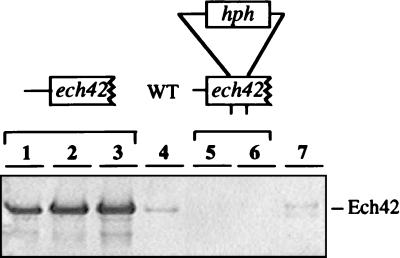
Western blot of extracellular proteins from T. harzianum transformed strains. A 2.5-μg sample of protein from each strain (lanes 1 through 6) or 20 ng of purified recombinant Ech42 from E. coli (lane 7) was subjected to SDS-PAGE and transferred onto a nylon membrane. An antibody against Ech42 was used for immunodetection. Lane 1, QL-10; lane 2, QL-9; lane 3, QL-7; lane 4, wild type; lane 5, ΔQ-2; lane 6, ΔQ-1; lane 7, recombinant Ech42 from E. coli. Schematic representations of the different constructs used to transform T. harzianum are shown at the top.
FIG. 5
FIG. 5
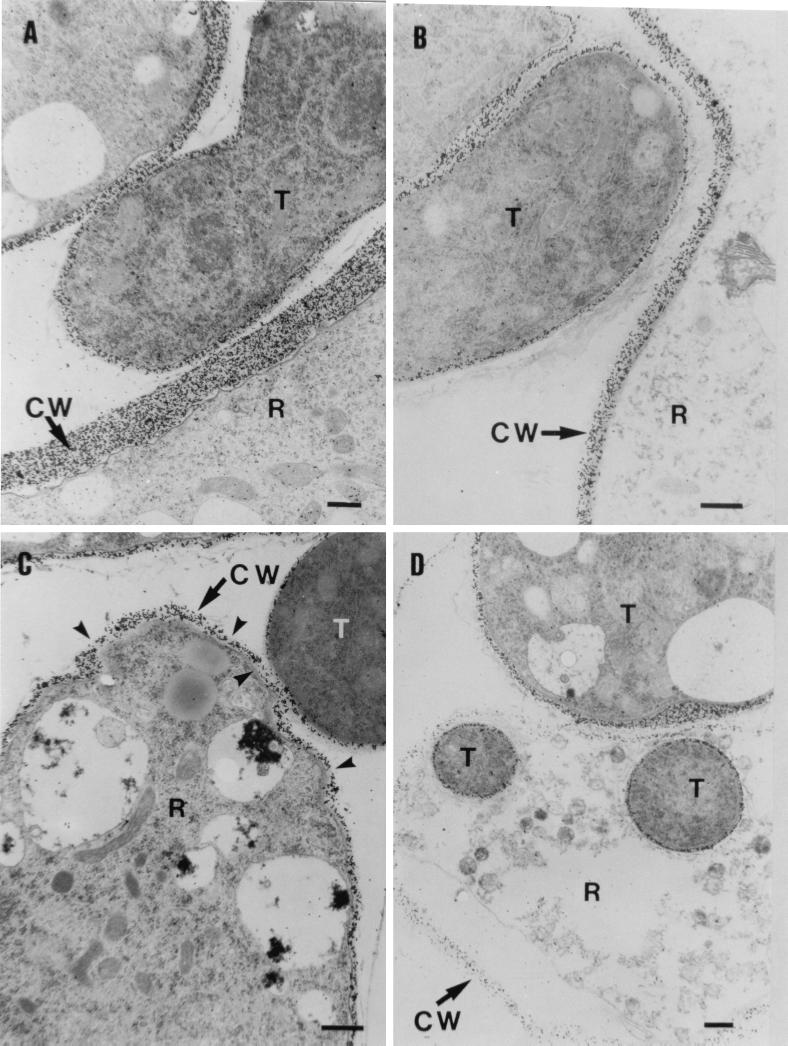
TEM micrographs of cultures containing either wild-type or transformed T. harzianum and R. solani. Chitin was labeled with the WGA-ovomucoid-gold complex. (A) Wild type, 4 h. (B) ΔQ-1, 4 h. (C) QL-9, 4 h. (D) QL-9, 16 h. T, Trichoderma cell; R, Rhizoctonia cell; CW, Rhizoctonia cell wall. The arrowheads indicate points where R. solani cell wall degradation is apparent.
FIG. 6
FIG. 6
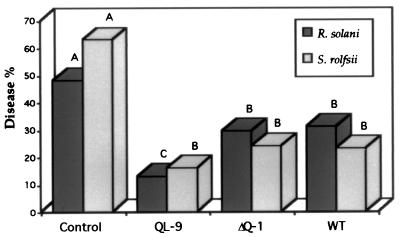
Plant disease control by wild-type and transformed T. harzianum in greenhouse experiments. Columns for each series (R. solani, S. rolfsii) marked with different letters are significantly different (P = 0.05), as determined by Duncan’s multiple range test. Control, R. solani or S. rolfsii in soil; QL-9, pathogen plus QL-9; ΔQ-1, pathogen plus ΔQ-1; WT, pathogen plus wild-type T. harzianum.
FIG. 7
FIG. 7
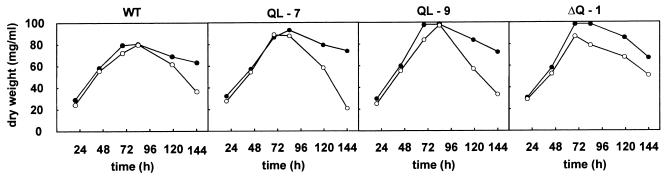
Growth curves for transformed T. harzianum strains. Strains were grown in MM containing glycerol (●) or MM containing glycerol and chitin (○).

References

    1. Benhamou N. Preparation and applications of lectin-gold complexes. In: Hayat M A, editor. Colloidal gold. Principles, methods and applications. Vol. 1. New York, N.Y: Academic Press; 1989. pp. 95–143.
    1. Benhamou N, Chet I. Hyphal interactions between Trichoderma harzianum and Rhizoctonia solani: ultrastructure and gold cytochemistry of the mycoparasitic process. Phytopathology. 1993;83:1062–1071.
    1. Carsolio C, Gutiérrez A, Jiménez B, Van Montagu M, Herrera-Estrella A. Characterization of ech-42, a Trichoderma harzianum endochitinase gene expressed during mycoparasitism. Proc Natl Acad Sci USA. 1994;91:10903–10907. - PMC - PubMed
    1. Casadaban M J, Martínez-Arias A, Shapira S K, Chou J. β-Galactosidase gene fusions for analyzing gene expression in Escherichia coli and yeast. Methods Enzymol. 1983;100:293–308. - PubMed
    1. Cherif M, Benhamou N. Cytochemical aspects of chitin breakdown during the parasitic action of Trichoderma spp. on Fusarium oxysporum f. sp. radicis-lycopersici. Phytopathology. 1990;80:1406–1414.

Publication types

LinkOut - more resources