


Diversity of dissimilatory bisulfite reductase genes of bacteria associated with the deep-sea hydrothermal vent polychaete annelid Alvinella pompejana
- PMID: 10049872
- PMCID: PMC91153
- DOI: 10.1128/AEM.65.3.1127-1132.1999
Diversity of dissimilatory bisulfite reductase genes of bacteria associated with the deep-sea hydrothermal vent polychaete annelid Alvinella pompejana
Abstract
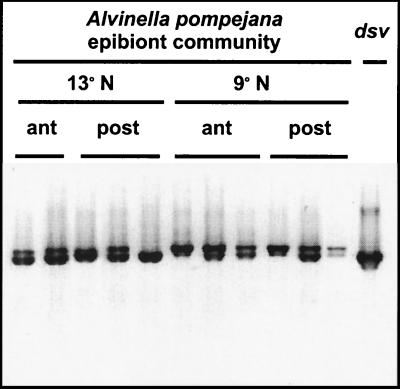
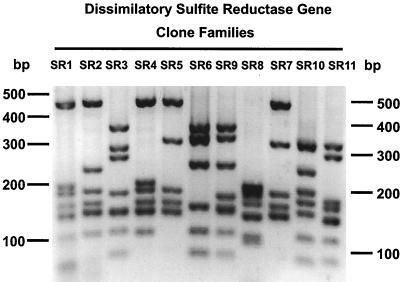
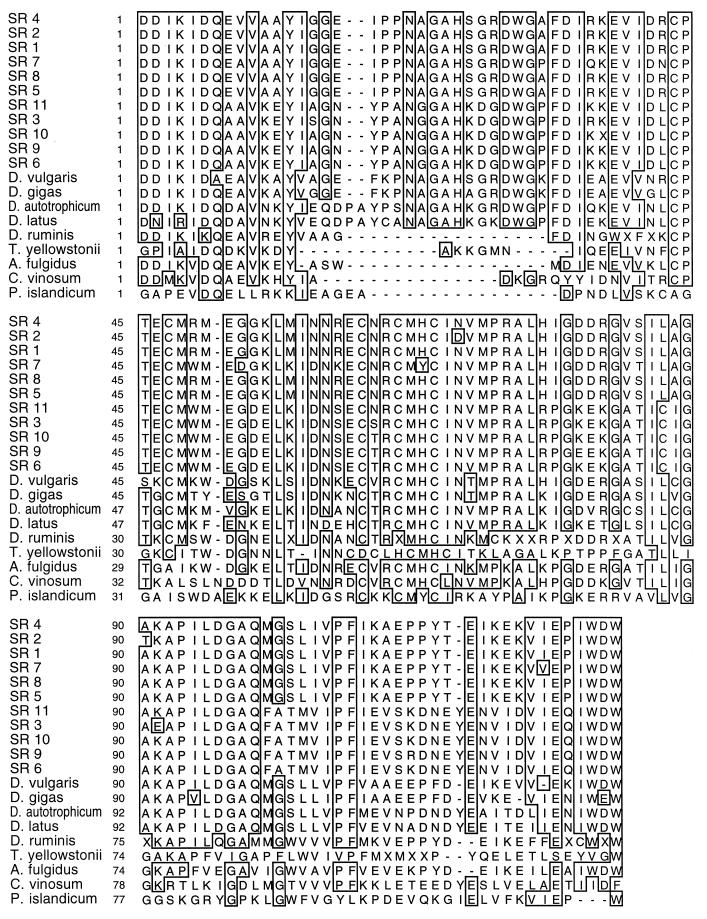
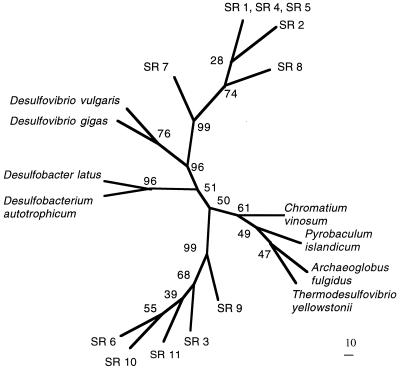
A unique community of bacteria colonizes the dorsal integument of the polychaete annelid Alvinella pompejana, which inhabits the high-temperature environments of active deep-sea hydrothermal vents along the East Pacific Rise. The composition of this bacterial community was characterized in previous studies by using a 16S rRNA gene clone library and in situ hybridization with oligonucleotide probes. In the present study, a pair of PCR primers (P94-F and P93-R) were used to amplify a segment of the dissimilatory bisulfite reductase gene from DNA isolated from the community of bacteria associated with A. pompejana. The goal was to assess the presence and diversity of bacteria with the capacity to use sulfate as a terminal electron acceptor. A clone library of bisulfite reductase gene PCR products was constructed and characterized by restriction fragment and sequence analysis. Eleven clone families were identified. Two of the 11 clone families, SR1 and SR6, contained 82% of the clones. DNA sequence analysis of a clone from each family indicated that they are dissimilatory bisulfite reductase genes most similar to the dissimilatory bisulfite reductase genes of Desulfovibrio vulgaris, Desulfovibrio gigas, Desulfobacterium autotrophicum, and Desulfobacter latus. Similarities to the dissimilatory bisulfite reductases of Thermodesulfovibrio yellowstonii, the sulfide oxidizer Chromatium vinosum, the sulfur reducer Pyrobaculum islandicum, and the archaeal sulfate reducer Archaeoglobus fulgidus were lower. Phylogenetic analysis separated the clone families into groups that probably represent two genera of previously uncharacterized sulfate-reducing bacteria. The presence of dissimilatory bisulfite reductase genes is consistent with recent temperature and chemical measurements that documented a lack of dissolved oxygen in dwelling tubes of the worm. The diversity of dissimilatory bisulfite reductase genes in the bacterial community on the back of the worm suggests a prominent role for anaerobic sulfate-reducing bacteria in the ecology of A. pompejana.
Figures
References
-
- Alayse-Danet A M, Gaill F, Desbruyeres D. In situ bicarbonate uptake by bacteria-Alvinella associations. Mar Ecol. 1986;7:233–240.
-
- Alayse-Danet A M, Desbruyeres D, Gaill F. The possible nutritional or detoxification role of the epibiotic bacteria of Alvinellid polychaetes: review of current data. Symbiosis. 1987;4:51–62.
-
- Altschul S F, Gish W, Miller W, Myers E W, Lipman D J. Basic local alignment search tool. J Mol Biol. 1990;215:403–410. - PubMed
-
- Arendsen A F, Verhagen M, Wolbert R B G, Pierik A J, Stams A J M, Jetten M S M, Hagen W R. The dissimilatory sulfite reductase from Desulfosarcina variabilis is a desulforubidin containing uncoupled metalated sirohemes and S = 9/2 iron-sulfur clusters. Biochemistry. 1993;32:10323–10330. - PubMed
-
- Baross J A, Deming J W. The role of bacteria in the ecology of black-smoker environments. Bull Biol Soc Wash. 1985;6:355–371.
Publication types
MeSH terms
Substances
Associated data
- Actions
- Actions
- Actions
- Actions
- Actions
- Actions
- Actions
- Actions
- Actions
- Actions
- Actions
LinkOut - more resources
Full Text Sources
Research Materials
