


In situ identification of cyanobacteria with horseradish peroxidase-labeled, rRNA-targeted oligonucleotide probes
- PMID: 10049892
- PMCID: PMC91173
- DOI: 10.1128/AEM.65.3.1259-1267.1999
In situ identification of cyanobacteria with horseradish peroxidase-labeled, rRNA-targeted oligonucleotide probes
Abstract
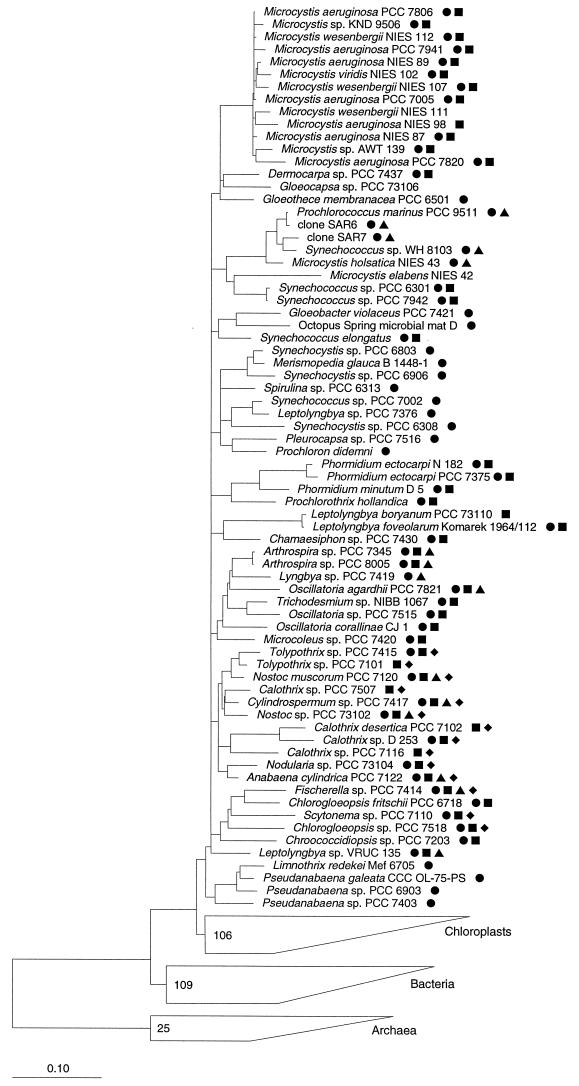
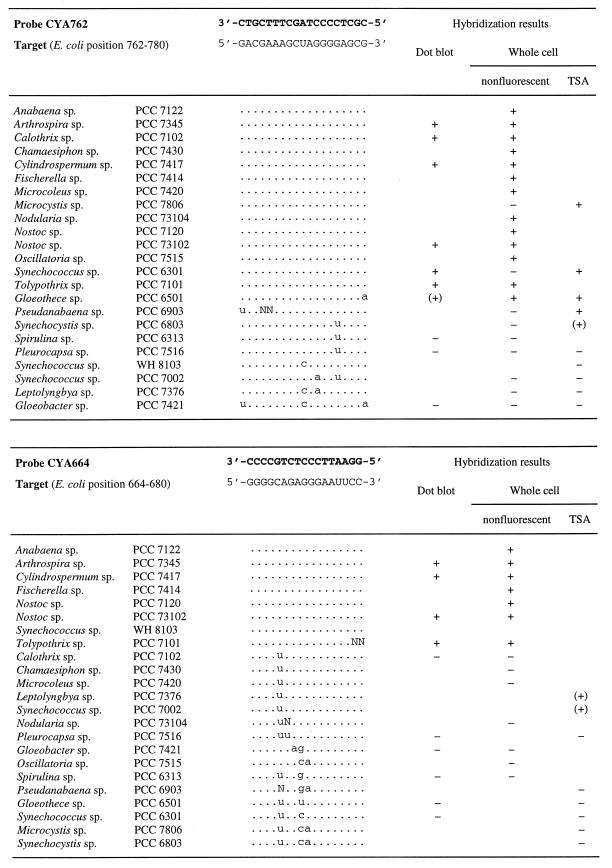
Individual cyanobacterial cells are normally identified in environmental samples only on the basis of their pigmentation and morphology. However, these criteria are often insufficient for the differentiation of species. Here, a whole-cell hybridization technique is presented that uses horseradish peroxidase (HRP)-labeled, rRNA-targeted oligonucleotides for in situ identification of cyanobacteria. This indirect method, in which the probe-conferred enzyme has to be visualized in an additional step, was necessary since fluorescently monolabeled oligonucleotides were insufficient to overstain the autofluorescence of the target cells. Initially, a nonfluorescent detection assay was developed and successfully applied to cyanobacterial mats. Later, it was demonstrated that tyramide signal amplification (TSA) resulted in fluorescent signals far above the level of autofluorescence. Furthermore, TSA-based detection of HRP was more sensitive than that based on nonfluorescent substrates. Critical points of the assay, such as cell fixation and permeabilization, specificity, and sensitivity, were systematically investigated by using four oligonucleotides newly designed to target groups of cyanobacteria.
Figures


References
-
- Anagnostidis K, Komárek J. Modern approach to the classification system of cyanophytes. 1. Introduction. Arch Hydrobiol Suppl. 1985;71:291–302.
Publication types
MeSH terms
Substances
LinkOut - more resources
Full Text Sources
Other Literature Sources
Research Materials
