


doi: 10.1128/AEM.65.3.1298-1303.1999.
A randomly amplified polymorphic DNA marker specific for the Bacillus cereus group is diagnostic for Bacillus anthracis
Affiliations
- PMID: 10049896
- PMCID: PMC91177
- DOI: 10.1128/AEM.65.3.1298-1303.1999
Item in Clipboard
A randomly amplified polymorphic DNA marker specific for the Bacillus cereus group is diagnostic for Bacillus anthracis
Appl Environ Microbiol.
1999 Mar.
Abstract
Aiming to develop a DNA marker specific for Bacillus anthracis and able to discriminate this species from Bacillus cereus, Bacillus thuringiensis, and Bacillus mycoides, we applied the randomly amplified polymorphic DNA (RAPD) fingerprinting technique to a collection of 101 strains of the genus Bacillus, including 61 strains of the B. cereus group. An 838-bp RAPD marker (SG-850) specific for B. cereus, B. thuringiensis, B. anthracis, and B. mycoides was identified. This fragment included a putative (366-nucleotide) open reading frame highly homologous to the ypuA gene of Bacillus subtilis. The restriction analysis of the SG-850 fragment with AluI distinguished B. anthracis from the other species of the B. cereus group.
Figures
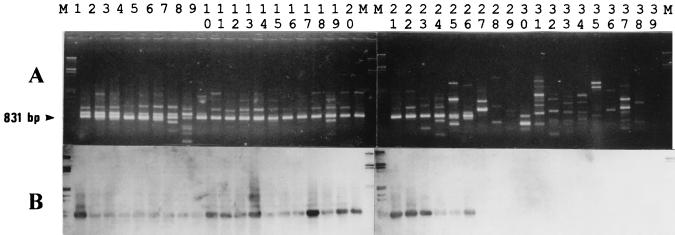
Identification of the SG-850 RAPD marker for the B. cereus group strains by RAPD fingerprinting of Bacillus strains obtained by amplifying total DNA with primer OPG-8 (A) and Southern hybridization of the RAPD patterns with the SG-850 DIG-labelled probe obtained from B. cereus 2896 (B). Lanes M, DNA size markers (EcoRI-, HindIII-digested lambda DNA, DIG labelled; Boehringer Mannheim). Lanes 1 to 22, B. cereus 31T, 318, 336, 6127, 46321, CER4, 487, CER6, 360, 345, 351, 626, 2896, BC1, BC2, CER1, CER3, CER5, MY1, MYd, CO1, and CO2. Lanes 23 and 24, B. thuringiensis 2046T and A1. Lane 25, B. mycoides 2048T. Lane 26, B. cereus PO1. Lanes 27 to 39, B. sphaericus 461, B. coagulans 1T, B. amyloliquefaciens 7T, B. circulans 11T, B. brevis 30T, B. smithii 4216, B. megaterium 32T, B. pasteurii 33T, B. polymyxa 36T, B. amyloliquefaciens BAM, B. subtilis 8633, B. licheniformis 14580T, and a negative control.
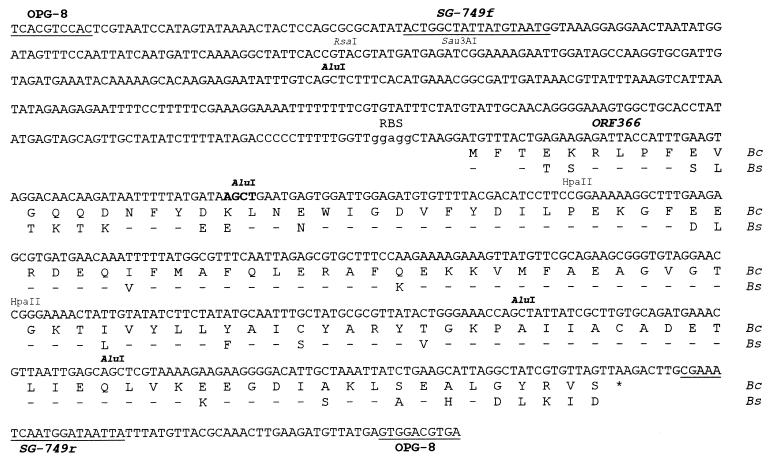
Nucleotide sequence of the SG-850 RAPD marker from B. cereus 336. Regions that are underlined represent the target sequences of primer OPG-8, SG-749f, or SG-749r. The recognition sites of the restriction endonuclease AluI (and those of others) are also indicated. The B. cereus (Bc) ORF366, spanning nt 404 to 773, encodes an amino acid sequence (shown below the nucleotide sequence in the single-letter code) homologous to the B. subtilis (Bs) YpuA protein. Hyphens represent residues identical in the B. cereus ORF366 and the B. subtilis YpuA protein; RBS indicates the putative ribosome binding site upstream from the ORF366.
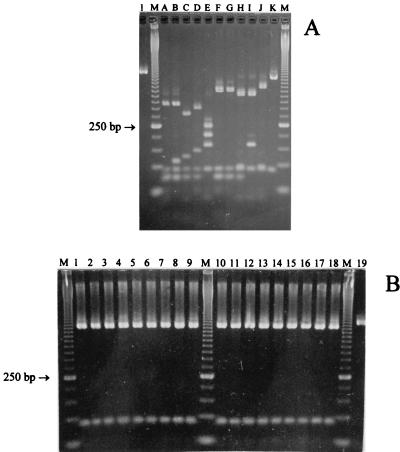
Characterization of the SG-749 fragment with the restriction enzyme AluI. (A) AluI restriction haplotypes of the SG-749 fragment found in the 61 strains of the B. cereus group listed in Table 1. Lanes M, 50-bp DNA size ladder; lane 1, SG-749 fragment; lanes A to K, AluI haplotypes (the capital letters refer to the haplotypes reported in Table 1). (B) AluI restriction pattern (haplotype K) of B. anthracis strains. Lanes M, 50-bp DNA size ladder; lanes 1 to 18, B. anthracis CEB 7700, 7702, 4229, 6602, Cepanzo, Davis TE702, 957, 227, 170, 300, 779, 832, 663, 376, 846, 256, 582, and 282; lane 19, SG-749 fragment.
References
-
- Angus T A. A bacterial toxin paralysing silkworm larvae. Nature. 1954;173:54–56. - PubMed
-
- Ash C, Collins M D. Comparative analysis of 23S ribosomal RNA gene sequences of Bacillus anthracis and emetic Bacillus cereus determined by PCR-direct sequencing. FEMS Microbiol Lett. 1992;94:75–80. - PubMed
-
- Ash C, Farrow J A E, Dorsch M, Stackebrandt E, Collins M D. Comparative analysis of Bacillus anthracis, Bacillus cereus, and related species on the basis of reverse transcriptase sequencing of 16S rRNA. Int J Syst Bacteriol. 1991;41:343–346. - PubMed
-
- Ash C, Farrow J A E, Wallbanks S, Collins M D. Phylogenetic heterogeneity of the genus Bacillus revealed by comparative analysis of small-subunit-ribosomal RNA sequences. Lett Appl Microbiol. 1991;13:202–206.
MeSH terms
Substances
Associated data
- Actions
LinkOut - more resources
Full Text Sources
