Lack of interaction between nitric oxide and the redox modulatory site of the NMDA receptor
- PMID: 10051148
- PMCID: PMC1565799
- DOI: 10.1038/sj.bjp.0702295
Lack of interaction between nitric oxide and the redox modulatory site of the NMDA receptor
Abstract
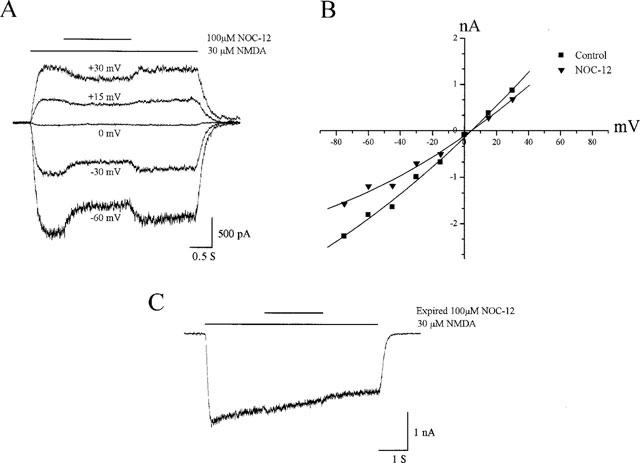
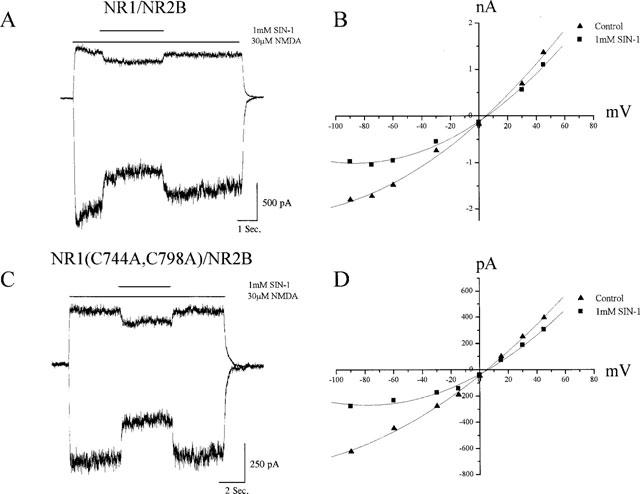
1. The inhibitory effects of nitric oxide (NO) on N-methyl-D-aspartate (NMDA) receptor function have been proposed to be mediated via the interaction of this gas with a redox-sensitive thiol moiety on the receptor. Here, we evaluated this suggested mechanism by examining the actions of various NO donors on native neuronal receptors as well as in wild-type and cysteine-mutated recombinant NMDA receptors expressed in Chinese hamster ovary (CHO) cells. 2. The NO donor N-ethyl-2-(1-ethyl-2-hydroxy-2-nitrosohydraxino)ethanamine (NOC-12; 100 microM) produced a rapid and readily reversible inhibition of whole-cell currents induced by NMDA (30 microM) in cultured cortical neurons. The inhibition was apparent at all holding potentials, though a more pronounced block was observed at negative voltages. The effects of NOC-12 disappeared when the donor was allowed to expire. A similar receptor block was observed with another NO-releasing agent, S-nitroso-N-acetylpenicillamine (SNAP; 1 mM). 3. The blocking effects of NO released by SNAP, 3-morpholinosydnonimine (SIN-1; 1 mM), and 3-[2-hydroxy-1-(1-methylethyl)-2-nitrosohydrazino]-1-propanamin e (NOC-5; 100 microM) on currents mediated by recombinant NRI/NR2B receptors were virtually indistinguishable from those observed on native receptors. Furthermore, mutating cysteines 744 and 798 of NR1, which constitute the principal redox modulatory site of the NR1/NR2B receptor configuration, did not affect the inhibition produced by NO. 4. The NR2A subunit may contribute its own redox-sensitive site. However, the effects of NO on NR1/NR2A receptors were very similar to those seen for all other receptor configurations evaluated. Hence, we conclude that NO does not exert its inhibition of NMDA-induced responses via a modification of any of the previously described redox-sensitive sites on the receptor.
Figures
References
-
- AIZENMAN E.Redox modulation of the NMDA receptor Direct and allosteric control of glutamate receptors 1994Boca Raton, FL, U.S.A.: CRC Press; 95–104.eds. Palfreyman, M.G., Reynolds, I.J. & Skolnik, P., pp
-
- AIZENMAN E., JENSEN F.E., GALLOP P.M., ROSENBERG P.A., TANG L.H. Further evidence that pyrroloquinoline quinone interacts with the N-methyl-D-aspartate receptor redox site in rat cortical neurons in vitro. Neurosci. Letts. 1994;168:189–192. - PubMed
-
- AIZENMAN E., LIPTON S.A., LORING R.H. Selective modulation of NMDA responses by reduction and oxidation. Neuron. 1989;2:1257–1263. - PubMed
-
- ARDEN S.R., SINOR J.D., POTTHOFF W.K., AIZENMAN E. Subunit-specific interactions of cyanide with the N-methyl-D-aspartate receptor. Proc. Natl. Acad. Sci., U.S.A. 1998;273:21505–21511. - PubMed
-
- BOECKMAN F.A., AIZENMAN E. Stable transfection of the NR1 subunit in Chinese hamster ovary cells fails to produce a functional N-methyl-D-aspartate receptor. Neurosci. Lett. 1994;173:189–192. - PubMed
Publication types
MeSH terms
Substances
Grants and funding
LinkOut - more resources
Full Text Sources