


Mechanisms involved in the metabotropic glutamate receptor-enhancement of NMDA-mediated motoneurone responses in frog spinal cord
- PMID: 10051153
- PMCID: PMC1565774
- DOI: 10.1038/sj.bjp.0702263
Mechanisms involved in the metabotropic glutamate receptor-enhancement of NMDA-mediated motoneurone responses in frog spinal cord
Abstract
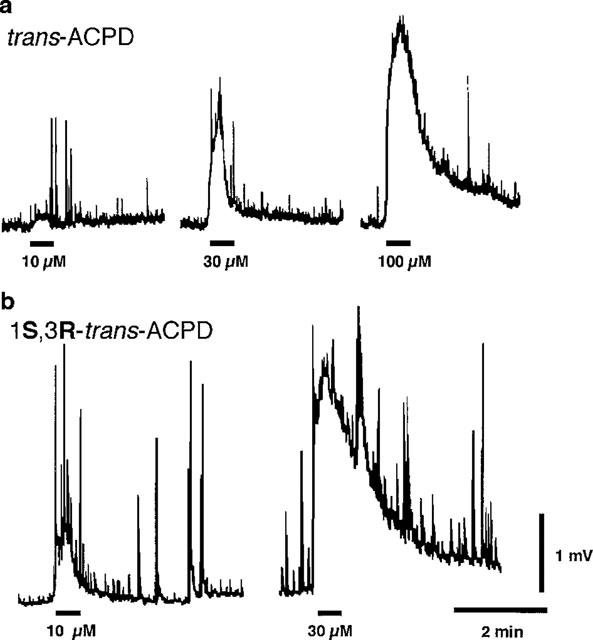
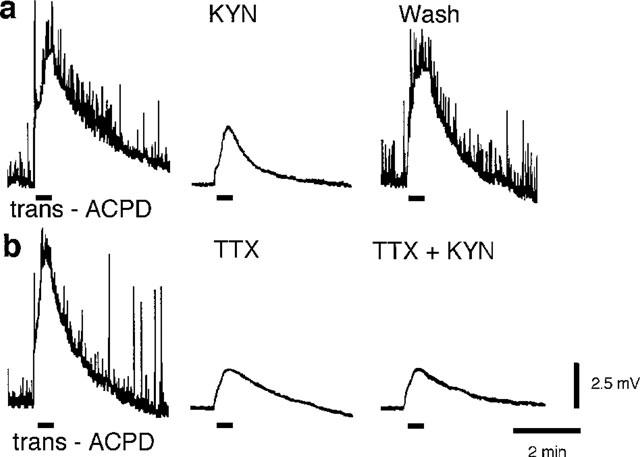
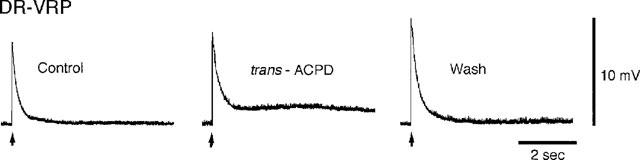
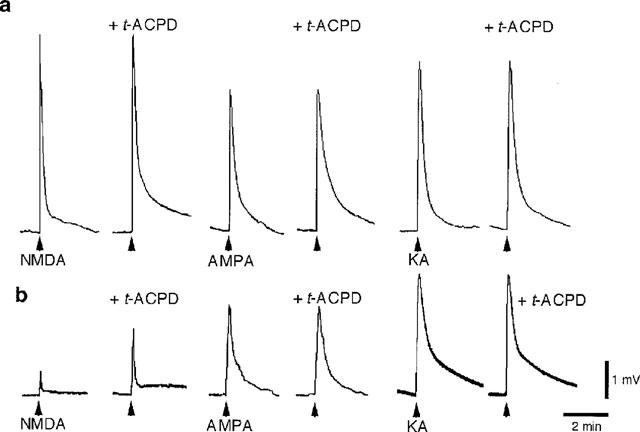
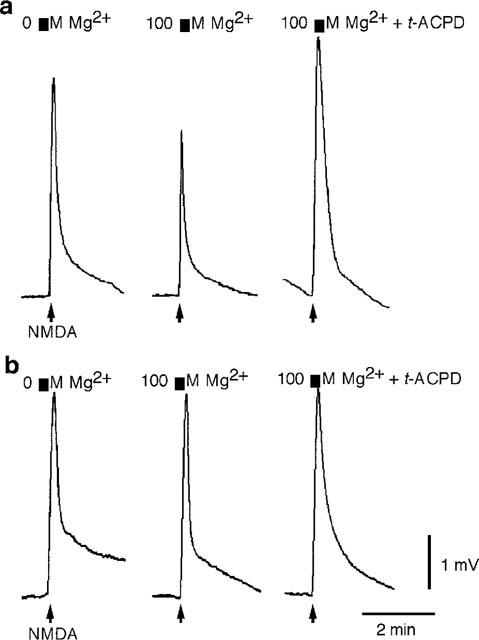
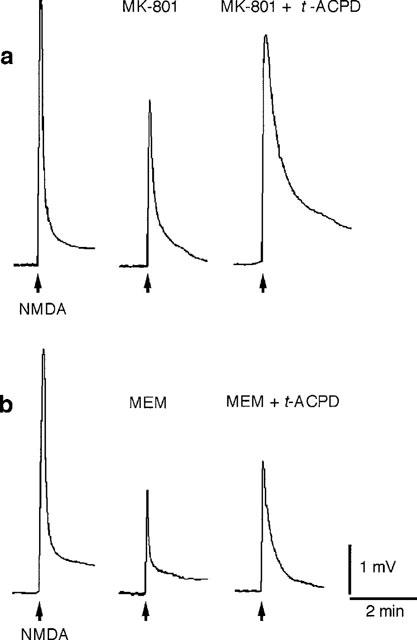
1. The metabotropic glutamate receptor (mGluR) agonist trans-(+/-)-1-amino-1,3-cyclopentanedicarboxylic acid (trans-ACPD) (10-100 microM) depolarized isolated frog spinal cord motoneurones, a process sensitive to kynurenate (1.0 mM) and tetrodotoxin (TTX) (0.783 microM). 2. In the presence of NMDA open channel blockers [Mg2+; (+)-5-methyl-10,11-dihydro-5H-dibenzo[a,d]cyclohepten-5,10-imine hydrogen maleate (MK801); 3,5-dimethyl-1-adamantanamine hydrochloride (memantine)] and TTX, trans-ACPD significantly potentiated NMDA-induced motoneurone depolarizations, but not alpha-amino-3-hydroxy-5-methylisoxazole-4-proprionate (AMPA)- or kainate-induced depolarizations. 3. NMDA potentiation was blocked by (RS)-alpha-methyl-4-carboxyphenylglycine (MCPG) (240 microM), but not by alpha-methyl-(2S,3S,4S)-alpha-(carboxycyclopropyl)-glycine (MCCG) (290 microM) or by alpha-methyl-(S)-2-amino-4-phosphonobutyrate (L-MAP4) (250 microM), and was mimicked by 3,5-dihydroxyphenylglycine (DHPG) (30 microM), but not by L(+)-2-amino-4-phosphonobutyrate (L-AP4) (100 microM). Therefore, trans-ACPD's facilitatory effects appear to involve group I mGluRs. 4. Potentiation was prevented by the G-protein decoupling agent pertussis toxin (3-6 ng ml(-1), 36 h preincubation). The protein kinase C inhibitors staurosporine (2.0 microM) and N-(2-aminoethyl)-5-isoquinolinesulphonamide HCI (H9) (77 microM) did not significantly reduce enhanced NMDA responses. Protein kinase C activation with phorbol-12-myristate 13-acetate (5.0 microM) had no effect. 5. Intracellular Ca2+ depletion with thapsigargin (0.1 microM) (which inhibits Ca2+/ATPase), 1,2-bis(O-aminophenoxy)ethane-N,N,N',N'-tetracetic acid acetyl methyl ester (BAPTA-AM) (50 microM) (which buffers elevations of [Ca2+]i), and bathing spinal cords in nominally Ca2+-free medium all reduced trans-ACPD's effects. 6. The calmodulin antagonists N-(6-aminohexyl)-5-chloro-1-naphthalenesulphonamide (W7) (100 microM) and chlorpromazine (100 microM) diminished the potentiation. 7. In summary, group I mGluRs selectively facilitate NMDA-depolarization of frog motoneurones via a G-protein, a rise in [Ca2+]i from the presumed generation of phosphoinositides, binding of Ca2+ to calmodulin, and lessening of the Mg2+-produced channel block of the NMDA receptor.
Figures
References
-
- BLANPIED T.A., BOECKMAN F.A., AIZENMAN E., JOHNSON J.W. Trapping channel block of NMDA-activated responses by amantadine and memantine. J. Neurophysiol. 1997;77:309–323. - PubMed
-
- BOXALL S.J., THOMPSON S.W.N., DRAY A., DICKENSON A.H., URBAN L. Metabotropic glutamate receptor activation contributes to nociceptive reflex activity in the rat spinal cord in vitro. Neuroscience. 1996;74:13–20. - PubMed
-
- BUDAI D., LARSON A.A. The involvement of metabotropic glutamate receptors in sensory transmission in dorsal horn of the rat spinal cord. Neuroscience. 1997;83:571–580. - PubMed
-
- CERNE R., RANDIC M. Modulation of AMPA and NMDA responses in rat spinal dorsal horn neurons by trans-1-aminocyclopentane-1, 3-dicarboxylic acid. Neurosci. Lett. 1992;144:180–184. - PubMed
-
- CERNE R., RUSKIN K.I., RANDIC M. Enhancement of the N-methyl-D-aspartate response in spinal dorsal horn neurons by cAMP-dependent protein kinase. Neurosci. Lett. 1993;161:124–128. - PubMed
Publication types
MeSH terms
Substances
Grants and funding
LinkOut - more resources
Full Text Sources
Research Materials
Miscellaneous
