. 1999 Mar 2;96(5):2077-81.
doi: 10.1073/pnas.96.5.2077.

Myogenic signaling of phosphatidylinositol 3-kinase requires the serine-threonine kinase Akt/protein kinase B

Affiliations

Myogenic signaling of phosphatidylinositol 3-kinase requires the serine-threonine kinase Akt/protein kinase B

B H Jiang et al. Proc Natl Acad Sci U S A. .

Abstract

The oncogene p3k, coding for a constitutively active form of phosphatidylinositol 3-kinase (PI 3-kinase), strongly activates myogenic differentiation. Inhibition of endogenous PI 3-kinase activity with the specific inhibitor LY294002, or with dominant-negative mutants of PI 3-kinase, interferes with myotube formation and with the expression of muscle-specific proteins. Here we demonstrate that a downstream target of PI 3-kinase, serine-threonine kinase Akt, plays an important role in myogenic differentiation. Expression of constitutively active forms of Akt dramatically enhances myotube formation and expression of the muscle-specific proteins MyoD, creatine kinase, myosin heavy chain, and desmin. Transdominant negative forms of Akt inhibit myotube formation and the expression of muscle-specific proteins. The inhibition of myotube formation and the reduced expression of muscle-specific proteins caused by the PI 3-kinase inhibitor LY294002 are completely reversed by constitutively active forms of Akt. Wild-type cellular Akt effects a partial reversal of LY294002-induced inhibition of myogenic differentiation. This result suggests that Akt can substitute for PI 3-kinase in the stimulation of myogenesis; Akt may be an essential downstream component of PI 3-kinase-induced muscle differentiation.


Figures

Figure 1
Figure 1
(A) Increase of Akt kinase activity in CEM expressing Akt-Myr. CEM were prepared as described in Materials and Methods and were infected with the retroviral vector RCAS (lane 1) or with RCAS-Akt-Myr (lane 2). The cells were cultured for 2 days in MG medium, followed by 3 days in MD medium. On day 5 after infection, Akt kinase activities were determined as described in the Materials and Methods section. (B) Enhancement of myogenic differentiation by Akt-Myr. CEM were infected with the RCAS vector or RCAS-Akt-Myr and cultured as above. Representative fields were photographed 5 days after infection (6.5× objective, phase contrast). (C) Induction of muscle-specific proteins by Akt-Myr. Total proteins were prepared from CEM on day 8 after infection with RCAS vector (lane 1), RCAS-Akt-Myr (lane 2), or v-Src (lane 3). Muscle-specific protein levels were analyzed by immunoblot assay as described in the Materials and Methods section. Actin served as ubiquitously expressed control and was detected with rabbit antibodies from Sigma. Similar results were obtained in three independent experiments.
Figure 2
Figure 2
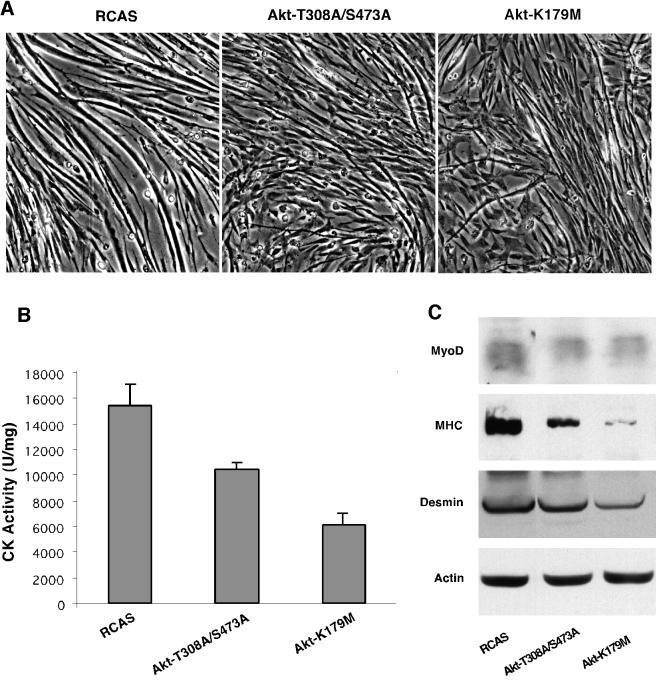
Expression of Akt mutants inhibits myogenic differentiation. (A) The mutants Akt-T308A/S473A and Akt-K179M inhibit myotube formation. CEM were infected with RCAS or RCAS viruses expressing Akt-T308A/S473A or Akt-K179M. The cells were cultured in MG medium for 2 days after infection, followed by 3 days in MD medium to induce MD. Representative fields were photographed on day 5 after infection (6.5× objective, phase contrast). (B) Expression of Akt mutants inhibits CK activity. CK activity was determined on day 6 in CEM infected and cultured as described above. Mean ± SE values were from two experiments with four replicate assays. (C) Expression of Akt mutants reduces the levels of muscle-specific proteins. Muscle-specific proteins were analyzed in CEM on day 6 after infection with RCAS, RCAS-Akt-T308A/S473A, or RCAS-Akt-K179M viruses and assayed by immunoblot as in Fig. 1C. Similar results were obtained in replicate experiments.
Figure 3
Figure 3
The inhibition of myotube formation by the PI 3-kinase-specific inhibitor LY294002 is counteracted by the expression of Akt. CEM cultured in MG medium were infected with RCAS, RCAS-Akt-Myr, or RCAS-c-Akt. On day 2 after infection, the cells were switched to MD medium and treated with 25 μM LY294002 (LY, +) or dimethyl sulfoxide solvent (LY, −) for 3 days. Representative fields were photographed on day 5 after infection (6.5× objective, phase contrast).
Figure 4
Figure 4
Expression of Akt-Myr increases levels of muscle-specific proteins in the presence of LY294002. CK activity (A) and muscle-specific protein levels (B) were analyzed on day 5 after infection by using CEM treated as in Fig. 3.

References

    1. Chang H W, Aoki M, Fruman D, Auger K R, Bellacosa A, Tsichlis P N, Cantley L C, Roberts T M, Vogt P K. Science. 1997;276:1848–1850. - PubMed
    1. Jiang B-H, Zheng J Z, Vogt P K. Proc Natl Acad Sci USA. 1998;95:14179–14183. - PMC - PubMed
    1. Kaliman P, Canicio J, Shepherd P R, Beeton C A, Testar X, Palacin M, Zorzano A. Mol Endocrinol. 1998;12:66–77. - PubMed
    1. Kaliman P, Vinals F, Testar X, Palacin M, Zorzano A. J Biol Chem. 1996;271:19146–19151. - PubMed
    1. Hayashi K, Saga H, Chimori Y, Kimura K, Yamanaka Y, Sobue K. J Biol Chem. 1998;273:28860–28867. - PubMed

Publication types

MeSH terms