. 1999 Mar 2;96(5):2356-60.
doi: 10.1073/pnas.96.5.2356.

Mutations in the organic cation/carnitine transporter OCTN2 in primary carnitine deficiency

Affiliations

Mutations in the organic cation/carnitine transporter OCTN2 in primary carnitine deficiency

Y Wang et al. Proc Natl Acad Sci U S A. .

Abstract

Primary carnitine deficiency is an autosomal recessive disorder of fatty acid oxidation caused by defective carnitine transport. This disease presents early in life with hypoketotic hypoglycemia or later in life with skeletal myopathy or cardiomyopathy. The gene for this condition maps to 5q31.2-32 and OCTN2, an organic cation/carnitine transporter, also maps to the same chromosomal region. Here we test the causative role of OCTN2 in primary carnitine deficiency by searching for mutations in this gene in affected patients. Fibroblasts from patients with primary carnitine deficiency lacked mediated carnitine transport. Transfection of patient's fibroblasts with the OCTN2 cDNA partially restored carnitine transport. Sequencing of the OCTN2 gene revealed different mutations in two unrelated patients. The first patient was homozygous (and both parents heterozygous) for a single base pair substitution converting the codon for Arg-282 to a STOP codon (R282X). The second patient was a compound heterozygote for a paternal 1-bp insertion producing a STOP codon (Y401X) and a maternal 1-bp deletion that produced a frameshift creating a subsequent STOP codon (458X). These mutations decreased the levels of mature OCTN2 mRNA and resulted in nonfunctional transporters, confirming that defects in the organic cation/carnitine transporter OCTN2 are responsible for primary carnitine deficiency.


Figures
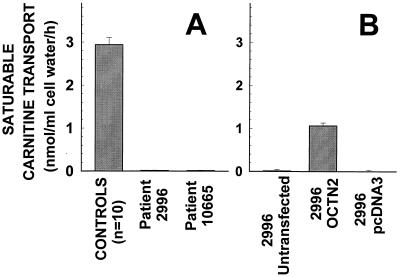
Figure 1
Figure 1
Carnitine transport by human fibroblasts from controls and patients with primary carnitine deficiency. (A) Confluent cells were washed and incubated for 90 min in Earle’s balanced salt solution containing d-glucose (5.5 mM) and supplemented with 0.5% BSA. Cells were then incubated for 2 h with [3H]carnitine (0.5 μM, 0.5 μCi/ml) in the absence or presence of 2 mM cold carnitine, included to assess nonsaturable carnitine uptake. Mediated transport was obtained by subtracting the nonsaturable component from total transport. Carnitine accumulation was corrected for cellular protein and intracellular water content. Each point is the mean of at least three independent triplicates (10 for control cells) ± SE. (B) Fibroblasts from patients 2996 were transfected with lipofectamine and 5 μg of OCTN2-pcDNA3, pcDNA3 alone, or nothing (untransfected). One day after transfection, cells were trypsinized and plated in 24-well plates and carnitine transport was measured the following day as above in the presence and absence of 2 mM carnitine. Points are means ± SE of triplicates.
Figure 2
Figure 2
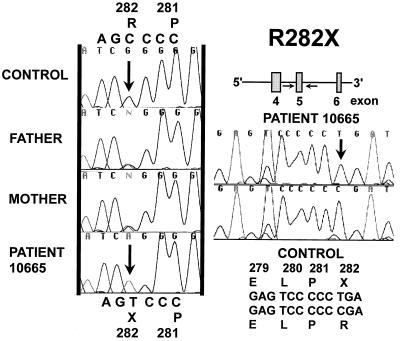
Direct sequencing of exon 5 of the OCTN2 gene in patient 10665 and both parents (10666 and 10667). Exon 5 of the OCTN2 gene was amplified by PCR and sequenced directly without subcloning. Only the reverse direction is shown for the parents. The proband was homozygous and both parents heterozygous for a 1-bp substitution inserting a premature STOP codon.
Figure 3
Figure 3
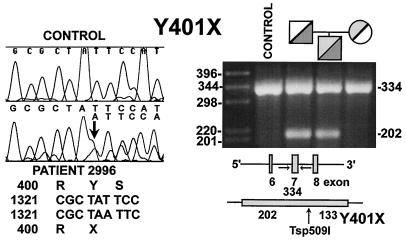
Sequence of exon 7 of the OCTN2 gene in patient 2996 (Left). Genomic DNA was amplified by PCR and sequenced. Note the presence of double sequence at and after the codon for Y401. Tsp509I digestion of PCR amplified exon 7 of the patient’s family (Right). Both the proband and the father were heterozygous for a normal 334-bp band and an abnormal 202-bp band.
Figure 4
Figure 4
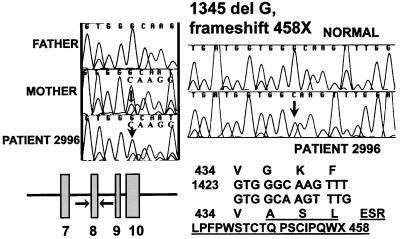
Sequence of exon 8 of the OCTN2 gene in patient 2996. Genomic DNA was amplified by PCR and sequenced. Note the presence of double sequence at and after the codon for G435 in the patient and the mother. The right side of the figure shows the normal sequence and that of a clone of exon 8 from the proband containing the one bp deletion. The predicted neo-amino acid sequence is shown below the sequencing chromatograms.
Figure 5
Figure 5
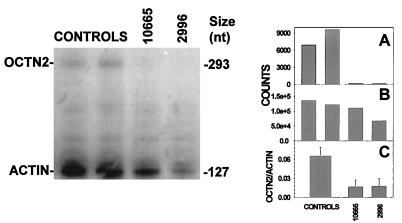
OCTN2 mRNA levels in fibroblasts from patients with primary carnitine deficiency. (Left) Total RNA (15–25 μg) from controls and patients with primary carnitine deficiency was analyzed by RNAse protection assay. Right. The gel was counted for 48 h with an Instant Imager and the counts obtained for OCTN2 (A) and actin (B) are reported at the right of the autoradiogram for each band. Initial experiments with normal RNA indicated a linear increase in signal intensity of both bands by increasing the amount of total RNA. The experiment was repeated three times using twice the 293-nucleotide probe presented in this figure and once a probe in the 3′ region of the OCTN2 cDNA. C reports the average OCTN2/actin ratio from these three experiments in the two patients as compared with three different control strains.

References

    1. Roe C R, Coates P M. In: The Metabolic and Molecular Basis of Inherited Disease. Scriver C R, Beaudet A L, Sly W S, Valle D, editors. New York: McGraw–Hill; 1995. pp. 1501–1533.
    1. Pons, R. & De Vivo, D. C. (1995) J. Child Neurol. 10, Suppl. 2, 2S8–2S24. - PubMed
    1. Engel A G, Angelini C. Science. 1973;179:899–902. - PubMed
    1. Treem W R, Stanley C A, Finegold D N, Hale D E, Coates P M. N Engl J Med. 1988;319:1331–1336. - PubMed
    1. Eriksson B O, Gustafson B, Lindstedt S, Nordin I. J Inherited Metab Dis. 1989;12:108–111. - PubMed

Publication types

MeSH terms