. 1999 Mar 2;96(5):2485-90.
doi: 10.1073/pnas.96.5.2485.

Blockade of N-methyl-D-aspartate receptor activation suppresses learning-induced synaptic elimination

Affiliations

Blockade of N-methyl-D-aspartate receptor activation suppresses learning-induced synaptic elimination

J Bock et al. Proc Natl Acad Sci U S A. .

Abstract

Auditory filial imprinting in the domestic chicken is accompanied by a dramatic loss of spine synapses in two higher associative forebrain areas, the mediorostral neostriatum/hyperstriatum ventrale (MNH) and the dorsocaudal neostriatum (Ndc). The cellular mechanisms that underlie this learning-induced synaptic reorganization are unclear. We found that local pharmacological blockade of N-methyl-D-aspartate (NMDA) receptors in the MNH, a manipulation that has been shown previously to impair auditory imprinting, suppresses the learning-induced spine reduction in this region. Chicks treated with the NMDA receptor antagonist 2-amino-5-phosphonovaleric acid (APV) during the behavioral training for imprinting (postnatal day 0-2) displayed similar spine frequencies at postnatal day 7 as naive control animals, which, in both groups, were significantly higher than in imprinted animals. Because the average dendritic length did not differ between the experimental groups, the reduced spine frequency can be interpreted as a reduction of the total number of spine synapses per neuron. In the Ndc, which is reciprocally connected with the MNH and not directly influenced by the injected drug, learning-induced spine elimination was partly suppressed. Spine frequencies of the APV-treated, behaviorally trained but nonimprinted animals were higher than in the imprinted animals but lower than in the naive animals. These results provide evidence that NMDA receptor activation is required for the learning-induced selective reduction of spine synapses, which may serve as a mechanism of information storage specific for juvenile emotional learning events.


Figures

Figure 1
Figure 1
Experimental design. Bars represent treatment of the experimental groups: N, naive chicks; I, noninjected, imprinted chicks; V, vehicle-injected, imprinted chicks; A, APV-injected, trained but nonimprinted chicks. Solid arrows indicate time points of APV injections; open arrows indicate time points of vehicle injections. See text for further details.
Figure 2
Figure 2
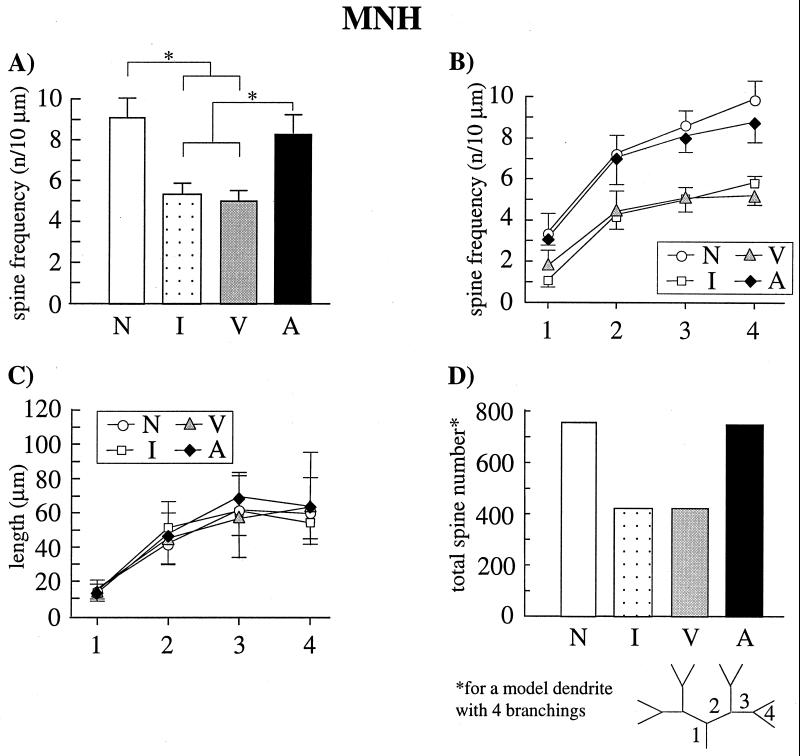
Spine frequencies, dendritic length, and spine number of type I neurons in the MNH from naive chicks (N), noninjected, imprinted chicks (I), vehicle-injected, imprinted chicks (V), and APV-injected, trained but nonimprinted chicks (A). (A) Mean spine frequencies (±SD) of the pooled 3rd and 4th dendritic branch orders. Spine frequencies of imprinted animals (groups I and V) were significantly lower than those in naive and APV-treated animals (*, P ≤ 0.02). APV-treated animals displayed a similar high spine frequency as the naive control animals. (B) Mean spine frequencies (±SD) for all dendritic segments from proximal (1) to distal (4). Segments were numbered from proximal to distal according to the illustration in D. The results described for the pooled 3rd and 4th branch order (A) were found in all dendritic segments. (C) Mean length (±SD) for all dendritic segments. There were no differences between the four experimental groups. (D) Spine number for a model dendrite with four complete branchings calculated under consideration of the mean spine frequencies and length of dendritic branches. In imprinted chicks spine number was 44% lower than in naive chicks. APV-treated chicks displayed nearly the same spine number as naive control animals.
Figure 3
Figure 3
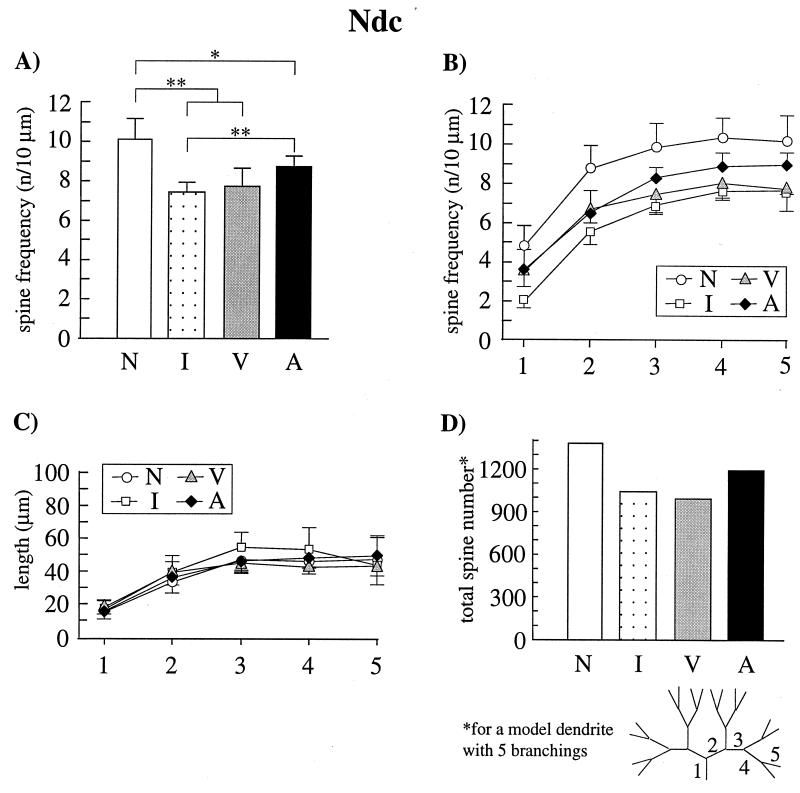
Spine frequencies, dendritic length, and spine number of neurons in the dorsocaudal neostriatum (Ndc) from naive chicks (N), noninjected, imprinted chicks (I), vehicle-injected, imprinted chicks (V), and APV-injected, trained but nonimprinted chicks (A). (A) Mean spine frequencies (±SD) of the pooled 3rd to 5th dendritic branch orders. Spine frequencies of imprinted animals (groups I and V) were significantly lower than those in naive and APV-treated animals (∗, P ≤ 0.01). APV-treated chicks displayed a significantly higher spine frequency than the imprinted animals (∗, P ≤ 0.01) and a significantly lower spine frequency than the naive controls (*, P ≤ 0.05). (B) Mean spine frequencies (±SD) for all dendritic segments from proximal (1) to distal (5). Segments were numbered according to the illustration in D. The results described for the pooled 3rd to 5th branch orders (A) were found in all dendritic segments with exception of the basal segment in which the noninjected, imprinted animals (I) had a significantly lower spine frequency than the other three groups. (C) Mean length (±SD) for all dendritic segments. There were no differences between the four experimental groups. (D) Spine number for a model dendrite with five complete branchings calculated under consideration of the mean spine frequencies and length of dendritic branches. In imprinted animals spine number was 25% lower than in naive controls. The spine number of APV-injected animals was between the spine number of the naive animals and those of the imprinted groups.
Figure 4
Figure 4
Spine frequencies (±SD) (A) and dendritic length (±SD) (B) of neurons in the ectostriatum from naive chicks (N), noninjected, imprinted chicks (I), vehicle-injected, imprinted chicks (V), and APV-injected, trained but nonimprinted chicks (A). In both parameters there were no differences between the four experimental groups.

References

    1. Horner C H. Prog Neurobiol. 1993;41:281–321. - PubMed
    1. Koch C, Zador A. J Neurosci. 1993;13:413–422. - PMC - PubMed
    1. Harris K M, Kater S B. Annu Rev Neurosci. 1994;17:341–371. - PubMed
    1. Segal M. Trends Neurosci. 1995;18:468–471. - PubMed
    1. Shepherd G M. J Neurophys. 1996;75:2197–2210. - PubMed

Publication types

MeSH terms

Substances

LinkOut - more resources