Neonatal examination and screening trial (NEST): a randomised, controlled, switchback trial of alternative policies for low risk infants
- PMID: 10066201
- PMCID: PMC27766
- DOI: 10.1136/bmj.318.7184.627
Neonatal examination and screening trial (NEST): a randomised, controlled, switchback trial of alternative policies for low risk infants
Abstract
Objective: To evaluate the effectiveness of one rather than two hospital neonatal examinations in detection of abnormalities.
Design: Randomised controlled switchback trial.
Setting: Postnatal wards in a teaching hospital in north east Scotland.
Participants: All infants delivered at the hospital between March 1993 and February 1995.
Intervention: A policy of one neonatal screening examination compared with a policy of two.
Main outcome measures: Congenital conditions diagnosed in hospital; results of community health assessments at 8 weeks and 8 months; outpatient referrals; inpatient admissions; use of general practioner services; focused analysis of outcomes for suspected hip and heart abnormalities.
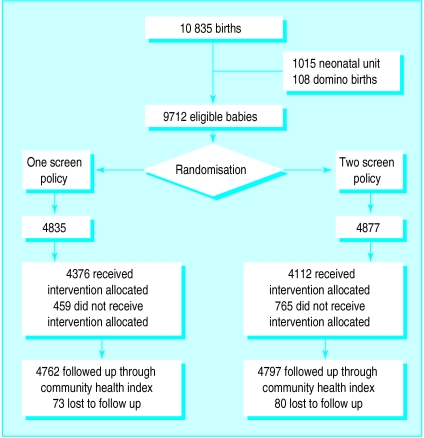
Results: 4835 babies were allocated to receive one screening examination (one screen policy) and 4877 to receive two (two screen policy). More congenital conditions were suspected at discharge among babies examined twice (9.9 v 8.3 diagnoses per 100 babies; 95% confidence interval for difference 0.3 to 2.7). There was no overall significant difference between the groups in use of community, outpatient, or inpatient resources or in health care received. Although more babies who were examined twice attended orthopaedic outpatient clinics (340 (7%) v 289 (6%)), particularly for suspected congenital dislocation of the hip (176 (3.6/100 babies) v 137 (2.8/100 babies); difference -0.8; -1.5 to 0.1), there was no significant difference in the number of babies who required active management (12 (0.2%) v 15 (0.3%)).
Conclusions: Despite more suspected abnormalities, there was no evidence of net health gain from a policy of two hospital neonatal examinations. Adoption of a single examination policy would save resources both during the postnatal hospital stay and through fewer outpatient consultations.
Comment in
-
The role of the routine neonatal examination.BMJ. 1999 Mar 6;318(7184):619-20. doi: 10.1136/bmj.318.7184.619. BMJ. 1999. PMID: 10066183 Free PMC article. No abstract available.
-
Commentary: "Switchback" allocation--dangerous bends ahead!BMJ. 1999 Mar 6;318(7184):631. BMJ. 1999. PMID: 10215359 No abstract available.
-
Combining the two neonatal examinations. In primary care, second examination is useful.BMJ. 1999 Jul 3;319(7201):53. doi: 10.1136/bmj.319.7201.53a. BMJ. 1999. PMID: 10390469 Free PMC article. No abstract available.
-
Role of the routine neonatal examination. Broader criteria should be used to evaluate the role of neonatal examination.BMJ. 1999 Jun 26;318(7200):1766. BMJ. 1999. PMID: 10428571 No abstract available.
-
Combining the two neonatal examinations. Midwives perform a neonatal examination, so was this counted?BMJ. 1999 Jul 3;319(7201):53. BMJ. 1999. PMID: 10523080 No abstract available.
References
-
- Maternity Services Advisory Committee to the Secretaries of State for Social Services and for Wales. Maternity care in action part III: care of the mother and baby (postnatal and neonatal care). London: HMSO; 1985.
-
- Hall DMB. Health for all children. A programme for child health surveillance. Oxford: Oxford University Press; 1989.
Publication types
MeSH terms
LinkOut - more resources
Full Text Sources
Medical