Timing of development of measles-specific immunoglobulin M and G after primary measles vaccination
- PMID: 10066650
- PMCID: PMC95683
- DOI: 10.1128/CDLI.6.2.178-180.1999
Timing of development of measles-specific immunoglobulin M and G after primary measles vaccination
Abstract
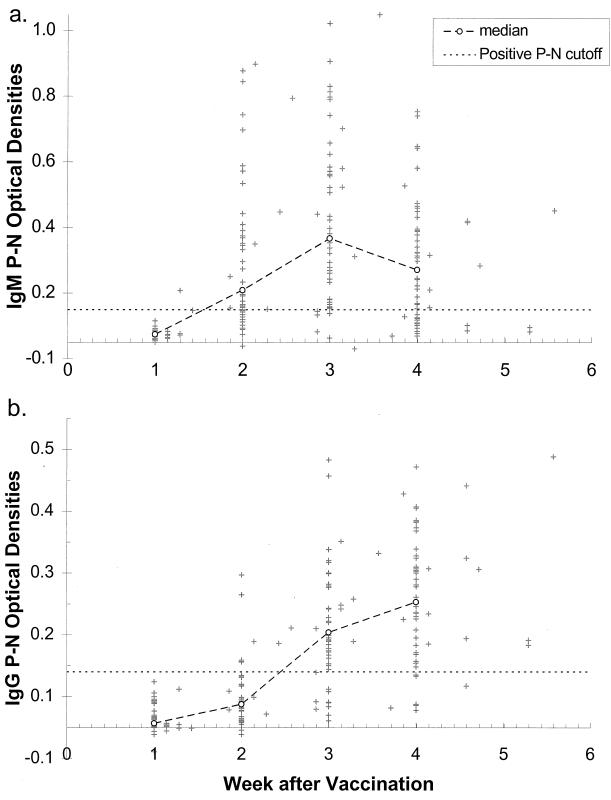
A standard method for diagnosing measles is to detect measles-specific immunoglobulin M (IgM) in the serum of infected persons. Interpreting a positive IgM result from a person with suspected measles can be difficult if the person has recently received a measles vaccine. We have previously demonstrated that measles-specific IgM may persist for at least 8 weeks after primary vaccination, but it is unknown how quickly IgM appears. This study determined the timing of the rise of measles-specific IgM and IgG after primary measles vaccination with Schwartz vaccine. Two hundred eighty 9-month-old children from Ethiopia presenting for routine measles vaccination were enrolled. Sera were collected before and either 1, 2, 3, or 4 weeks after vaccination and tested for measles-specific antibodies by an IgM capture enzyme immunoassay (EIA) and by an indirect IgG EIA. A total of 209 of the 224 children who returned for the second visit had prevaccination sera that were both IgM and IgG negative. The postvaccination IgM positivity rates for these 209 children were 2% at 1 week, 61% at 2 weeks, 79% at 3 weeks, and 60% at 4 weeks. The postvaccination IgG positivity rates were 0% at 1 week, 14% at 2 weeks, 81% at 3 weeks, and 85% at 4 weeks. We conclude that an IgM-positive result obtained by this antibody capture EIA is difficult to interpret if serum is collected between 8 days and 8 weeks after vaccination; in this situation, the diagnosis of measles should be based on an epidemiologic linkage to a confirmed case or on the detection of wild-type measles virus.
Figures
References
-
- American Academy of Pediatrics. Measles. In: Peter G, editor. 1997 Red Book: report of the Committee on Infectious Diseases. Elk Grove Village, Ill: American Academy of Pediatrics; 1997. pp. 344–357.
-
- Carson M M, Spady D W, Albrecht P, Beeler J A, Thipphawong J, Barreto L, Grimsrud K M, Pabst H F. Measles vaccination of infants in a well-vaccinated population. Pediatr Infect Dis J. 1995;14:17–22. - PubMed
-
- Halsey N A. The optimal age for administering measles vaccine in developing countries. In: Halsey N A, De Quadros C, editors. Recent advances in immunization. A bibliographic review. Washington, D.C: Pan American Health Organization; 1983. pp. 4–17.
-
- Halsey N A, Boulos R, Mode F, Andre J, Bowman L, Yaeger R G, Troureau S, Rohde J, Boulos C. Response to measles vaccine in Haitian infants 6 to 12 months old. Influence of maternal antibodies, malnutrition, and concurrent illnesses. N Engl J Med. 1985;313:544–549. - PubMed
Publication types
MeSH terms
Substances
LinkOut - more resources
Full Text Sources
Medical