Review
. 1999 Mar;63(1):54-105.
doi: 10.1128/MMBR.63.1.54-105.1999.

Cdc42: An essential Rho-type GTPase controlling eukaryotic cell polarity

Affiliations
Review

Cdc42: An essential Rho-type GTPase controlling eukaryotic cell polarity

D I Johnson. Microbiol Mol Biol Rev. 1999 Mar.

Abstract

Cdc42p is an essential GTPase that belongs to the Rho/Rac subfamily of Ras-like GTPases. These proteins act as molecular switches by responding to exogenous and/or endogenous signals and relaying those signals to activate downstream components of a biological pathway. The 11 current members of the Cdc42p family display between 75 and 100% amino acid identity and are functional as well as structural homologs. Cdc42p transduces signals to the actin cytoskeleton to initiate and maintain polarized gorwth and to mitogen-activated protein morphogenesis. In the budding yeast Saccharomyces cerevisiae, Cdc42p plays an important role in multiple actin-dependent morphogenetic events such as bud emergence, mating-projection formation, and pseudohyphal growth. In mammalian cells, Cdc42p regulates a variety of actin-dependent events and induces the JNK/SAPK protein kinase cascade, which leads to the activation of transcription factors within the nucleus. Cdc42p mediates these processes through interactions with a myriad of downstream effectors, whose number and regulation we are just starting to understand. In addition, Cdc42p has been implicated in a number of human diseases through interactions with its regulators and downstream effectors. While much is known about Cdc42p structure and functional interactions, little is known about the mechanism(s) by which it transduces signals within the cell. Future research should focus on this question as well as on the detailed analysis of the interactions of Cdc42p with its regulators and downstream effectors.


Figures
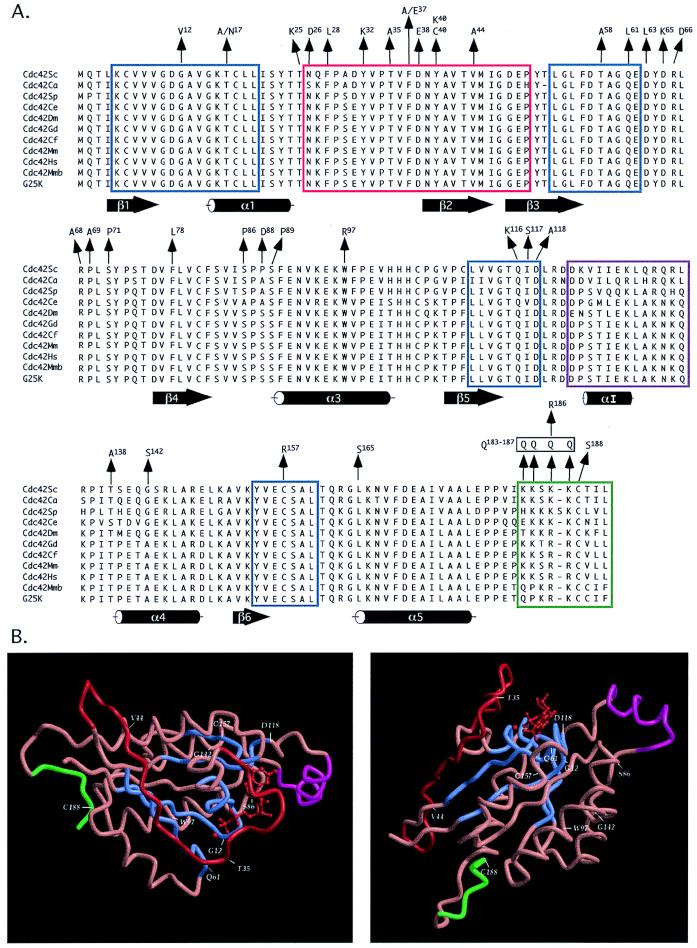
FIG. 1
FIG. 1
Cdc42p mutations and X-ray crystal structure. (A) Comparison of Cdc42p sequences from S. cerevisiae (Sc [242]), C. albicans (Ca [394]), S. pombe (Sp [390]), C. elegans (Ce [88]), D. melanogaster (Dm [336]), chicken (Gd [172]), dog (Cf [GenBank no. Z49944]), mouse (Mm [172]), human (Hs [525]), mouse brain (Mmb [367]), and human brain (G25K [407]). Included are the known Cdc42 mutations mapped onto the primary amino acid sequences and the known functional domains: GTP binding/hydrolysis domains (blue boxes), effector domain (red box), Rho insert domain (purple box), and membrane localization domain (green box). Secondary-structure elements indicated below the sequence are taken from reference . (B) Two views of the X-ray crystal structure of Cdc42Hs complexed with GDP (kindly provided by N. Nassar and R. Cerione, Cornell University). Color coding for functional domains is the same as in panel A.
FIG. 2
FIG. 2
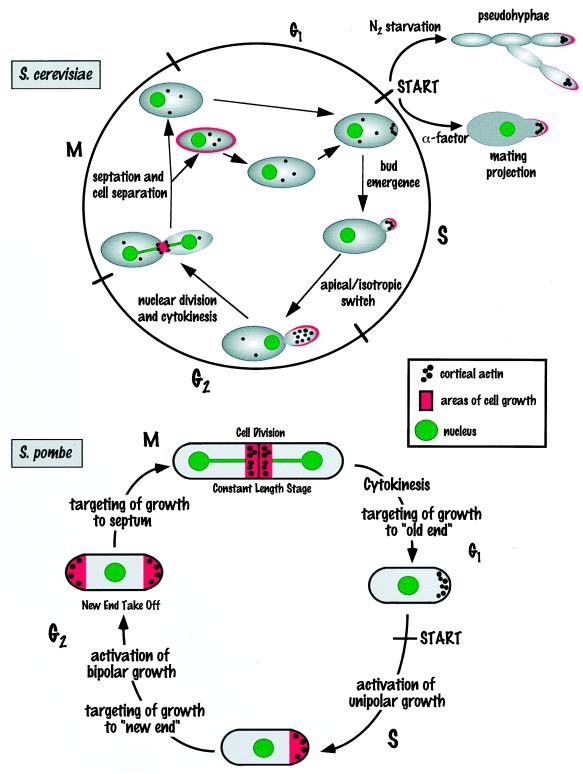
Polarized cell growth during the S. cerevisiae and S. pombe cell cycles. See the text for details.
FIG. 3
FIG. 3
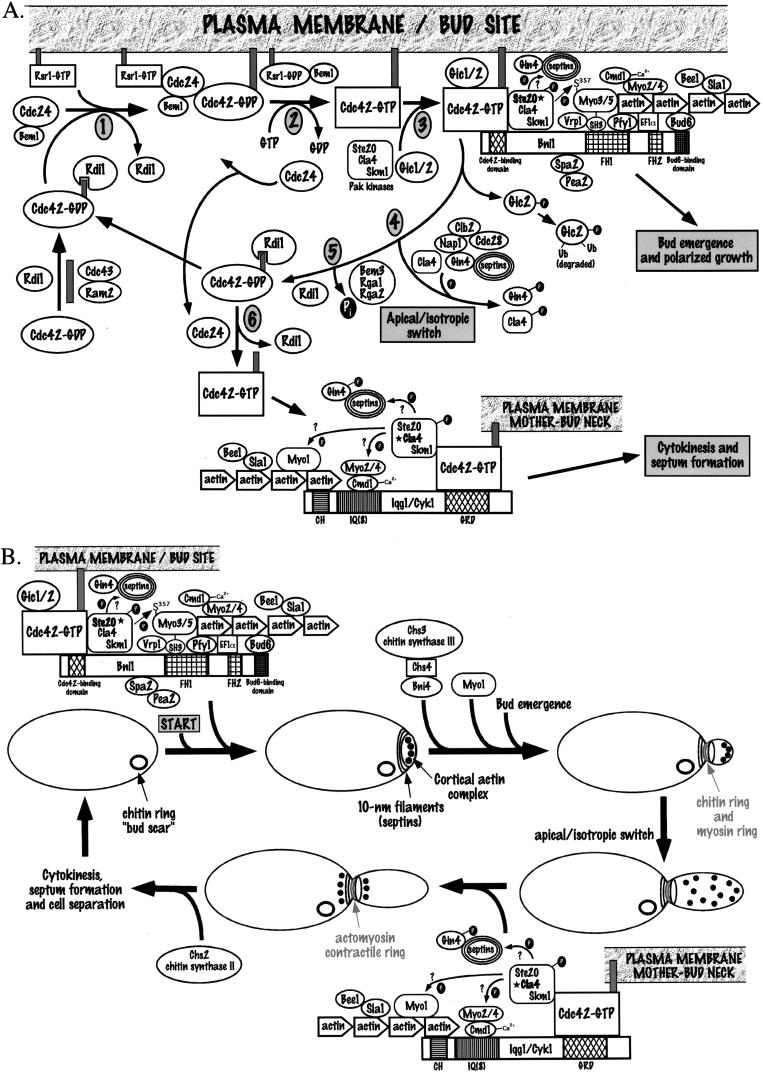
Molecular and cytological model for polarized cell growth in S. cerevisiae. (A) Molecular model for the Cdc42-dependent processes during the S. cerevisiae cell cycle. Shaded boxes attached to GTPases are isoprenyl groups. The stars by Ste20 in the bud emergence complex and Cla4 in the cytokinesis complex indicate that they are the likely PAK functioning at this stage of the cell cycle. See the text for details. (B) Cytological model for bud emergence and cytokinesis. Cdc42 complexes are the same as in panel A. See the text for details.
FIG. 4
FIG. 4
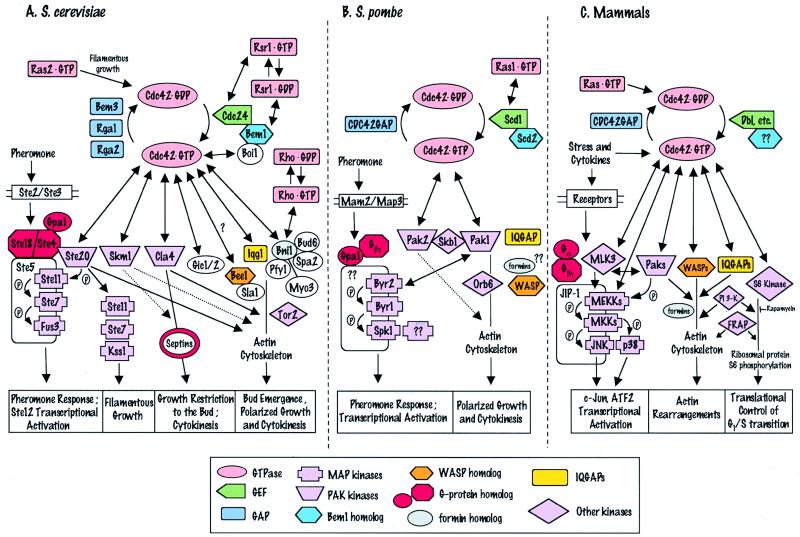
Comparison of Cdc42 interactions and dependent processes in S. cerevisiae (A), S. pombe (B), and mammals (C). Color and shape coding is given in the box at the bottom of figure. Two-headed arrows indicate physical interactions. Single-headed arrows indicate pathways; dotted arrows indicate potential involvement in pathways. For simplicity, not all components of the actin cytoskeleton or JNK kinase cascade are shown. See the text for details.
FIG. 5
FIG. 5
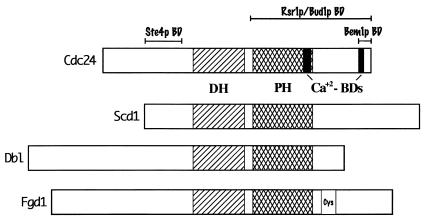
Structure of the representative Dbl family member GEFs Cdc24, Scd1, Dbl, and Fgd1. The DH and PH domains are indicated, along with the potential Ca2+ binding domains and Ste4p, Rsr1p/Bud1p, and Bem1p binding domains in Cdc24. See the text for details.
FIG. 6
FIG. 6
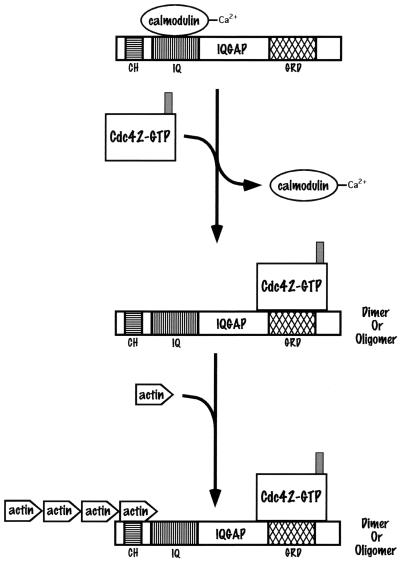
Molecular model for the generation of an IQGAP-Cdc42p-actin ternary complex. See the text for details.

References

    1. Adachi H, Takahashi Y, Hasebe T, Shirouzu M, Yokoyama S, Sutoh K. Dictyostelium IQGAP-related protein specifically involved in the completion of cytokinesis. J Cell Biol. 1997;137:891–898. - PMC - PubMed
    1. Adams A E M, Johnson D I, Longnecker R M, Sloat B F, Pringle J R. CDC42 and CDC43, two additional genes involved in budding and the establishment of cell polarity in the yeast Saccharomyces cerevisiae. J Cell Biol. 1990;111:131–142. - PMC - PubMed
    1. Adams A E M, Pringle J R. Relationship of actin and tubulin distribution to bud growth in wild-type and morphogenetic-mutant Saccharomyces cerevisiae. J Cell Biol. 1984;98:934–945. - PMC - PubMed
    1. Adra C N, Ko J, Leonard D, Wirth L J, Cerione R A, Lim B. Identification of a novel protein with GDP dissociation inhibitor activity for the Ras-like proteins CDC42Hs and Rac1. Genes Chromosomes Cancer. 1993;8:253–261. - PubMed
    1. Adra C N, Manor D, Ko J L, Zhu S, Horiuchi T, Aelst L V, Cerione R A, Lim B. RhoGDIγ: a GDP-dissociation inhibitor for Rho proteins with preferential expression in brain and pancreas. Proc Natl Acad Sci USA. 1997;94:4279–4284. - PMC - PubMed

Publication types

MeSH terms