Iron supplemented formula milk related to reduction in psychomotor decline in infants from inner city areas: randomised study
- PMID: 10074011
- PMCID: PMC27777
- DOI: 10.1136/bmj.318.7185.693
Iron supplemented formula milk related to reduction in psychomotor decline in infants from inner city areas: randomised study
Erratum in
- BMJ 2000 Jul 1;321(7252):23
Abstract
Objective: To compare the effect of unmodified cows' milk and iron supplemented formula milk on psychomotor development in infants from inner city areas when used as the main milk source.
Design: Double blind, randomised intervention trial.
Setting: Birmingham health centre.
Subjects: 100 infants, mean age 7.8 months (range 5.7 to 8.6 months), whose mothers had already elected to use unmodified cows' milk as their infant's milk source.
Intervention: Changing to an iron supplemented formula milk from enrolment to 18 months of age, or continuing with unmodified cows' milk.
Main outcome measures: Developmental assessments using Griffiths scales at enrolment and at 18 and 24 months.
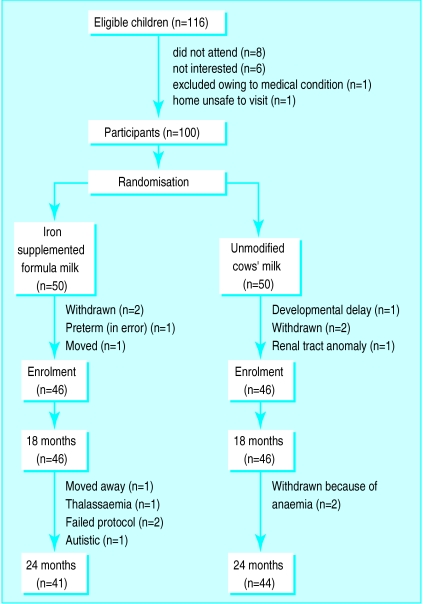
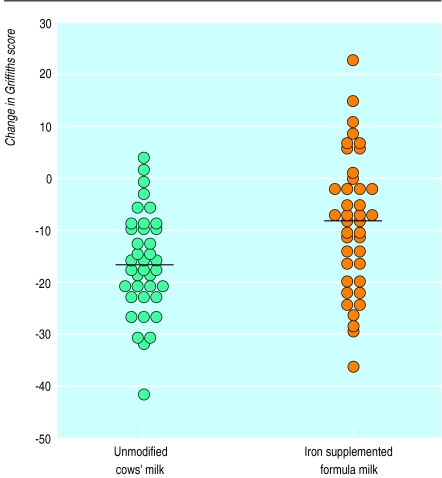
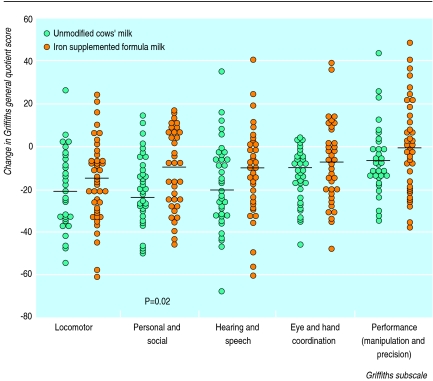
Results: 85 participants completed the trial. There were no significant differences in haemoglobin concentration between the two groups at enrolment, but by 18 months of age 33% of the unmodified cows' milk group, but only 2% of the iron supplemented group, were anaemic (P<0.001). The experimental groups had Griffiths general quotient scores that were not significantly different at enrolment, but the scores in both groups declined during the study. By 24 months the decrease in the mean scores in the unmodified cows' milk group was 14.7 whereas the decrease in the mean scores in the iron supplemented group was 9.3 (P<0.02, 95% confidence interval 0.4 to 10.4). Mean subquotient scores were considerably lower in the unmodified cows' milk group at 24 months; significantly so for personal and social scores (P<0.02, 1.2 to 16.8 [corrected]).
Conclusion: Replacing unmodified cows' milk with an iron supplemented formula milk up to 18 months of age in infants from inner city areas prevents iron deficiency anaemia and reduces the decline in psychomotor development seen in such infants from the second half of the first year.
Figures
References
-
- Dalman PR. Nutritional anaemias in childhood. In: Suskind RM, Lweinter-Suskind L, editors. Textbook of paediatric nutrition, 2nd ed. New York: Raven; 1993.
-
- Gregory JR, Collins DL, Davies PSW, Hughes JM, Clarke PC. National diet and nutrition survey: children aged 1½ to 4½ years. 1. Report of the diet and nutrition survey. London: HMSO; 1995.
-
- Lawson M. Iron. Nutritional and physiological significance. Report of the British Nutrition Foundation task force. London: Chapman and Hall; 1995. Iron in infancy and childhood.
-
- Lansdown R, Wharton BA. Iron. Nutrition and physiological significance. Report of the British Nutrition Foundation’s task force. London: Chapman and Hall; 1995. Iron and mental and motor behaviour in children.
-
- Pollitt E. Iron deficiency and cognitive function. Ann Rev Nutr. 1993;13:521–537. - PubMed
Publication types
MeSH terms
Substances
LinkOut - more resources
Full Text Sources
Medical