Genetic determination of islet cell autoimmunity in monozygotic twin, dizygotic twin, and non-twin siblings of patients with type 1 diabetes: prospective twin study
- PMID: 10074012
- PMCID: PMC27778
- DOI: 10.1136/bmj.318.7185.698
Genetic determination of islet cell autoimmunity in monozygotic twin, dizygotic twin, and non-twin siblings of patients with type 1 diabetes: prospective twin study
Abstract
Objective: To test the hypothesis that non-diabetic dizygotic and monozygotic twin siblings of patients with type 1 diabetes have a similar high prevalence of islet cell autoantibodies, thus suggesting that islet cell autoimmunity is mainly environmentally determined.
Design: Prospective twin study.
Setting: Two specialist centres for diabetes in the United States.
Participants: Non-diabetic monozygotic twin (n=53), dizygotic twin (n=30), and non-twin (n=149) siblings of patients with type 1 diabetes; 101 controls.
Main outcome measures: Analysis of progression to diabetes and expression of anti-islet autoantibodies.
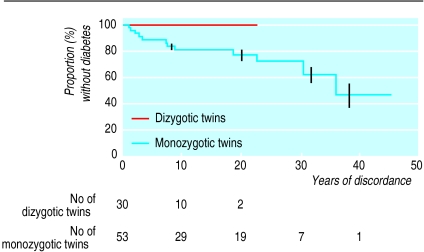
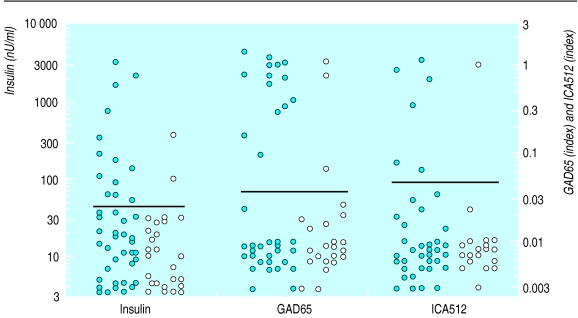
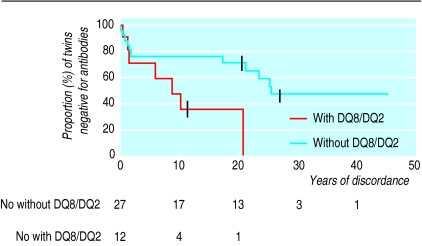
Results: Monozygotic twin siblings had a higher risk of progression to diabetes (12/53) than dizygotic twin siblings (0/30; P<0.005). At the last follow up 22 (41.5%) monozygotic twin siblings expressed autoantibodies compared with 6 (20%) dizygotic twin siblings (P<0.05), 16 (10.7%) non-twin siblings (P<0.0001), and 6 (5.9%) controls (P<0.0001). Monozygotic twin siblings expressed multiple (>/=2) antibodies more often than dizygotic twin siblings (10/38 v 1/23; P<0.05). By life table analysis the probability of developing positive autoantibodies was higher among the monozygotic twin siblings bearing the diabetes associated HLA DQ8/DQ2 genotype than in those without this genotype (64.2% (95% confidence interval 32.5% to 96%) v 23.5% (7% to 40%) at 10 years of discordance; P<0.05).
Conclusion: Monozygotic and dizygotic twins differ in progression to diabetes and expression of islet cell autoantibodies. Dizygotic twin siblings are similar to non-twin siblings. These two observations suggest that genetic factors play an important part in determination of islet cell autoimmunity, thus rejecting the hypothesis. In addition, there is a high penetrance of islet cell autoimmunity in DQ8/DQ2 monozygotic twin siblings.
Figures
Comment in
-
Reanalysis of twin studies suggests that diabetes is mainly genetic.BMJ. 2001 Oct 27;323(7319):997-8. BMJ. 2001. PMID: 11679394 Free PMC article. No abstract available.
References
-
- Verge CF, Gianani R, Yu L, Pietropaolo M, Smith T, Jackson RA, et al. Late progression to diabetes and evidence for chronic β cell autoimmunity in identical twins of patients with type I diabetes. Diabetes. 1995;44:1176–1179. - PubMed
-
- Srikanta S, Ganda OP, Eisenbarth GS, Soeldner JS. Islet cell antibodies and β cell function in monozygotic triplets and twins initially discordant for type I diabetes mellitus. N Engl J Med. 1983;308:322–325. - PubMed
-
- Srikanta S, Ganda OP, Jackson RA, Gleason RE, Kaldany A, Gorovoy MR, et al. Type I diabetes mellitus in monozygotic twins: chronic progressive beta cell dysfunction. Ann Intern Med. 1983;99:320–326. - PubMed
-
- Kumar D, Gemayel NS, Deapen D, Kapadia D, Yamashita PH, Lee M, et al. North-American twins with IDDM: genetic, etiological, and clinical significance of disease concordance according to age, zygosity, and the interval after diagnosis in first twin. Diabetes. 1993;42:1351–1363. - PubMed
Publication types
MeSH terms
Substances
Grants and funding
LinkOut - more resources
Full Text Sources
Medical
Research Materials