


Construction and analysis of hybrid Escherichia coli-Bacillus subtilis dnaK genes
- PMID: 10074100
- PMCID: PMC93606
- DOI: 10.1128/JB.181.6.1971-1974.1999
Construction and analysis of hybrid Escherichia coli-Bacillus subtilis dnaK genes
Abstract
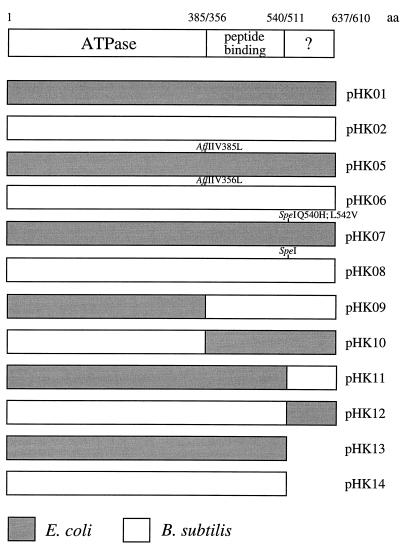
The highly conserved DnaK chaperones consist of an N-terminal ATPase domain, a central substrate-binding domain, and a C-terminal domain whose function is not known. Since Bacillus subtilis dnaK was not able to complement an Escherichia coli dnaK null mutant, we performed domain element swap experiments to identify the regions responsible for this finding. It turned out that the B. subtilis DnaK protein needed approximately normal amounts of the cochaperone DnaJ to be functional in E. coli. The ATPase domain and the substrate-binding domain form a species-specific functional unit, while the C-terminal domains, although less conserved, are exchangeable. Deletion of the C-terminal domain in E. coli DnaK affected neither complementation of growth at high temperatures nor propagation of phage lambda but abolished degradation of sigma32.
Figures


References
Publication types
MeSH terms
Substances
LinkOut - more resources
Full Text Sources
Molecular Biology Databases
