. 1999 Apr;73(4):2854-62.
doi: 10.1128/JVI.73.4.2854-2862.1999.

Adaptation of very virulent infectious bursal disease virus to chicken embryonic fibroblasts by site-directed mutagenesis of residues 279 and 284 of viral coat protein VP2

Affiliations

Adaptation of very virulent infectious bursal disease virus to chicken embryonic fibroblasts by site-directed mutagenesis of residues 279 and 284 of viral coat protein VP2

B L Lim et al. J Virol. 1999 Apr.

Abstract

The full-length RNA genomes of a chicken embryonic fibroblast (CEF)-nonpermissive, very virulent infectious bursal disease virus (IBDV) (strain HK46) were amplified into cDNAs by reverse transcription-PCR. The full-length cDNAs were sequenced and subcloned into a eukaryotic expression vector, from which point mutations were introduced into the VP2 region by site-directed mutagenesis. The wild-type and mutated plasmids were transfected directly into CEFs to examine their ability to generate CEF-permissive recombinant viruses. Substitution of amino acid residues 279 (Asp-->Asn) and 284 (Ala-->Thr) of the VP2 protein yielded a recombinant virus which was able to be passaged in CEFs, whereas the wild-type cDNAs and an amino acid substitution at residue 330 (Ser-->Arg) of the VP2 protein alone did not yield viable virus. The results indicated that mutation of other viral proteins, including VP1, VP3, VP4, and VP5, was not required for CEF adaptation of the virus. The same approach may be used to produce CEF-adapted strains from newly evolved IBDVs or to manipulate the antigenicity of the virus.


Figures
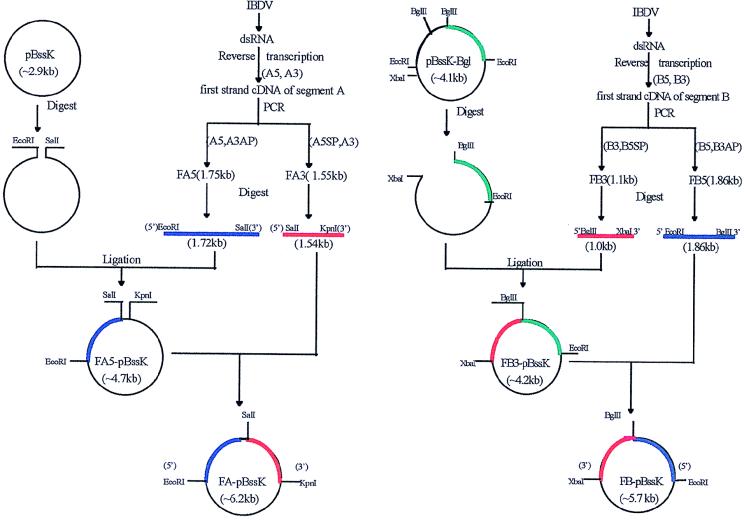
FIG. 1
FIG. 1
Construction of full-length cDNA clones. Four cDNA fragments derived from very virulent strain HK46, designated FA5 (5′ end fragment of segment A), FA3 (3′ end fragment of segment A), FB5 (5′ end fragment of segment B), and FB3 (3′ end fragment of segment B), were independently amplified by four primer pairs. Fragment FA5 digested with EcoRI and SalI was cloned into the EcoRI/SalI site of pBssK to obtain plasmid FA5-pBssK. Subsequently, fragment FA3 was subcloned into the SalI and KpnI sites of plasmid FA5-pBssK to generate FA-pBssk, which carried the full-length fragment A cDNA. Fragment FB3 digested with BglII and XbaI was cloned into the BglII/XbaI site of plasmid pBssK-Bgl to obtain plasmid FB3-pBssK. Subsequently, fragment FB5 was subcloned into the EcoRI and BglII sites of FB3-pBssK to yield a plasmid containing a full-length cDNA copy of segment B.
FIG. 2
FIG. 2
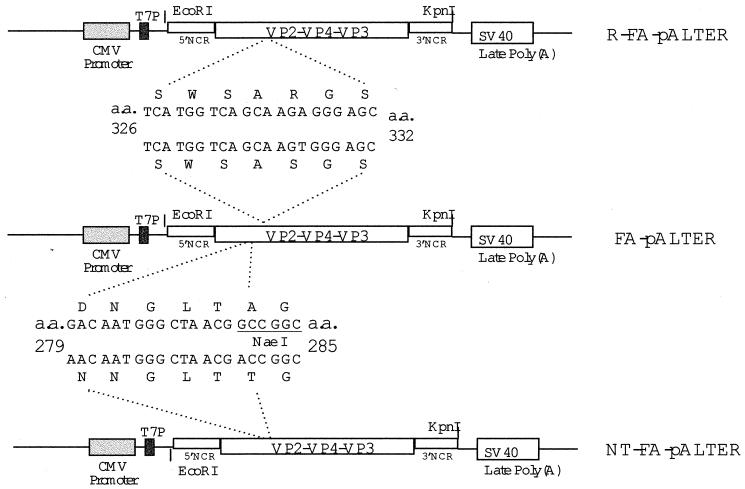
Schematic presentation of pALTER expression plasmids containing genome segment A derived from IBDV strain HK46. Plasmid FA-pALTER contains the wild-type cDNA without modification. In plasmid R-FA-pALTER, a nucleotide substitution at position 1121 (T→A) resulted in an amino acid (a.a.) substitution at position 330 (Ser→Arg). In plasmid NT-FA-pALTER, substitutions at nucleotide positions 966 (G→A) and 981 (G→A) resulted in amino acid substitutions at residues 279 (Asp→Asn) and 284 (Ala→Thr). The nucleotide substitution at position 981 (G→A) also eliminated a unique restriction site on the segment A cDNA, NaeI. All plasmids contained cytomegalovirus (CMV) promoter sequences at their 5′ ends, which could drive transcription of the segment A genome after transfection into CEFs.
FIG. 3
FIG. 3
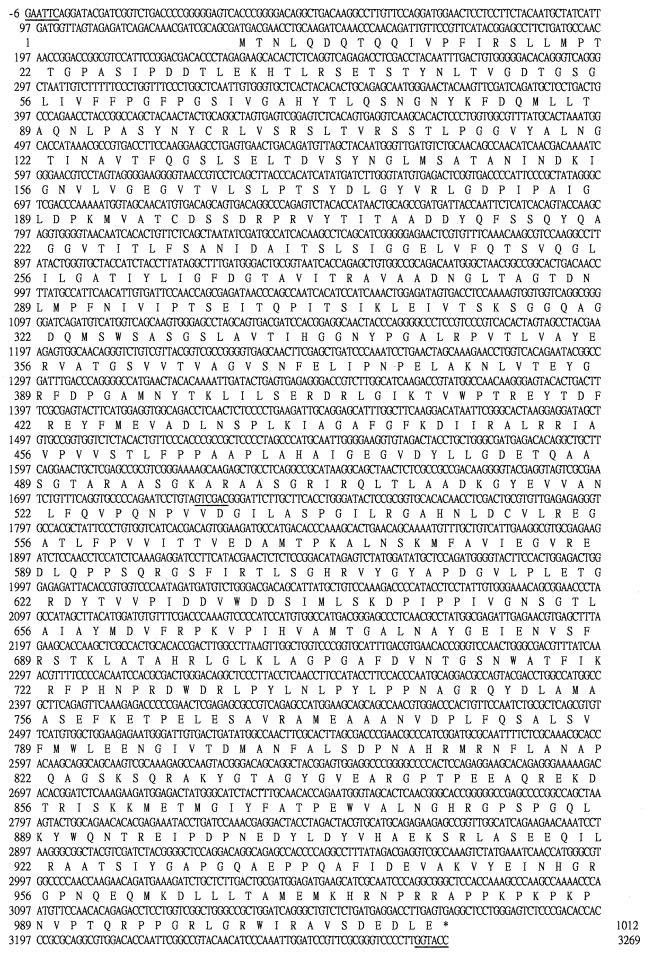
Full-length cDNA and amino acid sequences of the segment A genome of very virulent IBDV strain HK46. Cloning sites EcoRI (−6 to −1), SalI (1725 to 1730), and KpnI (3264 to 3269) are underlined. The stop codon is denoted by an asterisk.
FIG. 4
FIG. 4
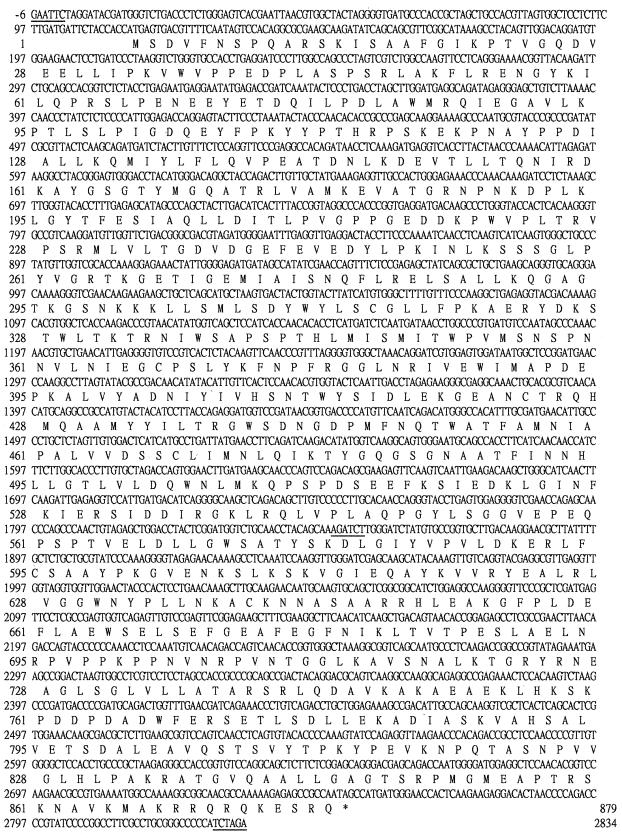
Full-length cDNA and amino acid sequences of the segment B genome of very virulent IBDV strain HK46. Cloning sites EcoRI (−6 to −1), BglII (1850 to 1855), and XbaI (2829 to 2834) are underlined. The stop codon is denoted by an asterisk.
FIG. 5
FIG. 5
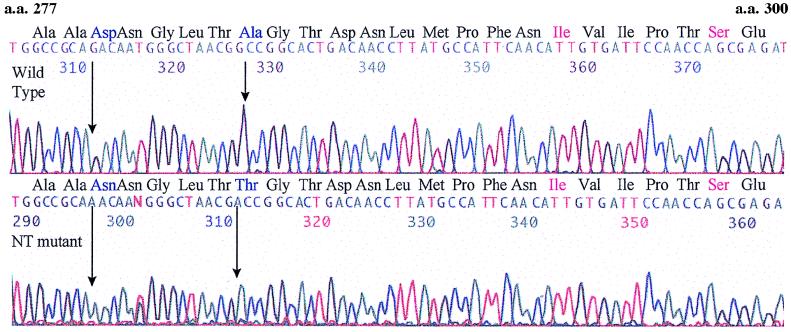
Confirmation of 279 Asn and 284 Thr substitutions in recombinant virus HK46-NT by DNA sequencing. The VP2 hypervariable region of recombinant virus HK46-NT was recovered by reverse transcription-PCR and sequenced. The sequencing result was compared with the wild-type sequence in plasmid FA-pALTER. Arrows indicate substitutions at nucleotide positions 966 (G→A) and 981 (G→A), which resulted in amino acid substitutions at residues 279 (Asp→Asn) and 284 (Ala→Thr). The amino acid residue in red (294I) is unique to very virulent IBDV.
FIG. 6
FIG. 6
Cytopathogenicity of recombinant virus on CEF cells. CEF cells (2 × 10⁴ in each well) were mixed with 100 TCID50 of D78 or HK46-NT. At daily intervals (up to 5 days), 20 μl of MTS/PES solution was added to each well and the plates were incubated at 37°C for 2 h in a humidified chamber with 5% CO2. The plates were then measured at OD490. The background reading, measured from wells with culture medium and MTS/PES only, was subtracted from the data. Each value is the average of two independent experiments.
FIG. 7
FIG. 7
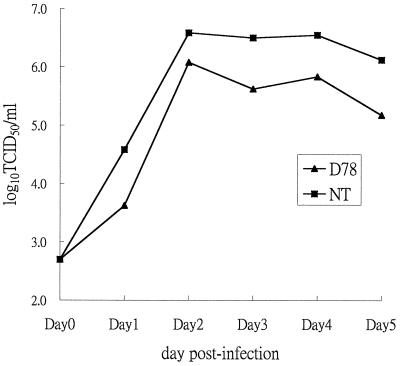
Growth curve of the mutant virus. CEF cells were infected with 100 TCID50 of D78 or HK46-NT in 200 μl of culture medium. Virus harvested at daily intervals was then titered and expressed as TCID50 per milliliter. Each value is the average of two independent experiments.

References

    1. Becht H, Muller H, Muller H K. Comparative studies on structural and antigenic properties of two serotypes of infectious bursal disease virus. J Gen Virol. 1988;69:631–640. - PubMed
    1. Brown M D, Skinner M A. Coding sequences of both genome segments of a European ‘very virulent’ infectious bursal disease virus. Virus Res. 1996;40:1–15. - PubMed
    1. Cao Y C, Yeung W S, Law M, Bi Y Z, Leung F C, Lim B L. Molecular characterization of seven Chinese isolates of infectious bursal disease virus: classical, very virulent and variant strains. Avian Dis. 1998;42:340–351. - PubMed
    1. Fahey K J, McWaters P, Brown M A, Erny K, Murphy V J, Hewish D R. Virus-neutralizing and passively protective monoclonal antibodies to infectious bursal disease virus of chickens. Avian Dis. 1991;35:365–373. - PubMed
    1. Heine H G, Haritou M, Failla P, Fahey K, Azad A. Sequence analysis and expression of the host-protective immunogen VP2 of a variant strain of infectious bursal disease virus which can circumvent vaccination with standard type I strains. J Gen Virol. 1991;72:1835–1843. - PubMed

Publication types

Substances

Associated data

LinkOut - more resources