. 1999 Apr;73(4):3301-8.
doi: 10.1128/JVI.73.4.3301-3308.1999.

ERV-L elements: a family of endogenous retrovirus-like elements active throughout the evolution of mammals

Affiliations

ERV-L elements: a family of endogenous retrovirus-like elements active throughout the evolution of mammals

L Bénit et al. J Virol. 1999 Apr.

Abstract

We have previously identified in the human genome a family of 200 endogenous retrovirus-like elements, the HERV-L elements, disclosing similarities with the foamy retroviruses and which might be the evolutionary intermediate between classical intracellular retrotransposons and infectious retroviruses. Southern blot analysis of a large series of mammalian genomic DNAs shows that HERV-L-related elements-so-called ERV-L-are present among all placental mammals, suggesting that ERV-L elements were already present at least 70 million years ago. Most species exhibit a low copy number of ERV-L elements (from 10 to 30), while simians (not prosimians) and mice (not rats) have been subjected to bursts resulting in increases in the number of copies up to 200. The burst of copy number in primates can be dated to shortly after the prosimian and simian branchpoint, 45 to 65 million years ago, whereas murine species have been subjected to two much more recent bursts (less than 10 million years ago), occurring after the Mus/Rattus split. We have amplified and sequenced 360-bp ERV-L internal fragments of the highly conserved pol gene from a series of 22 mammalian species. These sequences exhibit high percentages of identity (57 to 99%) with the murine fully coding MuERV-L element. Phylogenetic analyses allowed the establishment of a plausible evolutionary scheme for ERV-L elements, which accounts for the high level of sequence conservation and the widespread dispersion among mammals.


Figures
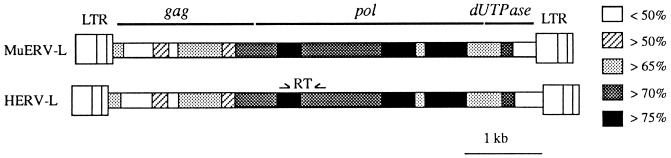
FIG. 1
FIG. 1
Schematic representation and comparison of HERV-L (6,591 bp) and MuERV-L (6,471 bp) cloned elements. The positions of the oligonucleotides (see Materials and Methods) used to amplify a 360-bp fragment of the highly conserved reverse transcriptase (RT) gene are indicated.
FIG. 2
FIG. 2
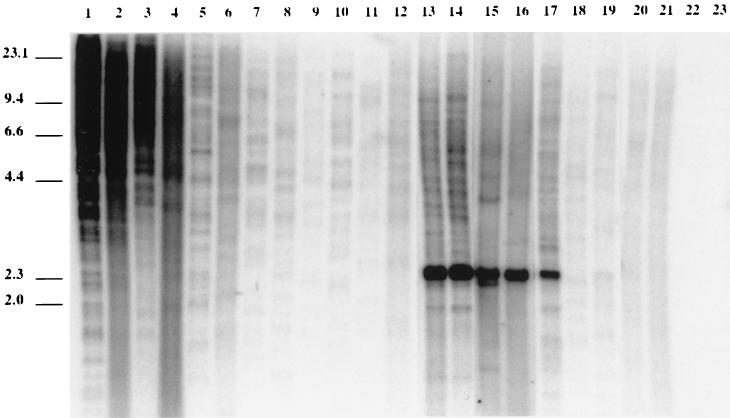
Southern blot analysis of HERV-L pol-related sequences in various vertebrates. EcoRI-digested DNAs were hybridized with a 360-bp HERV-L pol fragment. Species of samples are as follows: lane 1, Homo sapiens (hominoid); lane 2, Pan troglodytes (hominoid); lane 3, Macaca cynomolgus (Old World monkey); lane 4, Alouatta seniculus (New World monkey); lane 5, Microcebus murinus (prosimian); lane 6, Cheirogaleus medius (prosimian); lane 7, Felis cattus (cat); lane 8, Canis familiaris (dog); lane 9, Oryctolagus cuniculus (rabbit); lane 10, Bos taurus (cow); lane 11, Sus scrofa domesticus (pig); lane 12, Equus caballus (horse); lane 13, C57BL/6 mouse (laboratory strain); lane 14, Mus musculus domesticus (Northern African and Near Eastern house mouse); lane 15, M. (Pyromys) saxicola (southeast Asian mouse); lane 16, M. (Coelomys) famulus (southeast Asian mouse); lane 17, Mus (Nannomys) minutoïde (African pygmy mouse); lane 18, N. fulvescens (Asian rat); lane 19, Rattus tanezumi (Asian rat); lane 20, Microcus nivalis (meadow vole); lane 21, Clethrionomys glareolus (bank vole); lane 22, Oncorhynchus sp. (salmon); and lane 23, Gallus domesticus (chicken). Numbers to the left are molecular size markers (in kilobase).
FIG. 3
FIG. 3
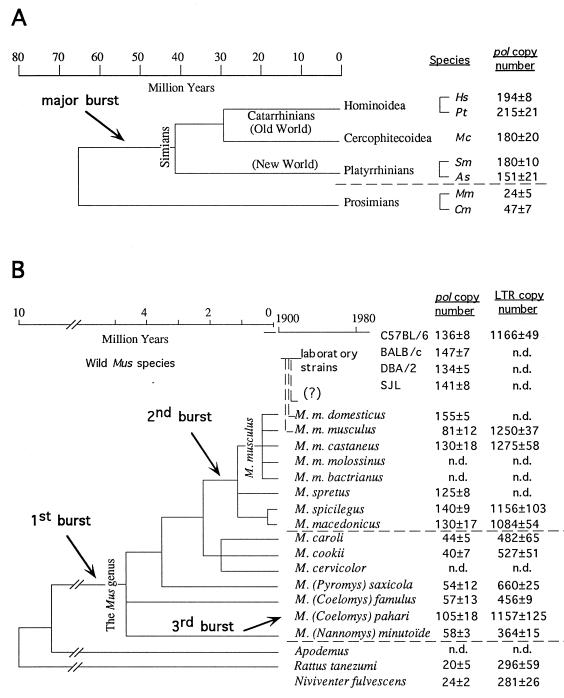
(A) Copy number determination of ERV-L elements (pol probe) in primates. The arrow indicates the major primate burst (>100 copies). Cm, Cheirogaleus medius; Mm, Microcebus murinus; As, Alovatta seniculus; Sm, Saguinus midas; Mc, Macaca cynomolgus; Pt, Pan troglodytes; Hs, Homo sapiens. (B) Copy number determination of ERV-L elements (pol probe) and ERV-L LTRs (LTR probe) for feral and laboratory mice as well as for two Asian rats. Arrows indicate the proposed dating of the two major bursts and the burst observed in M. pahari (3). Phylogenetic links were established by Sage et al. (22) and Boursot et al. (5). All data are expressed as means ± standard errors of the means (n = 3). n.d., not determined.
FIG. 4
FIG. 4
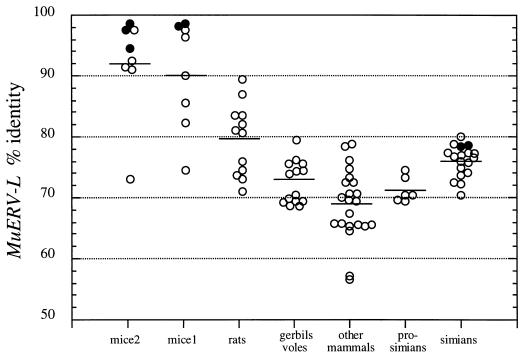
Percentages of identity between 87 ERV-L mammal sequences and MuERV-L. mice2 and mice1 refer to mice subjected to 2 bursts or 1 burst, respectively. Other mammals includes cows, pigs, cats, dogs, donkeys, horses, and rabbits. Black circles indicate entirely coding sequences. The average value for each group is indicated by a horizontal line.
FIG. 5
FIG. 5
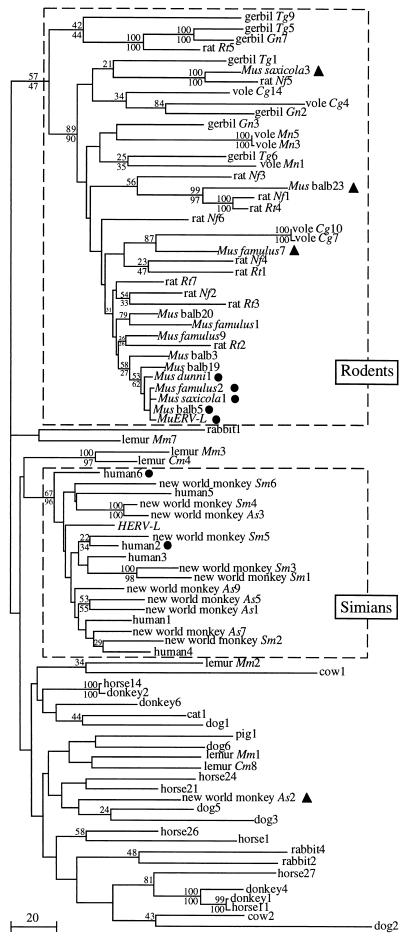
Phylogenetic tree of 87 ERV-L elements. BALB/c (laboratory strain), Mus balb; Rattus tanezumi, rat Rt; Niviventer fulvescens, rat Nf; Clethrionomys glareolus, vole Cg; Microtus nivalis, vole Mn; Tatera gambiana, gerbil Tg; Gerbillus nigeriae, gerbil Gn. Clone numbers are indicated. HERV-L and MuERV-L correspond to the cloned human and BALB/c mouse elements, respectively (2, 10). This tree comprises 87 taxa and is 3,663 steps long, with a consistency index of 0.323 and a retention index of 0.484. Bootstrap proportions are indicated when greater than 20% with the values for the MP and NJ methods above and below the nodes, respectively. Bar, 20 substitutions. Rodents and primate monophyletic groups are boxed. Black circles indicate coding sequences, and triangles indicate candidate burst-unrelated sequences among mouse and simian sequences.

References

    1. Adachi J, Hasegawa M. Computer monographs. Vol. 28. Tokyo, Japan: Institute of Statistical Mathematics; 1996. MOLPHY: programs for molecular phylogenetics based on maximum likelihood, version 2.3.
    1. Bénit L, de Parseval N, Casella J-F, Callebaut I, Cordonnier A, Heidmann T. Cloning of a new murine endogenous retrovirus, MuERV-L, with strong similarity to the human HERV-L element and with a gag coding sequence closely related to the Fv1 restriction gene. J Virol. 1997;71:5652–5257. - PMC - PubMed
    1. Benveniste R E, Callahan R, Sherr C J, Chapman V, Todaro G J. Two distinct endogenous type C viruses isolated from the asian rodent Mus cervicolor: conservation of virogene sequences in related rodent species. J Virol. 1977;21:849–862. - PMC - PubMed
    1. Best S, le Tissier P, Towers G, Stoye J P. Positional cloning of the mouse retrovirus restriction gene Fv1. Nature. 1996;382:826–829. - PubMed
    1. Boursot P, Auffray J C, Britton-Davidian J, Bonhomme F. The evolution of house mice. Annu Rev Ecol Syst. 1993;24:119–152.

Publication types

Associated data

LinkOut - more resources