


Human papillomavirus (HPV) DNA copy number is dependent on grade of cervical disease and HPV type
- PMID: 10074522
- PMCID: PMC88645
- DOI: 10.1128/JCM.37.4.1030-1034.1999
Human papillomavirus (HPV) DNA copy number is dependent on grade of cervical disease and HPV type
Abstract
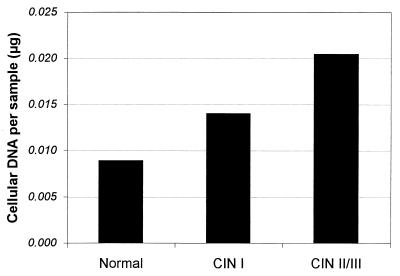
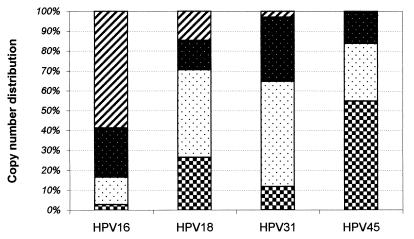
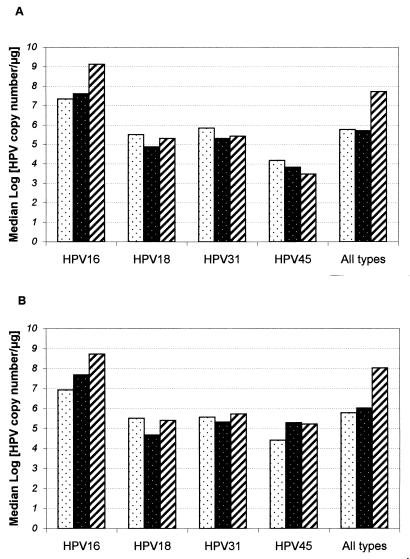
The association between human papillomavirus (HPV) DNA copy number and cervical disease was investigated. Viral DNA copy number for the most common high-risk HPV types in cervical cancer (types 16, 18, 31, and 45) was determined in cervical cytobrush specimens from 149 women with high-grade cervical intraepithelial neoplasias (CIN II-CIN III), 176 with low-grade CIN (CIN I), and 270 with normal cytology. Quantitative, PCR-based fluorescent assays for each of the HPV genotypes and for the beta-globin gene were used. The amount of cellular DNA increased significantly with increasing disease; thus, HPV was expressed as copies per microgram of cellular DNA. The assay had a dynamic range of >10(7), allowing documentation for the first time of the wide range of HPV copy numbers seen in clinical specimens. Median HPV DNA copy number varied by more than 10(4) among the viral types. HPV16 was present in the highest copy number; over 55% of HPV16-positive samples contained more than 10(8) copies/microgram. Median copy number for HPV16 showed dramatic increases with increasing epithelial abnormality, an effect not seen with the other HPV types. HPV16 increased from a median of 2.2 x 10(7) in patients with normal cytology, to 4.1 x 10(7) in CIN I patients, to 1.3 x 10(9) copies/microgram in CIN II-III patients. Even when stratified by cervical disease and viral type, the range of viral DNA copies per microgram of cellular DNA was quite large, precluding setting a clinically significant cutoff value for "high" copy numbers predictive of disease. This study suggests that the clinical usefulness of HPV quantitation requires reassessment and is assay dependent.
Figures
References
-
- Banks L, Edmonds C, Vousden K H. Ability of the HPV16 E7 protein to bind RB and induce DNA synthesis is not sufficient for efficient transforming activity in NIH3T3 cells. Oncogene. 1990;5:1383–1389. - PubMed
-
- Bosch F X, Manos M M, Muõz N, Sherman M, Jansen A M, Peto J, Schiffman M H, Moreno V, Kurman R, Shah K V. Prevalence of human papillomavirus in cervical cancer: a worldwide perspective. International biological study on cervical cancer (IBSCC) study group. J Natl Cancer Inst. 1995;87:796–802. - PubMed
-
- Cavuslu S, Mant C, Starkey W G, Bible J M, Biswas C, Kell B, Rice P, Best J M, Cason J. Analytic sensitivities of hybrid-capture, consensus and type-specific polymerase chain reactions for the detection of human papillomavirus type 16 DNA. J Med Virol. 1996;49:319–324. - PubMed
-
- Chang D Y, Chen R J, Lee S C, Huang S C. Prevalence of single and multiple infection with human papillomaviruses in various grades of cervical neoplasia. J Med Microbiol. 1997;46:54–60. - PubMed
-
- Chang D Y, Hsieh C Y, Chen R J, Lee S C, Huang S C. Comparison of detection of human papillomavirus 16 DNA in cervical carcinoma tissues by Southern blot hybridisation and nested polymerase chain reaction. J Med Microbiol. 1995;43:430–435. - PubMed
MeSH terms
Substances
LinkOut - more resources
Full Text Sources
Other Literature Sources
Medical
