Bronchoconstrictor effect of thrombin and thrombin receptor activating peptide in guinea-pigs in vivo
- PMID: 10077241
- PMCID: PMC1565816
- DOI: 10.1038/sj.bjp.0702303
Bronchoconstrictor effect of thrombin and thrombin receptor activating peptide in guinea-pigs in vivo
Abstract
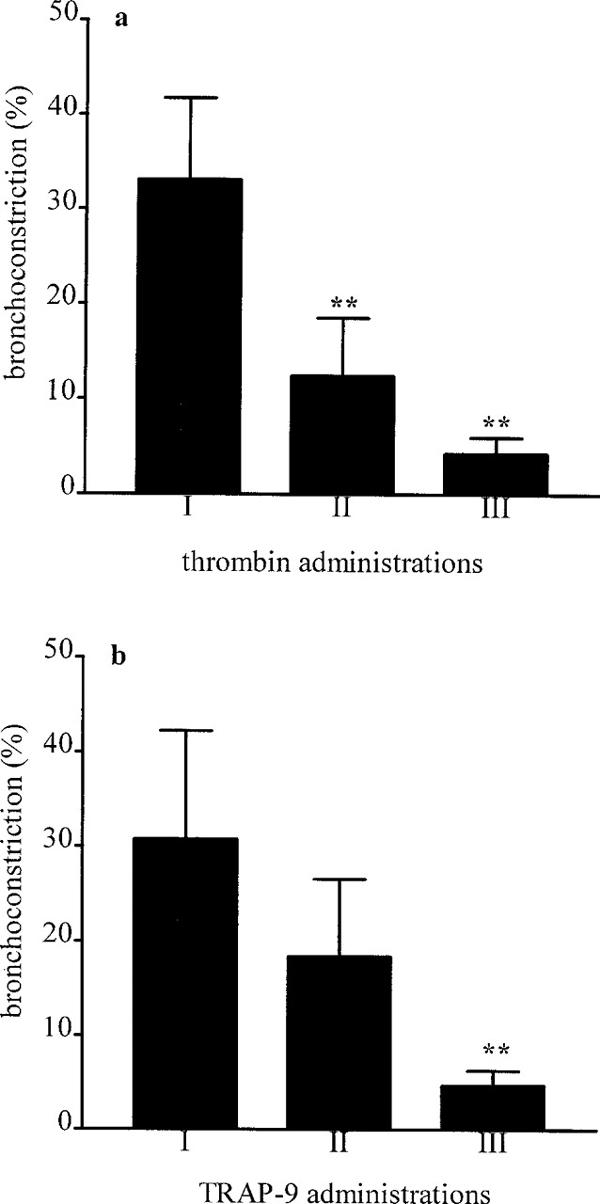
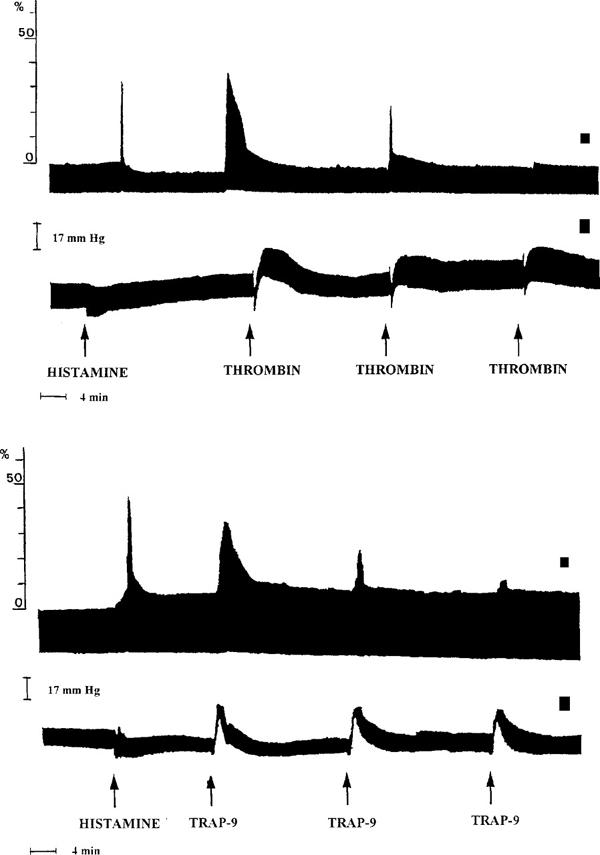
1. Several thrombin cellular effects are dependent upon stimulation of proteinase activated receptor-1 (PAR-1) localized over the cellular surface. Following activation by thrombin, a new N-terminus peptide is unmasked on PAR-1 receptor, which functions as a tethered ligand for the receptor itself. Synthetic peptides called thrombin receptor activating peptides (TRAPs), corresponding to the N-terminus residue unmasked, reproduce several thrombin cellular effects, but are devoid of catalytic activity. We have evaluated the bronchial response to intravenous administration of human alpha-thrombin or a thrombin receptor activating peptide (TRAP-9) in anaesthetized, artificially ventilated guinea-pigs. 2. Intravenous injection of thrombin (100 microkg(-1)) caused bronchoconstriction that was recapitulated by injection of TRAP-9 (1 mg kg(-1)). Animal pretreatment with the thrombin inhibitor Hirulog (10 mg kg(-1) i.v.) prevented thrombin-induced bronchoconstriction, but did not affect bronchoconstriction induced by TRAP-9. Both agents did not induce bronchoconstriction when injected intravenously to rats. 3. The bronchoconstrictor effect of thrombin and TRAP-9 was subjected to tolerance; however, in animals desensitized to thrombin effect, TRAP-9 was still capable of inducing bronchoconstriction, but not vice versa. 4. Depleting animals of circulating platelets prevented bronchoconstriction induced by both thrombin and TRAP-9. 5. Bronchoconstriction was paralleled by a biphasic change in arterial blood pressure, characterized by a hypotensive phase followed by a hypertensive phase. Thrombin-induced hypotension was not subject to tolerance and was inhibited by Hirulog; conversely, hypertension was subject to tolerance and was not inhibited by Hirulog. Hypotension and hypertension induced by TRAP-9 were neither subject to tolerance nor inhibited by Hirulog. 6. Our results indicate that thrombin causes bronchoconstriction in guinea-pigs through a mechanism that requires proteolytic activation of its receptor and the exposure of the tethered ligand peptide. Platelet activation might be triggered by the thrombin effect.
Figures
References
-
- BAR-SHAVIT R., KAHN A., WILNER G.D. Monocyte chemiotaxis: Stimulation by specific exosite region in thrombin. Science. 1983;220:728–731. - PubMed
-
- BIZIOS R., LAI L., FENTON J.W., II, MALIK A.B. Thrombin-induced chemiotaxis and aggregation of neutrophils. J. Cell. Physiol. 1986;128:485–490. - PubMed
-
- CHAO B.H., KALKUNTE S., MARAGANORE J.M., STONE S.R. Essential groups in synthetic agonist peptides for activation of the platelet thrombin receptor. Biochemistry. 1992;31:6175–6178. - PubMed
-
- CHIU P.J.S., TETZLOFF G.G., FOSTER C., CHINTALA M., SYBERTZ E.J. Characterization of in vitro and in vivo platelet response to thrombin and thrombin receptor-activating peptides in guinea pigs. Eur. J. Pharmacol. 1997;321:129–135. - PubMed
-
- CICALA C., CIRINO G. Linkage between inflammation and coagulation: an update on the molecular basis of the crosstalk. Life Sci. 1998;62:1817–1824. - PubMed
MeSH terms
Substances
LinkOut - more resources
Full Text Sources
Other Literature Sources