


Specific interaction of Tat with the human but not rodent P-TEFb complex mediates the species-specific Tat activation of HIV-1 transcription
- PMID: 10077579
- PMCID: PMC15837
- DOI: 10.1073/pnas.96.6.2728
Specific interaction of Tat with the human but not rodent P-TEFb complex mediates the species-specific Tat activation of HIV-1 transcription
Abstract
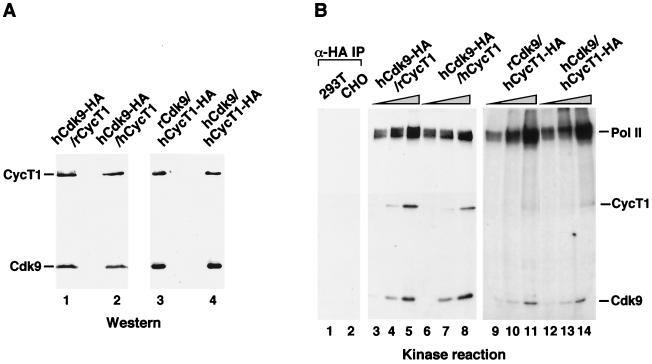
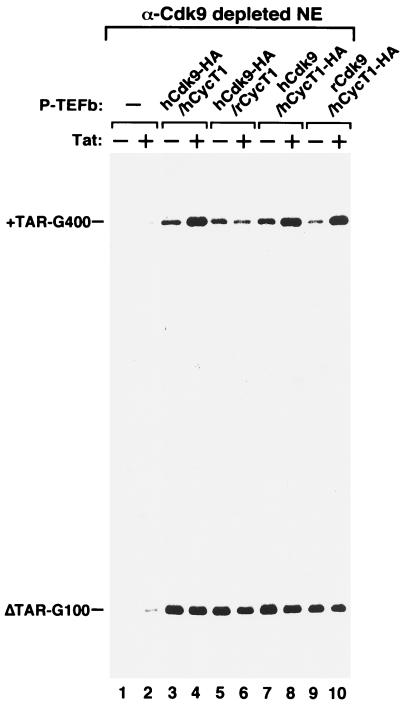
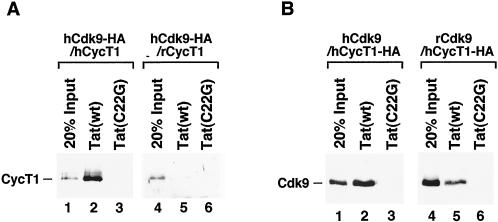
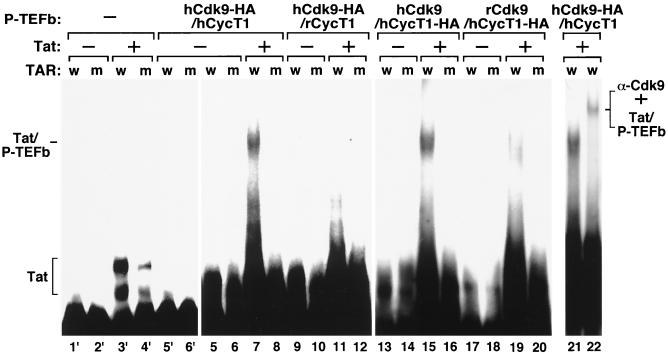
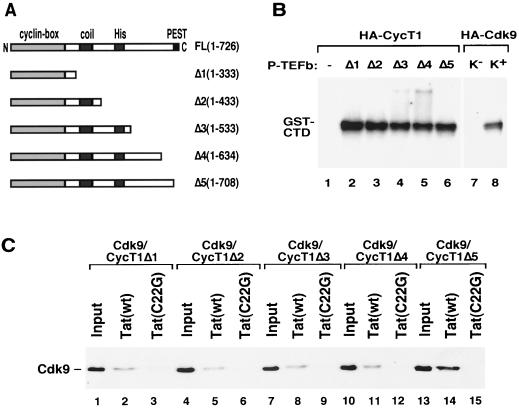
Tat stimulation of HIV-1 transcriptional elongation is species-specific and is believed to require a specific cellular cofactor present in many human and primate cells but not in nonpermissive rodent cells. Human P-TEFb, composed of Cdk9 and cyclin T1, is a general transcription elongation factor that phosphorylates the C-terminal domain of RNA polymerase II. Previous studies have also implicated P-TEFb as a Tat-specific cellular cofactor and, in particular, human cyclin T1 as responsible for the species-specific Tat activation. To obtain functional evidence in support of these hypotheses, we generated and examined the activities of human-rodent "hybrid" P-TEFb complexes. We found that P-TEFb complexes containing human cyclin T1 complexed with either human or rodent Cdk9 supported Tat transactivation and interacted with the Tat activation domain and the HIV-1 TAR RNA element to form TAR loop-dependent ribonucleoprotein complexes. Although a stable complex containing rodent cyclin T1 and human Cdk9 was capable of phosphorylating CTD and mediating basal HIV-1 elongation, it failed to interact with Tat and to mediate Tat transactivation, indicating that the abilities of P-TEFb to support basal elongation and Tat activation can be separated. Together, our data indicated that the specific interaction of human P-TEFb with Tat/TAR, mostly through cyclin T1, is crucial for P-TEFb to mediate a Tat-specific and species-restricted activation of HIV-1 transcription. Amino acid residues unique to human Cdk9 also contributed partially to the formation of the P-TEFb-Tat-TAR complex. Moreover, the cyclin box of cyclin T1 and its immediate flanking region are largely responsible for the specific P-TEFb-Tat interaction.
Figures
References
-
- Cullen B R. Cell. 1993;73:417–420. - PubMed
-
- Jones K A, Peterlin B M. Annu Rev Biochem. 1994;63:717–743. - PubMed
-
- Marciniak R A, Calnan B J, Frankel A D, Sharp P A. Cell. 1990;63:791–802. - PubMed
-
- Sheline C T, Milocco L H, Jones K A. Genes Dev. 1991;5:2508–2520. - PubMed
-
- Selby M J, Peterlin B M. Cell. 1990;62:769–776. - PubMed
Publication types
MeSH terms
Substances
Grants and funding
LinkOut - more resources
Full Text Sources
Miscellaneous
