


Toward controlling gene expression at will: selection and design of zinc finger domains recognizing each of the 5'-GNN-3' DNA target sequences
- PMID: 10077584
- PMCID: PMC15842
- DOI: 10.1073/pnas.96.6.2758
Toward controlling gene expression at will: selection and design of zinc finger domains recognizing each of the 5'-GNN-3' DNA target sequences
Abstract
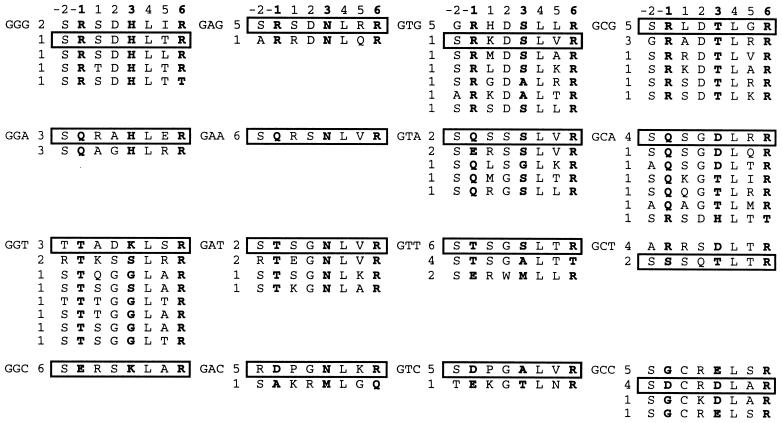
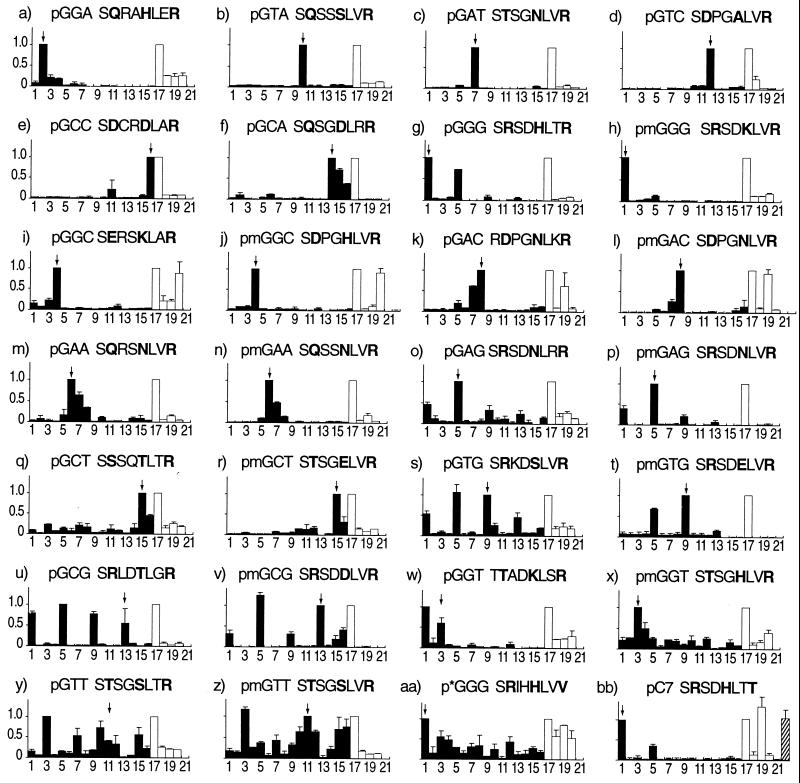
We have taken a comprehensive approach to the generation of novel DNA binding zinc finger domains of defined specificity. Herein we describe the generation and characterization of a family of zinc finger domains developed for the recognition of each of the 16 possible 3-bp DNA binding sites having the sequence 5'-GNN-3'. Phage display libraries of zinc finger proteins were created and selected under conditions that favor enrichment of sequence-specific proteins. Zinc finger domains recognizing a number of sequences required refinement by site-directed mutagenesis that was guided by both phage selection data and structural information. In many cases, residues not expected to make base-specific contacts had effects on specificity. A number of these domains demonstrate exquisite specificity and discriminate between sequences that differ by a single base with >100-fold loss in affinity. We conclude that the three helical positions -1, 3, and 6 of a zinc finger domain are insufficient to allow for the fine specificity of the DNA binding domain to be predicted. These domains are functionally modular and may be recombined with one another to create polydactyl proteins capable of binding 18-bp sequences with subnanomolar affinity. The family of zinc finger domains described here is sufficient for the construction of 17 million novel proteins that bind the 5'-(GNN)6-3' family of DNA sequences. These materials and methods should allow for the rapid construction of novel gene switches and provide the basis for a universal system for gene control.
Figures
References
-
- Ptashne M. Nature (London) 1967;214:232–234. - PubMed
-
- Lee M S, Gippert G P, Soman K V, Case D A, Wright P E. Science. 1989;245:635–637. - PubMed
-
- Pavletich N P, Pabo C O. Science. 1991;252:809–817. - PubMed
-
- Elrod-Erickson M, Rould M A, Nekludova L, Pabo C O. Structure (London) 1996;4:1171–1180. - PubMed
Publication types
MeSH terms
Substances
Grants and funding
LinkOut - more resources
Full Text Sources
Other Literature Sources
