. 1999 Mar 16;96(6):3047-52.
doi: 10.1073/pnas.96.6.3047.

An inducible gene product for 6-phosphofructo-2-kinase with an AU-rich instability element: role in tumor cell glycolysis and the Warburg effect

Affiliations

An inducible gene product for 6-phosphofructo-2-kinase with an AU-rich instability element: role in tumor cell glycolysis and the Warburg effect

J Chesney et al. Proc Natl Acad Sci U S A. .

Abstract

Cancer cells maintain a high glycolytic rate even in the presence of oxygen, a phenomenon first described over 70 years ago and known historically as the Warburg effect. Fructose 2,6-bisphosphate is a powerful allosteric regulator of glycolysis that acts to stimulate the activity of 6-phosphofructo-1-kinase (PFK-1), the most important control point in mammalian glycolysis. The steady state concentration of fructose 2,6-bisphosphate in turn depends on the activity of the enzyme 6-phosphofructo-2-kinase (PFK-2)/fructose-2, 6-bisphosphatase, which is expressed in several tissue-specific isoforms. We report herein the identification of a gene product for this enzyme that is induced by proinflammatory stimuli and which is distinguished by the presence of multiple copies of the AUUUA mRNA instability motif in its 3'-untranslated end. This inducible gene for PFK-2 is expressed constitutively in several human cancer cell lines and was found to be required for tumor cell growth in vitro and in vivo. Inhibition of inducible PFK-2 protein expression decreased the intracellular level of 5-phosphoribosyl-1-pyrophosphate, a product of the pentose phosphate pathway and an important precursor for nucleic acid biosynthesis. These studies identify a regulatory isoenzyme that may be essential for tumor growth and provide an explanation for long-standing observations concerning the apparent coupling of enhanced glycolysis and cell proliferation.


Figures
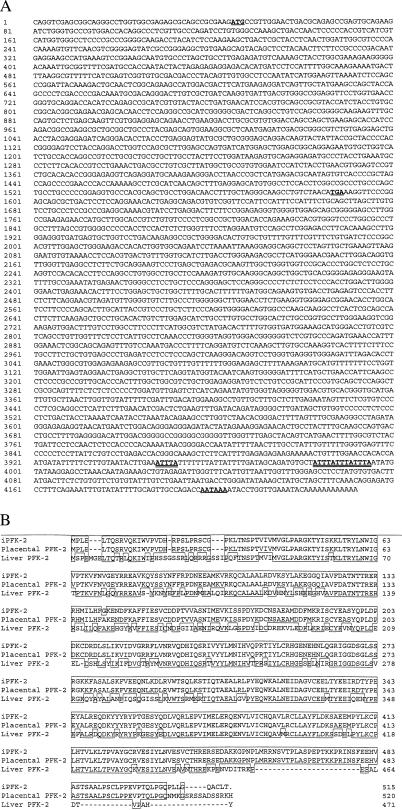
Figure 1
Figure 1
iPFK-2 nucleotide sequence and predicted amino acid sequence. (A) cDNA nucleotide sequence of an isoform of human PFK-2 cDNA (designated iPFK-2). The ATG initiation codon, TAA termination codon, and polyadenylation signal (AATAAA) are bold and underlined. The AT-rich mRNA destabilizing elements are bold and double-underlined (GenBank accession no. AF056320). (B) Predicted amino acid sequence and alignment of the PFK-2 cDNA with PFK-2 sequences deduced from a human placental (19) and a human liver (12) cDNA clone.
Figure 2
Figure 2
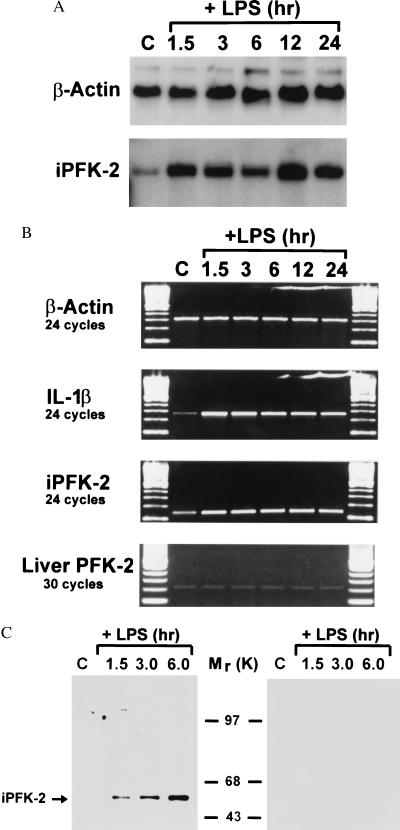
Time-dependent induction of iPFK-2 expression by LPS-stimulated human peripheral blood monocytes. (A) Northern blotting analysis of RNA obtained from control or LPS-stimulated monocytes using a 32P-labeled, iPFK-2 cDNA probe containing the AU-rich 3′UTR. (B) Reverse transcription–PCR analysis of monocyte mRNA by using gene-specific oligonucleotides for β-actin, IL-1β, iPFK-2, and liver PFK-2. (C) Western blot analysis of total monocyte protein by using an anti-iPFK-2 peptide specific antibody (Left) and after coincubation of the anti-iPFK-2 antibody with the iPFK-2-specific peptide (Right).
Figure 3
Figure 3
Expression of iPFK-2 in tumor cell lines. (A) Expression of iPFK-2 mRNA in human cancer cell lines. Shown is a Northern blot analysis of the cell lines HL-60 (promyelocytic leukemia), S3 (HeLa cell), K562 (chronic myelogenous leukemia), MOLT4 (lymphoblastic leukemia), Raji (Burkitt’s lymphoma), SW480 (colorectal adenocarcinoma), A549 (lung carcinoma), and G361 (melanoma). GADPH, glyceraldehyde-3-phosphate dehydrogenase RNA control. (B) Reverse transcription–PCR analysis of the expression of iPFK-2 and liver PFK-2 mRNA by K562 cells. (C) Western blot analysis of total cellular protein by using an anti-iPFK-2 antibody. PBL, human peripheral blood leukocytes, KG1a, human promyelocytic leukemia cells.
Figure 4
Figure 4
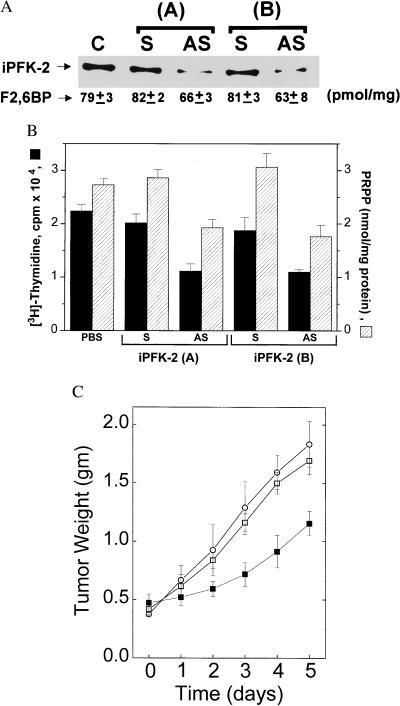
Inhibition of iPFK-2 expression decreases intracellular F2,6BP and PRPP concentrations and decreases K562 tumor cell growth. (A) Western blotting and F2,6BP analysis of lysates obtained from untransfected, K562 control cells (C) and K562 cells transfected with two different pairs (A, B) of iPFK-2 sense (S) or iPFK-2 antisense (AS) oligonucleotides. The F2,6BP concentration of each lysate is indicated below the corresponding band of immunoreactive iPFK-2 protein (mean ± SD, oligonucleotide pair A, P = 0.0023 for AS vs. S; oligonucleotide pair B, P = 0.033 for AS vs. S, [t test statistic, independent variable (27)]. (B) Intracellular PRPP and [3H]thymidine incorporation measurements in untransfected, K562 control cells (PBS controls) and cells transfected with two pairs (A, B) of iPFK-2 sense (S) or iPFK-2 antisense (AS) oligonucleotides (mean ± SD) (25). Oligonucleotide pair A, P = 0.0017 for intracellular PRPP and P = 0.0018 for [3H]thymidine incorporation (AS vs. S). Oligonucleotide pair B, P = 0.0023 for intracellular PRPP and P = 0.0061 for [3H]thymidine incorporation (AS vs. S) (t test statistic, independent variable). (C) K562 tumor-bearing nude mice (n = 5 mice per group) were implanted with microosmotic pumps that administered PBS (○), iPFK-2 sense oligonucleotide B (□), or iPFK-2 antisense oligonucleotide B (■). After the indicated period of treatment, tumor weight was determined in a blinded fashion with Vernier calipers according the following formula: weight (mg) = (width, mm)2 × (length, mm)/2. AS vs. S, day 1, P = 0.176; day 2, P = 0.007; day 3, P = 0.0005; day 4, P < 0.00004; day 5, P = 0.0023 (t test statistic, independent variable).
Figure 5
Figure 5
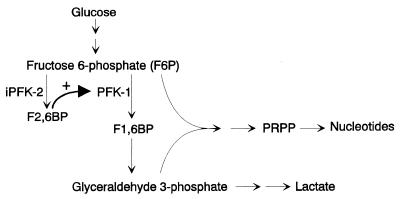
Scheme for the F2,6BP-mediated induction of glycolysis and nucleotide synthesis via iPFK-2.

References

    1. Warburg O. Biochem Z. 1924;152:319–344.
    1. Warburg O. Science. 1956;123:309–314. - PubMed
    1. Van Schaftingen E, Jett M F, Hue L, Hers H G. Proc Natl Acad Sci USA. 1981;78:3483–3486. - PMC - PubMed
    1. Hue L, Rousseau G G. Adv Enzyme Regul. 1993;33:97–110. - PubMed
    1. Hue L, Rider M H. Biochem J. 1987;245:313–324. - PMC - PubMed

Publication types

MeSH terms

Substances

Associated data