


X chromosome evidence for ancient human histories
- PMID: 10077682
- PMCID: PMC15940
- DOI: 10.1073/pnas.96.6.3320
X chromosome evidence for ancient human histories
Abstract
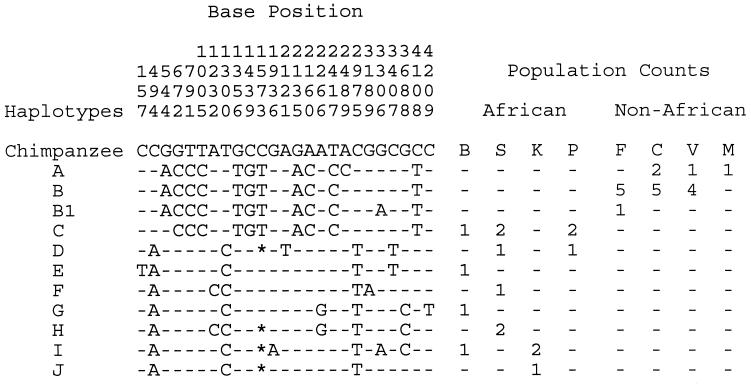
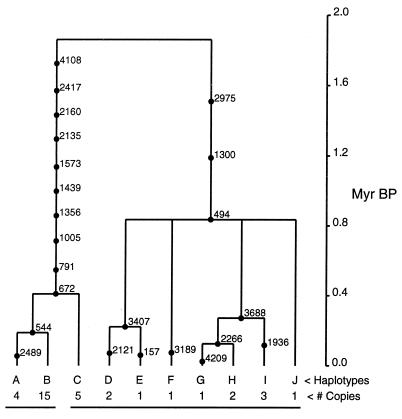
Diverse African and non-African samples of the X-linked PDHA1 (pyruvate dehydrogenase E1 alpha subunit) locus revealed a fixed DNA sequence difference between the two sample groups. The age of onset of population subdivision appears to be about 200 thousand years ago. This predates the earliest modern human fossils, suggesting the transformation to modern humans occurred in a subdivided population. The base of the PDHA1 gene tree is relatively ancient, with an estimated age of 1.86 million years, a late Pliocene time associated with early species of Homo. PDHA1 revealed very low variation among non-Africans, but in other respects the data are consistent with reports from other X-linked and autosomal haplotype data sets. Like these other genes, but in conflict with microsatellite and mitochondrial data, PDHA1 does not show evidence of human population expansion.
Figures
Comment in
-
The tail domain of lamin Dm0 binds histones H2A and H2B.Proc Natl Acad Sci U S A. 1999 Mar 16;96(6):2852-7. doi: 10.1073/pnas.96.6.2852. Proc Natl Acad Sci U S A. 1999. PMID: 10077600 Free PMC article.
References
-
- Bräuer G. In: The Human Revolution: Behavioral and Biological Perspectives on the Origins of Modern Humans. Mellars P, Stringer C, editors. Princeton, NJ: Princeton Univ. Press; 1989. pp. 123–154.
-
- Valladas H, Reyss J L, Joron J L, Valladas G, Bar-Yosef O, Vandermeersch B. Nature (London) 1988;331:614–616.
-
- Klein R G. The Human Career: Human Biological and Cultural Origins. Chicago: Univ. Chicago Press; 1989.
-
- Zietkiewicz E, Yotova V, Jarnik M, Korab-Laskowska M, Kidd K K, Modiano D, Scozzari R, Stoneking M, Tishkoff S, Batzer M, et al. J Mol Evol. 1998;47:146–155. - PubMed
Publication types
MeSH terms
Substances
Associated data
- Actions
- Actions
- Actions
- Actions
- Actions
- Actions
- Actions
- Actions
- Actions
- Actions
- Actions
- Actions
- Actions
- Actions
- Actions
- Actions
- Actions
- Actions
- Actions
- Actions
- Actions
- Actions
- Actions
- Actions
- Actions
- Actions
- Actions
- Actions
- Actions
- Actions
Grants and funding
LinkOut - more resources
Full Text Sources
Other Literature Sources
Molecular Biology Databases
