


Frequent genetic alterations in simple urothelial hyperplasias of the bladder in patients with papillary urothelial carcinoma
- PMID: 10079249
- PMCID: PMC1866404
- DOI: 10.1016/S0002-9440(10)65318-7
Frequent genetic alterations in simple urothelial hyperplasias of the bladder in patients with papillary urothelial carcinoma
Abstract
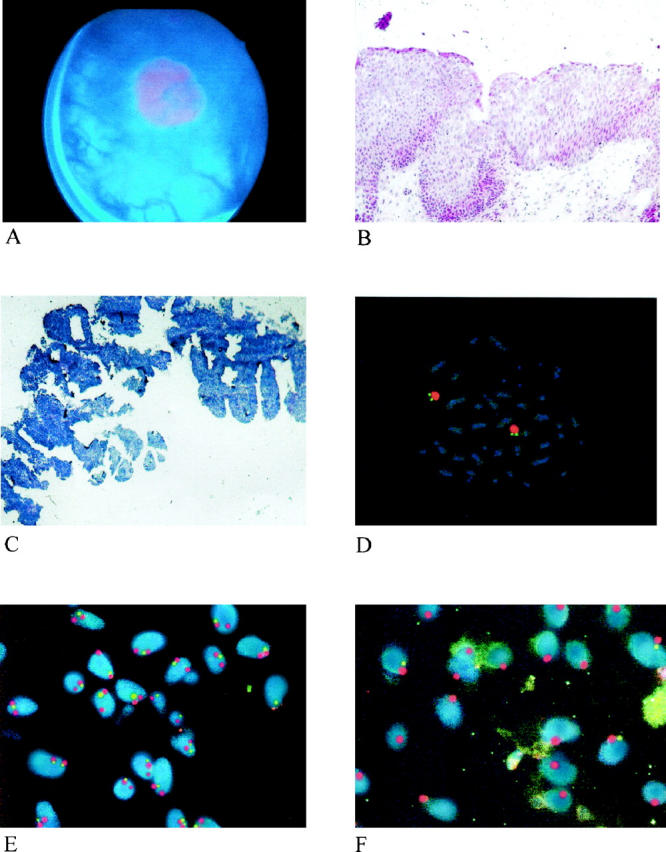
In order to understand the origin of bladder cancer, very early urothelial lesions must be investigated in addition to more advanced tumors. Tissue from 31 biopsies of 12 patients with urothelial hyperplasias and simultaneous or consecutive superficial papillary tumors were used to microdissect urothelium from 15- microm sections of biopsies. The biopsies were obtained with the recently developed highly sensitive diagnostic method of 5-aminolevulinic acid-induced fluorescence endoscopy (AFE). Besides flat and papillary urothelial neoplasms, the method of photodynamic diagnostics also detects simple urothelial hyperplasias as fluorescent positive lesions. In addition, 12 fluorescence-positive biopsies showing histologically normal urothelium were investigated. Fluorescence in situ hybridization was done using a dual color staining technique of biotinylated centromeric probes of chromosomes 9 and 17 and digoxigenin-labeled gene-specific P1 probes for chromosomes 9q22 (FACC), 9p21(p16/CDKI2), and 17p13(p53). Ten of 14 hyperplasias (70%) showed deletions of chromosome 9. In 7 out of 8 patients with genetic alterations in the hyperplasias the genetic change was also present in the papillary tumor. Six out of 12 samples of microdissected normal urothelium also showed genetic alterations on chromosome 9. Microdissection of urothelial lesions, obtained during AFE, has led to the first unequivocal documentation of genetic changes in urothelial lesions diagnosed as normal in histopathology. Thus, this technical approach is important to provide insight into the earliest molecular alterations in bladder carcinogenesis.
Figures
References
-
- Amin MB, Young RH: Intraepithelial lesions of the urinary bladder with a discussion of the histogenesis of urothelial neoplasia. Semin Diagn Pathol 1997, 14:84-97 - PubMed
-
- Kriegmair M, Baumgartner R, Knuchel R, Stepp H, Hofstadter F, Hofstetter A: Detection of early bladder cancer by 5-aminolevulinic acid induced porphyrin fluorescence [see comments]. J Urol 1996, 155:105-109 - PubMed
-
- Steinbach P, Kriegmair M, Baumgartner R, Hofstadter F, Knuchel R: Intravesical instillation of 5-aminolevulinic acid: the fluorescent metabolite is limited to urothelial cells. Urology 1994, 44:676-668 - PubMed
-
- Peng Q, Warloe T, Berg K, Moan J, Kongshaug M, Giercksky KE, Nesland JM: 5-Aminolevulinic acid-based photodynamic therapy: clinical research and future challenges. Cancer 1997, 79:2282-2308 - PubMed
-
- Chatuverdi V, Hodges S, Johnston D, Ro JY, Logothetis C, von Eschenbach AC, Batsakis JG, Czerniak B: Superimposed histologic and genetic mapping of chromosome 17 alterations in human urinary bladder neoplasia. Oncogene 1997, 14:2059-2070 - PubMed
Publication types
MeSH terms
LinkOut - more resources
Full Text Sources
Medical
Research Materials
Miscellaneous
