


Nature and severity of the glomerular response to nephron reduction is strain-dependent in mice
- PMID: 10079267
- PMCID: PMC1866424
- DOI: 10.1016/S0002-9440(10)65336-9
Nature and severity of the glomerular response to nephron reduction is strain-dependent in mice
Abstract
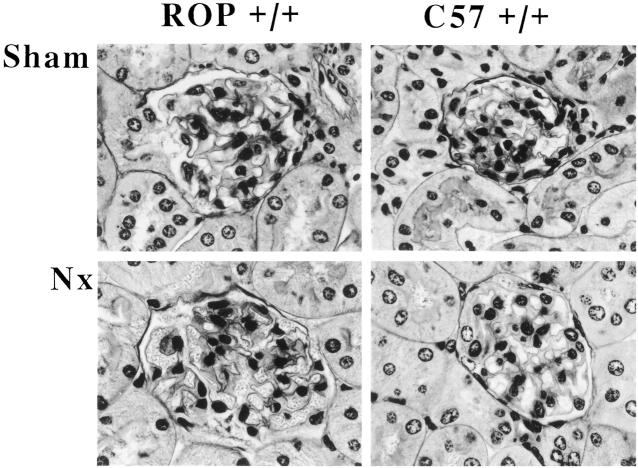
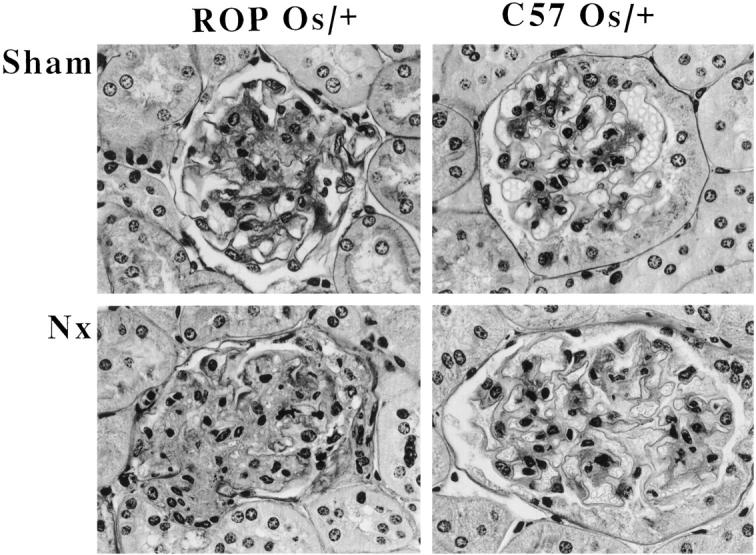
Nephron reduction is an important factor in the development of glomerulosclerosis. In a study of the oligosyndactyly (Os) mutation that causes a congenital 50% reduction in nephron number, we previously found that ROP Os/+ mice developed glomerulosclerosis whereas C57B1/6J Os/+ mice did not. We concluded that the predisposition to glomerulosclerosis depended largely on the genetic background, the ROP being sclerosis-prone whereas the C57 strain was sclerosis-resistant. In the current experiments we asked whether the intensity of the sclerotic response to nephron reduction in the ROP strain was related to the time at which it occurred, ie, a pre- or post-natal event. We also determined whether the absence of lesions in C57 Os/+ mice was caused by a higher threshold for the induction of a sclerotic response in C57 mice. We further examined the relationship between glomerular hypertrophy and sclerosis. C57 +/+, C57 Os/+, ROP +/+, and ROP Os/+ mice were uninephrectomized (NX) at age 10 weeks and followed for 8 weeks. We found no sclerotic changes in NX C57 +/+ and C57 Os/+ mice, despite a 75% reduction in nephron number in the latter. In contrast, both NX ROP +/+ and NX ROP Os/+ mice had glomerulosclerosis, which was more severe in the NX ROP Os/+ mice. Examination of extracellular matrix synthesis and degradation at the mRNA level revealed that synthesis exceeded degradation in ROP Os/+ mice. The lesions in NX ROP +/+ were less severe than in sham-operated ROP/Os mice, suggesting that the timing of nephron reduction affected the amplitude of the sclerotic response in this strain. Following NX, an increase in glomerular volume was found in C57 +/+, ROP +/+, and ROP Os/+ mice. However, NX did not lead to a further increase in glomerular volume in C57 Os/+ mice. We make three conclusions: 1) sclerosis was more severe in the ROP strain when nephron reduction occurred in utero; 2) the absence of glomerulosclerosis in C57 mice was not related to a higher threshold for a sclerosis response in this strain; and 3) whereas glomerular size continued to increase as nephron number decreased in ROP mice, it reached a plateau in C57 mice.
Figures
References
-
- Bay WH, Hebert LA: The living donor in kidney transplantation. Ann Int Med 1987, 106:719-727 - PubMed
-
- Kasiske BL, Ma JZ, Louis TA, Swan SK: Long-term effects of reduced renal mass in humans. Kidney Int 1995, 48:814-819 - PubMed
-
- Narkun-Burgess DM, Nolan CR, Norman JE, Page WF, Miller PL, Meyer TW: Forty-five year follow-up after uninephrectomy. Kidney Int 1993, 43:1110-1115 - PubMed
-
- Liu PL, Gallery ED, Mahony JF, Gyory AZ: Renal function in unilateral nephrectomy subjects. J Urol 1992, 147:337-339 - PubMed
-
- Lent V, Harth J: Nephropathy in remnant kidneys: pathological proteinuria after unilateral nephrectomy. J Urol 1994, 152:312-316 - PubMed
MeSH terms
Substances
LinkOut - more resources
Full Text Sources
Other Literature Sources
Molecular Biology Databases
