


Interleukin-10 and antigen-presenting cells actively suppress Th1 cells in BALB/c mice infected with the filarial parasite Brugia pahangi
- PMID: 10084992
- PMCID: PMC96502
- DOI: 10.1128/IAI.67.4.1599-1605.1999
Interleukin-10 and antigen-presenting cells actively suppress Th1 cells in BALB/c mice infected with the filarial parasite Brugia pahangi
Abstract
Infection with the third-stage larvae (L3) of the filarial nematode Brugia results in a Th2-biased immune response in mice and humans. Previously we have shown that the production of interleukin 4 (IL-4) is critical for down-regulating polyclonal Th1 responses in L3-infected mice. However, the in vitro neutralization of IL-4 did not fully recover the defective polyclonal Th1 responses, nor did it result in the production of any antigen (Ag)-specific Th1 cytokines, suggesting that perhaps infection with L3 does not result in priming of Th1 cells in vivo. In this study, we analyzed the role of IL-10 and Ag-presenting cells (APCs) in the spleen as additional factors controlling the Th2 bias in infected mice. Our data show that IL-10 and APCs also contribute to the suppression of mitogen-driven Th1 responses of spleen cells from infected mice. In addition, the neutralization of IL-10 or the replacement of the resident APC population from spleen cell cultures resulted in the production of Ag-specific Th1 cytokines. Irradiated spleen cells from either L3-infected or uninfected mice were able to restore Ag-specific Th1 responses in vitro. Therefore, it appears that Brugia-reactive Th1 cells are primed following infection with L3, but are actively suppressed in vivo by a mechanism that involves IL-10 and the resident APC population, but not IL-4. These results indicate that a complex interplay of cytokines and cell populations underscores the Th2-polarized response in L3-infected mice.
Figures
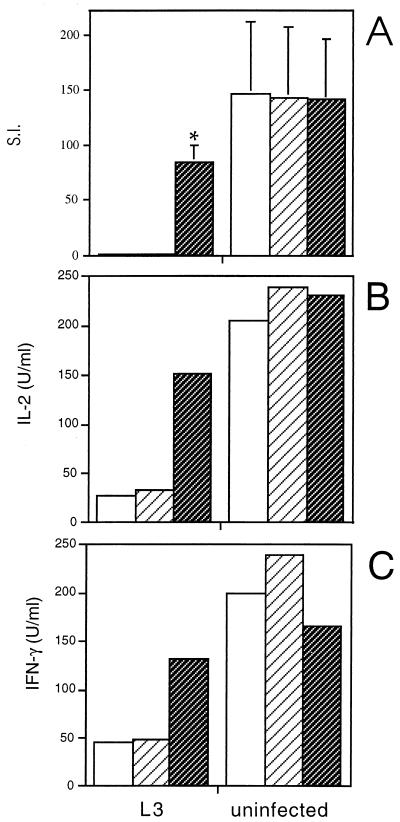
 ) per ml.
After 48 h of incubation, proliferation (A) and IL-2 (B) and
IFN-γ (C) production were measured. (A) The means of triplicate wells
are expressed as SIs (cpm with ConA/cpm with medium alone). The SIs
represent the means ± standard deviations of five animals per
group, ∗, significant difference (P < 0.05) between
the values obtained with JES5-2A5 and R59-40. SIs were also
significantly different (P < 0.05) between the cells
of L3-infected mice treated with JES5-2A5 and uninfected mice with no
treatment. (B) and (C) Cytokine assays were performed with spleen cells
pooled from five animals in each group. The results presented were
comparable in two additional experiments.
) per ml.
After 48 h of incubation, proliferation (A) and IL-2 (B) and
IFN-γ (C) production were measured. (A) The means of triplicate wells
are expressed as SIs (cpm with ConA/cpm with medium alone). The SIs
represent the means ± standard deviations of five animals per
group, ∗, significant difference (P < 0.05) between
the values obtained with JES5-2A5 and R59-40. SIs were also
significantly different (P < 0.05) between the cells
of L3-infected mice treated with JES5-2A5 and uninfected mice with no
treatment. (B) and (C) Cytokine assays were performed with spleen cells
pooled from five animals in each group. The results presented were
comparable in two additional experiments.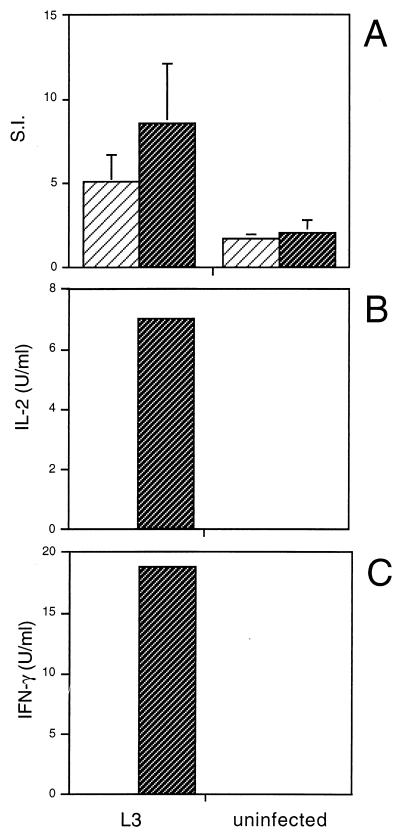 ) per ml, and proliferation
(A) and IL-2 (B) and IFN-γ (C) production were measured, as described
previously. (A) The SIs shown are the means ± standard deviations
of five animals per group. (B and C) Cytokine assays were performed
with spleen cells pooled from five animals in each group. The results
presented were comparable in two additional experiments.
) per ml, and proliferation
(A) and IL-2 (B) and IFN-γ (C) production were measured, as described
previously. (A) The SIs shown are the means ± standard deviations
of five animals per group. (B and C) Cytokine assays were performed
with spleen cells pooled from five animals in each group. The results
presented were comparable in two additional experiments.
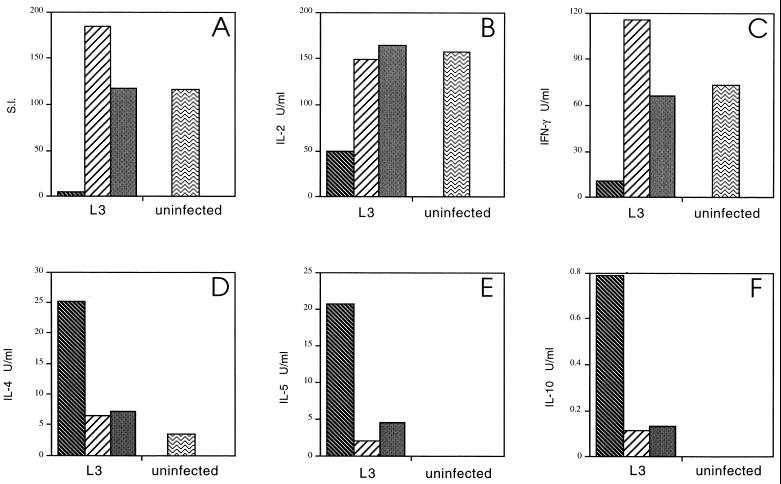
 ) and
uninfected (
) and
uninfected ( )
mice.
)
mice.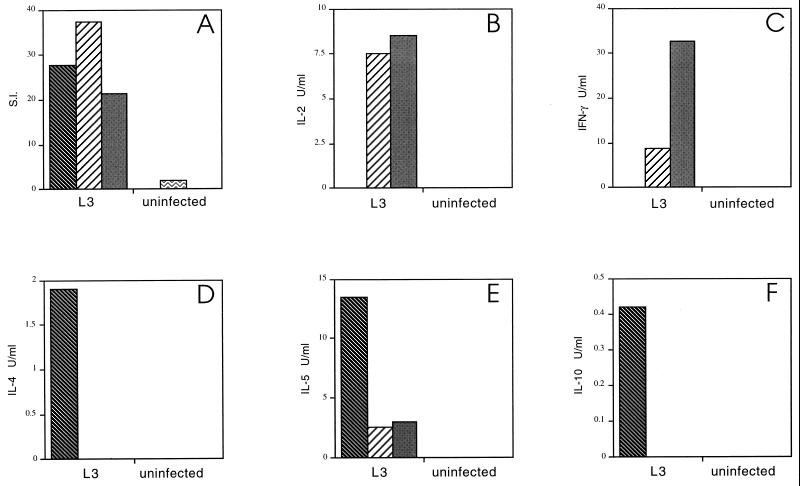
 ) and
uninfected ()
mice.
) and
uninfected ()
mice.References
-
- Albina J E, Abate J A, Henry W L., Jr Nitric oxide production is required for murine resident macrophages to suppress mitogen-stimulated T cell proliferation. J Immunol. 1991;147:144–148. - PubMed
-
- Allen J E, Lawrence R A, Maizels R M. APC from mice harbouring the filarial nematode, Brugia malayi, prevent cellular proliferation but not cytokine production. Int Immunol. 1996;8:143–151. - PubMed
-
- Barral-Netto M, Barral A, Brownell C E, Skeiky Y A W, Ellingsworth L R, Twardzik D R, Reed S G. Transforming growth factor-B in leishmanial infection: a parasite escape mechanism. Science. 1992;257:545–548. - PubMed
-
- Bretscher P A, Wei G, Menon J N, Bielefeldt-Ohmann H. Establishment of stable, cell-mediated immunity that makes “susceptible” mice resistant to Leishmania major. Science. 1992;257:539–542. - PubMed
Publication types
MeSH terms
Substances
Grants and funding
LinkOut - more resources
Full Text Sources
Molecular Biology Databases
Miscellaneous
