. 1999 Apr;181(7):2067-74.
doi: 10.1128/JB.181.7.2067-2074.1999.

HmbR, a hemoglobin-binding outer membrane protein of Neisseria meningitidis, undergoes phase variation

Affiliations

HmbR, a hemoglobin-binding outer membrane protein of Neisseria meningitidis, undergoes phase variation

A R Richardson et al. J Bacteriol. 1999 Apr.

Abstract

Neisseria meningitidis uses hemoglobin (Hb) as an iron source via two TonB-dependent outer membrane receptors, HmbR and HpuB. Analysis of 25 epidemiologically unrelated clinical isolates from serogroups A, B, C, and Y revealed that 64% strains possessed both Hb receptor genes. Examination of the hmbR expression pattern in strains in which the hpuB gene was genetically inactivated revealed two distinct Hb utilization phenotypes. Five strains retained the ability to grow as a confluent lawn, while seven grew only as single colonies around Hb discs. The single-colony phenotype observed for some hpuB mutants is suggestive of phase variation of hmbR. The length of the poly(G) tract starting at position +1164 of hmbR absolutely correlated with the two Hb utilization phenotypes. All five strains that grew as confluent lawns around Hb discs possessed either 9 or 12 consecutive G residues. All seven strains that grew as single colonies around Hb discs had poly(G) tracts of a length other than 9 or 12. These single-colony variants that arose around the Hb discs had poly(G) tracts with either 9 or 12 consecutive G residues restoring the hmbR reading frame. Inactivation of hmbR in these strains resulted in a loss of Hb utilization, demonstrating that the change in the hmbR gene was responsible for the phenotypic switch. The switching rates from hmbR phase off to phase on were approximately 5 x 10(-4) in four serogroup C strains, 2 x 10(-2) in the serogroup A isolate, and 7 x 10(-6) in the serogroup B isolate.


Figures
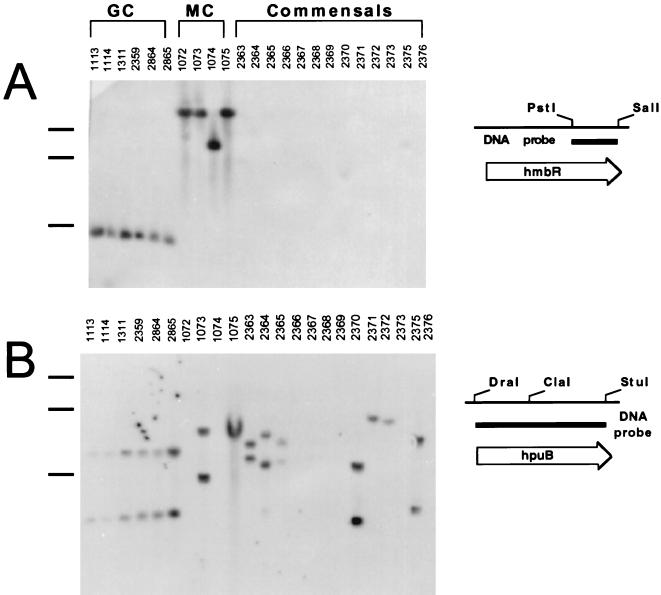
FIG. 1
FIG. 1
Distribution of hmbR and hpuB genes in isolates of N. gonorrhoeae (GC), N. meningitidis (MC), and commensal Neisseria species. N. meningitidis 1072 and 1075 represent serotype C, strain 1074 represents serotype B, and strain 1073 represents serotype A. ClaI-digested chromosomal DNA from indicated strains was hybridized with hmbR-specific (A) or hpuB-specific (B) DIG-labeled DNA probes. The positions of 3-, 6-, and 12-kb marker bands are indicated by the black bars to the left of the gel (from the bottom to the top).
FIG. 2
FIG. 2
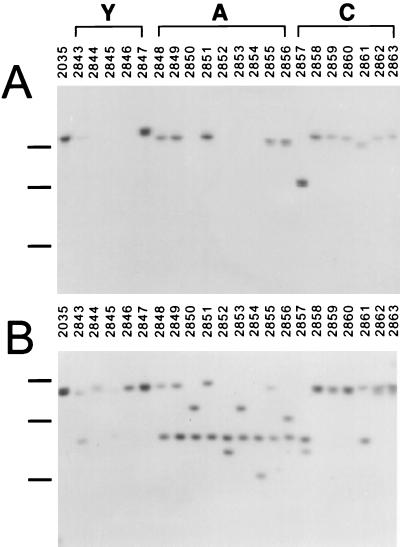
Distribution of hmbR and hpuB in N. meningitidis clinical isolates representing serogroups Y, A, and C. ClaI-digested chromosomal DNA from indicated strains was hybridized with hmbR-specific (A) or hpuB-specific (B) DIG-labeled DNA probes. The positions of 3-, 6-, and 12-kb marker bands are indicated by the black bars to the left of the gel (from the bottom to the top). Due to the small amount of DNA loaded in lane 2845, the hpuB-hybridizable band is relatively weak.
FIG. 3
FIG. 3
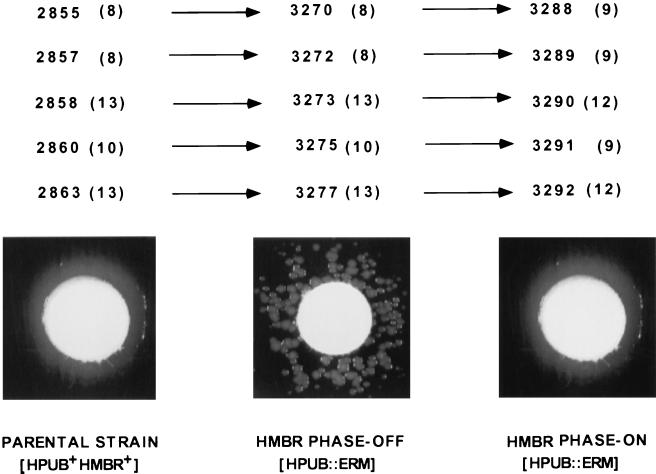
Phase variation of hmbR. The number of G residues in the poly(G) tract of hmbR is shown in parentheses for each strain analyzed. The photographs shown are examples of the phenotypes seen for each group of strains. Parental strains (left) all demonstrate a phase-on phenotype. After inactivation of hpuB, the phase-off phenotype of hmbR can be seen as a single-colony phenotype (middle). These single colonies, representing rare phase-on cells, show a confluent lawn phenotype when tested again for Hb utilization (right). The changes in the Hb utilization phenotypes were accompanied by changes in the number of G residues in the hmbR poly(G) tracts.
FIG. 4
FIG. 4
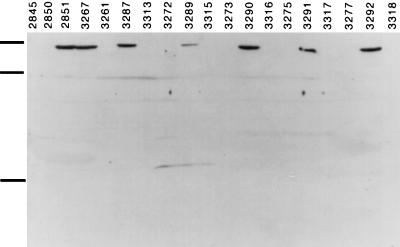
Western blot analysis of N. meningitidis outer membrane preparations isolated from strains with different HmbR-dependent Hb utilization phenotypes. Strains 2845 and 2850 are both HmbR negative controls. Strain 2851 and its hpuB::erm derivative 3267 are hmbR phase on. Strains 3261, 3272, 3273, 3275, and 3277 are hmbR phase off. Strains 3287, 3289, 3290, 3291, and 3292 are hmbR phase-on revertants of strains 3261, 3272, 3273, 3275, and 3277, respectively. Strains 3313, 3315, 3316, 3317, and 3318 are hmbR::kan derivatives of strains 3287, 3289, 3290, 3291, and 3292, respectively. The positions of 97.4-, 68-, and 18.4-kDa marker bands are indicated by the black bars to the left of the gel (from the top to the bottom).

References

    1. Aho E L, Murphy G L, Cannon J G. Distribution of specific DNA sequences among pathogenic and commensal Neisseria species. Infect Immun. 1987;55:1009–1013. - PMC - PubMed
    1. Ala’Aldeen D A A, Stevenson P, Griffiths E, Gorringe A R, Irons L I, Robinson A, Hyde S, Borriello S P. Immune responses in humans and animals to meningococcal transferrin-binding proteins: implications for vaccine design. Infect Immun. 1994;62:2984–2990. - PMC - PubMed
    1. Barrett S J, Sneath P H A. A numerical phenotypic taxonomic study of the genus Neisseria. Microbiology. 1994;140:2867–2891. - PubMed
    1. Belland R J, Morrison S G, van der Lay P, Swanson J. Expression and phase variation of gonococcal P.II genes in Escherichia coli involves ribosomal frameshifting and slipped-strand mispairing. Mol Microbiol. 1989;3:777–786. - PubMed
    1. Belland R J, Morrison S G, Carlson J H, Hogan D M. Promoter strength influences phase variation of neisserial opa genes. Mol Microbiol. 1997;23:123–135. - PubMed

Publication types

MeSH terms

LinkOut - more resources