. 1999 Mar 30;96(7):3786-9.
doi: 10.1073/pnas.96.7.3786.

The anterior determinant bicoid of Drosophila is a derived Hox class 3 gene

Affiliations

The anterior determinant bicoid of Drosophila is a derived Hox class 3 gene

M Stauber et al. Proc Natl Acad Sci U S A. .

Abstract

The Drosophila gene bicoid functions as the anterior body pattern organizer of Drosophila. Embryos lacking maternally expressed bicoid fail to develop anterior segments including head and thorax. In wild-type eggs, bicoid mRNA is localized in the anterior pole region and the bicoid protein forms an anterior-to-posterior concentration gradient. bicoid activity is required for transcriptional activation of zygotic segmentation genes and the translational suppression of uniformly distributed maternal caudal mRNA in the anterior region of the embryo. caudal genes as well as other homeobox genes or members of the Drosophila segmentation gene cascade have been found to be conserved in animal evolution. In contrast, bicoid homologs have been identified only in close relatives of the schizophoran fly Drosophila. This poses the question of how the bicoid gene evolved and adopted its unique function in organizing anterior-posterior polarity. We have cloned bicoid from a basal cyclorrhaphan fly, Megaselia abdita (Phoridae, Aschiza), and show that the gene originated from a recent duplication of the direct homolog of the vertebrate gene Hox3, termed zerknüllt, which specifies extraembryonic tissues in insects.


Figures
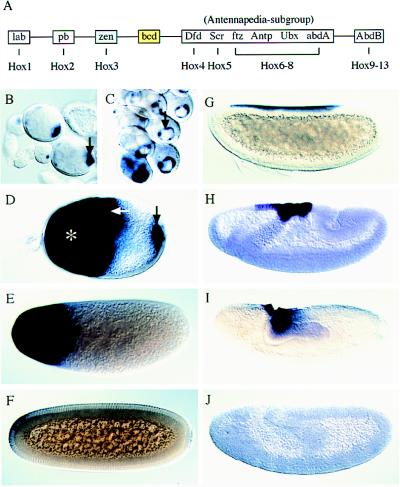
Figure 1
Figure 1
Hox gene cluster and expression patterns of Ma-bcd and Ma-zen in Megaselia. (A) The Hox-C of Drosophila and homologous genes in vertebrates (Hox1–13) (–7). Dfd (Deformed), Scr (Sex combs reduced), ftz (fushi tarazu), Antp (Antennapedia), Ubx (Ultrabithorax), and abdA (abdominal A) form a subgroup of Antennapedia related genes. lab, labial; pb, proboscipedia; zen, zerknüllt; bcd, bicoid; AbdB, Abdominal B. (B to F) In situ hybridization showing the transcript distribution of Ma-bcd in the oocyte (B–D; arrows), nurse cells (D; asterisk), and embryos before (E) and during (F) cellularization. (G–J) Patterns of Ma-zen transcripts before (G), during (H), and after (I, J) gastrulation. In Drosophila, zerknüllt is expressed also in the pole cells (22).
Figure 2
Figure 2
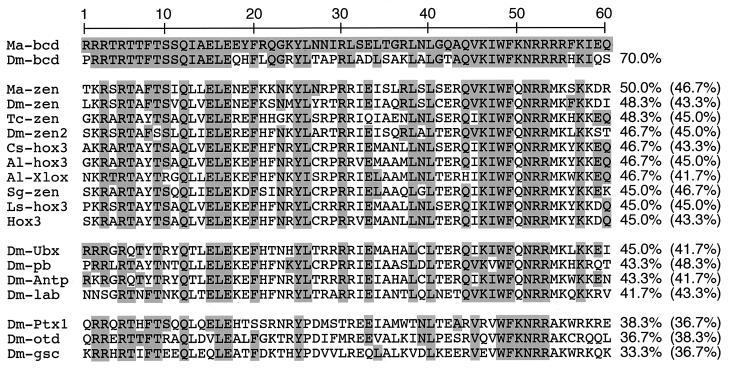
Homeodomain alignment and percent sequence similarity relative to Ma-bcd and Dm-bcd (in brackets). Numbers refer to amino acid position. Abbreviations: Ma-bcd, bicoid of Megaselia (this work); Dm-bcd, bicoid of Drosophila (27); Ma-zen, zerknüllt of Megaselia (this work); Dm-zen, zerknüllt of Drosophila (22);Tc-zen, zerknüllt of beetle (7); Cs-hox3, Hox3 of spider (24); Al-hox3 (28) and Al-Xlox (29), Hox3 and Xlox of cephalochordate, respectively; Dm-zen2, zerknüllt-2 of Drosophila (22); Sg-zen, zerknüllt of grasshopper (7); Ls-hox3, Hox3 of ribbonworm (30); Hox3, consensus reported for the Hox3 paralogy group (7). Other abbreviations refer to Hox genes (cf. legend to Fig. 1; 31–34), Ptx1, orthodenticle and goosecoid of Drosophila (–21). Identical amino acids (reference to Ma-bcd) are underlaid.
Figure 3
Figure 3
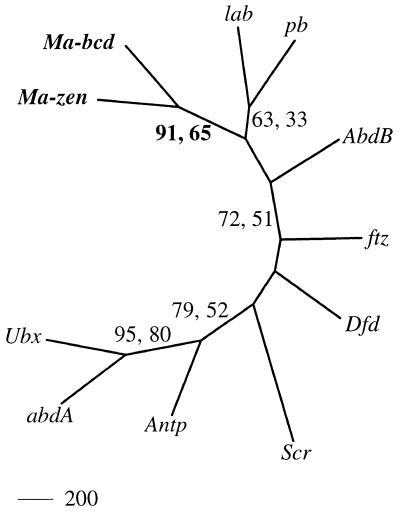
Evolutionary relationship of Ma-bcd, Ma-zen, and Hox-C genes of Drosophila, as deduced by neighbor-joining analysis. Numbers refer to bootstrap percentages obtained from neighbor-joining (first value) and maximum parsimony analysis. Trees including the more diverged bicoid and zerknüllt genes of Drosophila remain unresolved with respect to the monophyletic cluster of bicoid and zerknüllt orthologs (bootstrap value below 50%; data not shown). For abbreviations, see legend to Figs. 1 and 2.
Figure 4
Figure 4
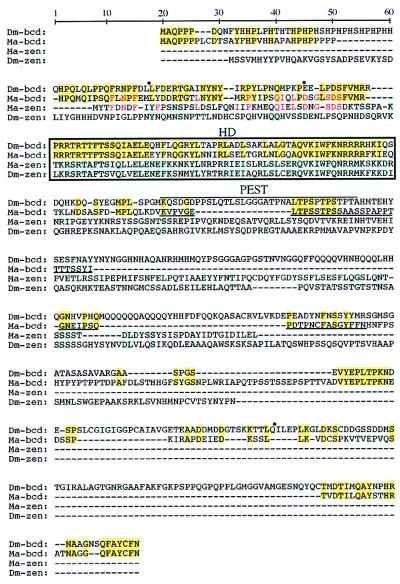
Proteins encoded by bicoid and zerknüllt of Megaselia (Ma-bcd, Ma-zen) and Drosophila (Dm-bcd, Dm-zen) (27, 22). Dashes indicate sequence gaps for optimal alignment. Amino acid identities of the bicoid proteins (yellow boxes) or the zerknüllt proteins (blue boxes) and between Ma-bcd and Ma-zen in front of the homeodomain (red letters) are highlighted. Dots above Dm-bcd mark intron positions; only the first two are conserved in Ma-bcd (64 bases and 11.5 kb). Homeodomains (HD) are boxed, PEST domains (35) are overlined (Dm-bcd) and underlined (Ma-bcd).

References

    1. St Johnston D, Nüsslein-Volhard C. Cell. 1992;68:201–219. - PubMed
    1. Rivera-Pomar R, Jäckle H. Trends Genet. 1996;12:478–483. - PubMed
    1. Driever W. In: The Development of Drosophila melanogaster. Bate M, Martinez-Arias A, editors. Vol. 1. Plainview, NY: Cold Spring Harbor Lab. Press; 1993. pp. 301–324.
    1. Akam M, Averof M, Castelli-Gair J, Dawes R, Falciani F, Ferrier D. Development (Cambridge, U.K.) Supplement; 1994. 209–215. - PubMed
    1. von Allmen G, Hogga I, Spierer A, Karch F, Bender W, Gyurkovics H, Lewis E. Nature (London) 1996;380:116. - PubMed

Publication types

Associated data

LinkOut - more resources