


Distribution of haplotypes from a chromosome 21 region distinguishes multiple prehistoric human migrations
- PMID: 10097117
- PMCID: PMC22374
- DOI: 10.1073/pnas.96.7.3796
Distribution of haplotypes from a chromosome 21 region distinguishes multiple prehistoric human migrations
Abstract
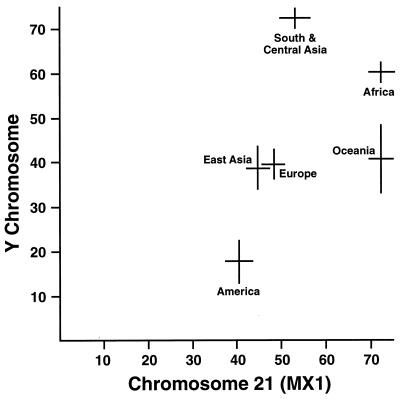
Despite mounting genetic evidence implicating a recent origin of modern humans, the elucidation of early migratory gene-flow episodes remains incomplete. Geographic distribution of haplotypes may show traces of ancestral migrations. However, such evolutionary signatures can be erased easily by recombination and mutational perturbations. A 565-bp chromosome 21 region near the MX1 gene, which contains nine sites frequently polymorphic in human populations, has been found. It is unaffected by recombination and recurrent mutation and thus reflects only migratory history, genetic drift, and possibly selection. Geographic distribution of contemporary haplotypes implies distinctive prehistoric human migrations: one to Oceania, one to Asia and subsequently to America, and a third one predominantly to Europe. The findings with chromosome 21 are confirmed by independent evidence from a Y chromosome phylogeny. Loci of this type will help to decipher the evolutionary history of modern humans.
Figures
References
-
- Wolpoff M H. Science. 1996;274:704–706. - PubMed
-
- Wolpoff M H. In: The Human Revolution: Behavioral and Biological Perspectives on the Origins of Modern Humans. Mellars P, Stringer C, editors. Edinburgh: Edinburgh Univ. Press; 1989. pp. 123–154.
-
- Cann R L, Stoneking M, Wilson A C. Nature (London) 1987;325:31–36. - PubMed
-
- Stringer C B. Nature (London) 1989;331:565–566. - PubMed
-
- Lahr M M. The Evolution of Human Diversity: A Study of Cranial Variation. Cambridge, MA: Cambridge Univ. Press; 1996.
Publication types
MeSH terms
Substances
Grants and funding
LinkOut - more resources
Full Text Sources
Other Literature Sources
