. 1999 Mar 30;96(7):4180-5.
doi: 10.1073/pnas.96.7.4180.

Characterization of maize (Zea mays L.) Wee1 and its activity in developing endosperm

Affiliations

Characterization of maize (Zea mays L.) Wee1 and its activity in developing endosperm

Y Sun et al. Proc Natl Acad Sci U S A. .

Abstract

We report the characterization of a maize Wee1 homologue and its expression in developing endosperm. Using a 0.8-kb cDNA from an expressed sequence tag project, we isolated a 1.6-kb cDNA (ZmWee1), which encodes a protein of 403 aa with a calculated molecular size of 45.6 kDa. The deduced amino acid sequence shows 50% identity to the protein kinase domain of human Wee1. Overexpression of ZmWee1 in Schizosaccharomyces pombe inhibited cell division and caused the cells to enlarge significantly. Recombinant ZmWee1 obtained from Escherichia coli is able to inhibit the activity of p13(suc1)-adsorbed cyclin-dependent kinase from maize. ZmWee1 is encoded by a single gene at a locus on the long arm of chromosome 4. RNA gel blots showed the ZmWee1 transcript is about 2.4 kb in length and that its abundance reaches a maximum 15 days after pollination in endosperm tissue. High levels of expression of ZmWee1 at this stage of endosperm development imply that ZmWee1 plays a role in endoreduplication. Our results show that control of cyclin-dependent kinase activity by Wee1 is conserved among eukaryotes, from fungi to animals and plants.


Figures
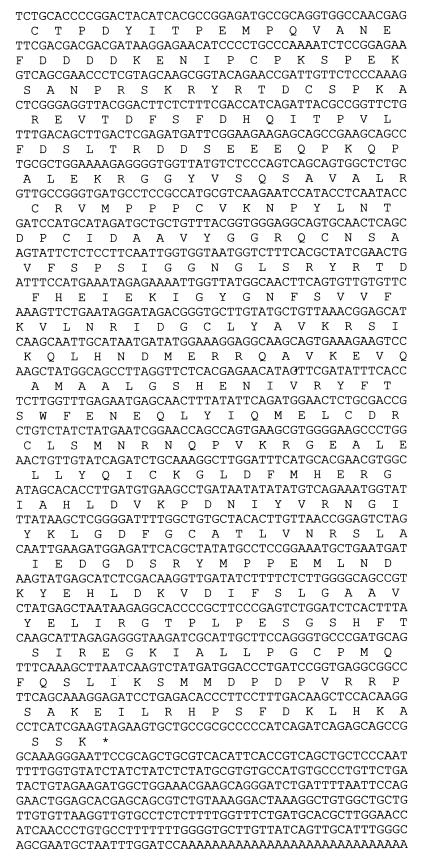
Figure 1
Figure 1
Nucleotide and amino acid sequences of maize Wee1.
Figure 2
Figure 2
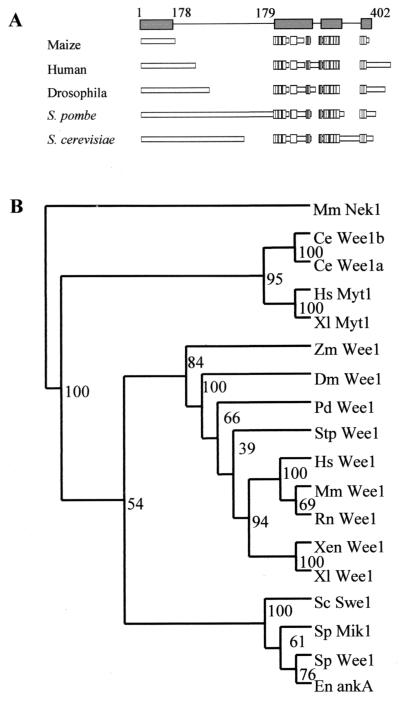
Sequence identity of Wee1 from maize, human, Drosophila, S. pombe, and S. cerevisiae, determined by the macaw computer program (A) and a phylogenic tree for ankA, Mik1, Myt1, Nek1, Swe1, and Wee1, created by clustalw (B). Amino acid sequences were obtained from the conceptual translations of GenBank files for the following gene names (species name, accession no.): Mm Nek1 (Mus musculus, S45828); Ce Wee1b (Caenorhabditis elegans, Z99277), Ce Wee1a (C. elegans, Z36752); Hs Myt1 (Homo sapiens, U56816); Xl Myt1 (Xenopus laevis, U28931); Zm Wee1 (this work); Dm Wee1 (Drosophila melanogaster, U17223); Pd Wee1 (Platynereis dumerilii, AJ224984); Stp Wee1 (Strongylocentrotus purpuratus, U43745); Hs Wee1 (H. sapiens, U10564); Mm Wee1 (M. musculus, D30743); Rn Wee1 (Rattus sp., D31838); Xen Wee1 (X. laevis, U13962); Xl Wee1 (X. laevis, AF035443); Sc Swe1 (S. cerevisiae, X73966); Sp Mik1 (S. pombe, M60834); Sp Wee1 (S. pombe, M16508); En ankA (Emericella nidulans, U25693).
Figure 3
Figure 3
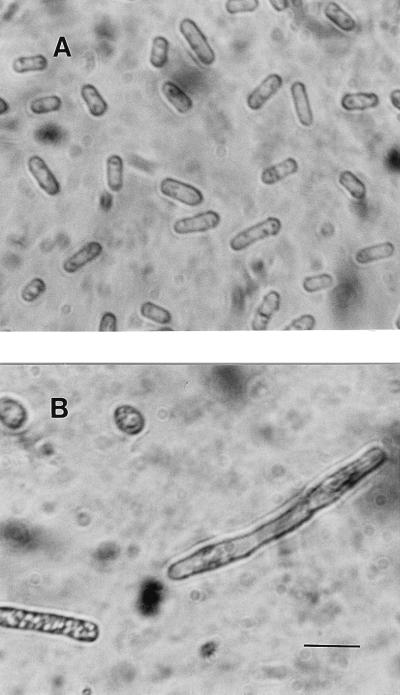
Overexpression of ZmWee1 in S. pombe causes cell enlargement. S. pombe cells were transformed with pREP1 (A) or pREP1 expressing ZmWee1 (B). Morphology of the cells was analyzed by light microscopy; both samples are shown at the same magnification.
Figure 4
Figure 4
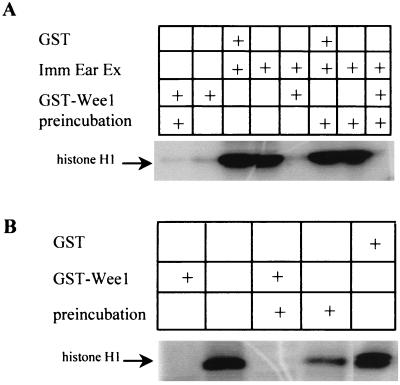
ZmWee1 inhibits CDK activity in vitro. GST-ZmWee1 fusion protein from E. coli was purified by affinity chromatography with glutathione agarose and added to a histone H1 phosphorylation reaction containing p13suc1-adsorbed CDK from immature maize ears (A) or total protein extract from immature ears (B). The autoradiograph indicates the degree of 32P-labeling of histone H1. ZmWee1 inhibited histone H1 kinase activity of the p13suc1-adsorbed CDK as well as that in immature ear extract.
Figure 5
Figure 5
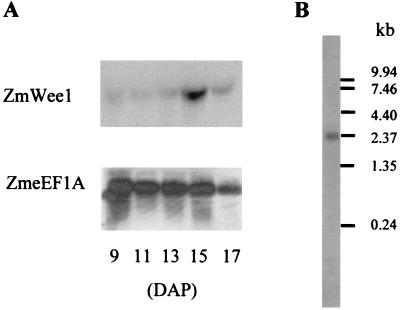
ZmWee1 RNA transcripts are increased in maize endosperm during the period of endoreduplication. RNA gel blot hybridization was performed with poly(A)+ RNA from maize endosperm isolated between 9 and 17 DAP (A) or with total RNA from seedlings (B). The abundance of ZmWee1 transcripts peaked at 15 DAP in developing endosperm, coincident with the peak of endoreduplication activity.

References

    1. Jacobs T. Dev Biol. 1992;153:1–15. - PubMed
    1. Sherr C J. Cell. 1994;79:551–555. - PubMed
    1. Nurse P. Cell. 1994;79:547–550. - PubMed
    1. Doerner P W. Plant Physiol. 1994;106:823–827. - PMC - PubMed
    1. Nasmyth K. Science. 1996;274:1643–1645. - PubMed

Publication types

MeSH terms

Associated data

LinkOut - more resources