. 1999 Mar 30;96(7):4192-7.
doi: 10.1073/pnas.96.7.4192.

Conversion of cucumber linoleate 13-lipoxygenase to a 9-lipoxygenating species by site-directed mutagenesis

Affiliations

Conversion of cucumber linoleate 13-lipoxygenase to a 9-lipoxygenating species by site-directed mutagenesis

E Hornung et al. Proc Natl Acad Sci U S A. .

Abstract

Multiple lipoxygenase sequence alignments and structural modeling of the enzyme/substrate interaction of the cucumber lipid body lipoxygenase suggested histidine 608 as the primary determinant of positional specificity. Replacement of this amino acid by a less-space-filling valine altered the positional specificity of this linoleate 13-lipoxygenase in favor of 9-lipoxygenation. These alterations may be explained by the fact that H608V mutation may demask the positively charged guanidino group of R758, which, in turn, may force an inverse head-to-tail orientation of the fatty acid substrate. The R758L+H608V double mutant exhibited a strongly reduced reaction rate and a random positional specificity. Trilinolein, which lacks free carboxylic groups, was oxygenated to the corresponding (13S)-hydro(pero)xy derivatives by both the wild-type enzyme and the linoleate 9-lipoxygenating H608V mutant. These data indicate the complete conversion of a linoleate 13-lipoxygenase to a 9-lipoxygenating species by a single point mutation. It is hypothesized that H608V exchange may alter the orientation of the substrate at the active site and/or its steric configuration in such a way that a stereospecific dioxygen insertion at C-9 may exclusively take place.


Figures
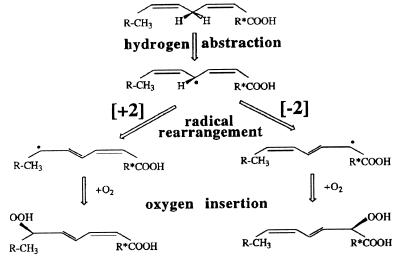
Figure 1
Figure 1
Specificity of LOX reaction with substrates containing one doubly allylic methylene. In this case, the specificity of the LOX reaction solely depends on the direction of the radical rearrangement. [+2] Radical rearrangement indicates that dioxygen is inserted at the second carbon atom in the direction of the methyl terminus of the substrate counted from the site of hydrogen removal. [−2] Indicates an inverse direction of radical rearrangement.
Figure 2
Figure 2
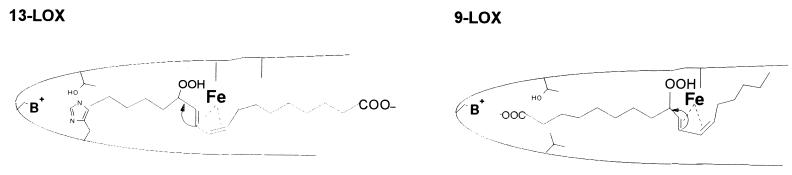
Straight- and inverse-substrate orientation at the active site of LOXs.
Figure 3
Figure 3
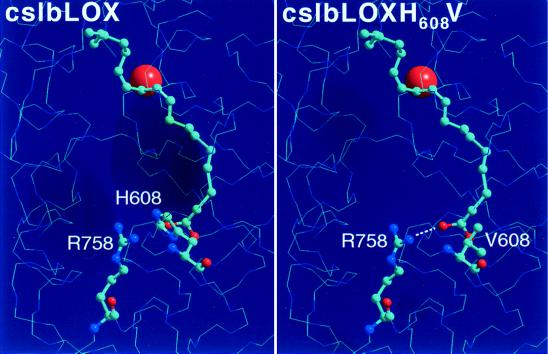
Model showing inverse-substrate binding with respect to the proposed mode of binding of the lipid body LOX and its H608V mutant. (Left) Active-site model of the lipid body LOX. Here, the methyl terminus of LA is nearby the side chain of H608. The charged R758 is shielded by H608. (Right) Model for the H608V mutant. When oriented inversely, the negatively charged carboxylic group of LA (red) may form a salt bridge (dotted line) with positively charged nitrogens (blue) of R758.
Figure 4
Figure 4
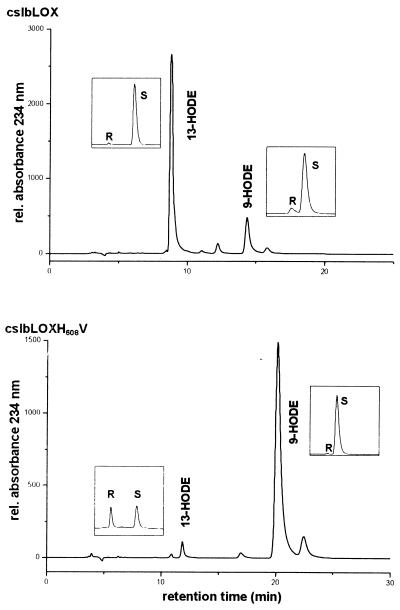
HPLC analysis of hydroxy fatty acids formed from LA by the lipid body LOX and its H608V mutant. Equal amounts of LOX protein were incubated with 0.9 mM LA at room temperature for 30 min. After reduction of lipids with sodium borohydride, the reaction mixture was acidified and the lipids were extracted. Oxygenated fatty acid derivatives were isolated by RP-HPLC, and positional isomers were analyzed by SP-HPLC. Ratios of S and R were determined by CP-HPLC (Insets).
Figure 5
Figure 5
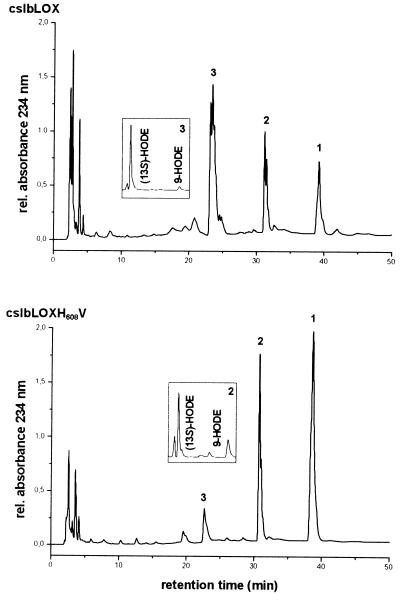
HPLC analysis of oxidized TL derivatives formed by the lipid body LOX and its H608V mutant. Equal amounts of LOX protein were incubated with an emulsion of 1.2 mM TL for 30 min. Lipids were reduced with sodium borohydride, and the reaction mixture was acidified. After extraction the lipids were analyzed by RP-HPLC. A representative chromatogram is shown. Numbers mark the resulting LOX-derived products: 1, TL derivative containing one oxygenated fatty acid; 2, doubly oxygenated TL isomers; and 3, triple-oxygenated TL. For analysis of positional isomers of the LA moieties, the free fatty acid derivatives were obtained by alkaline hydrolysis and isolated by RP-HPLC. Positional isomers of hydroxy LA (HODE) were given as molar ratios determined by SP-HPLC as shown in the Insets. Optical isomers were determined by CP-HPLC.

References

    1. Siedow J N. Annu Rev Plant Physiol Plant Mol Biol. 1991;42:145–188.
    1. Yamamoto S. Biochim Biophys Acta. 1992;1128:117–131. - PubMed
    1. Rosahl S. Z Naturforsch. 1996;51c:123–138. - PubMed
    1. Schewe T, Rapaport S M, Kühn H. Adv Enzymol Mol Biol. 1986;58:191–272. - PubMed
    1. Gardner H W. Biochim Biophys Acta. 1991;1084:221–239. - PubMed

Publication types