Twins and maternal smoking: ordeals for the fetal origins hypothesis? A cohort study
- PMID: 10102850
- PMCID: PMC27807
- DOI: 10.1136/bmj.318.7188.897
Twins and maternal smoking: ordeals for the fetal origins hypothesis? A cohort study
Abstract
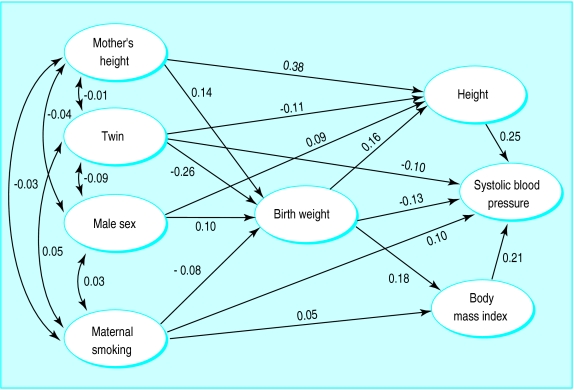
Objective: To assess the direct and indirect effects of being a twin, maternal smoking, birth weight, and mother's height on blood pressure at ages 9 and 18 years.
Design: Longitudinal study.
Subjects: Cohort born in 1972-3.
Setting: Dunedin, New Zealand.
Main outcome measure: Blood pressure at ages 9 and 18 years.
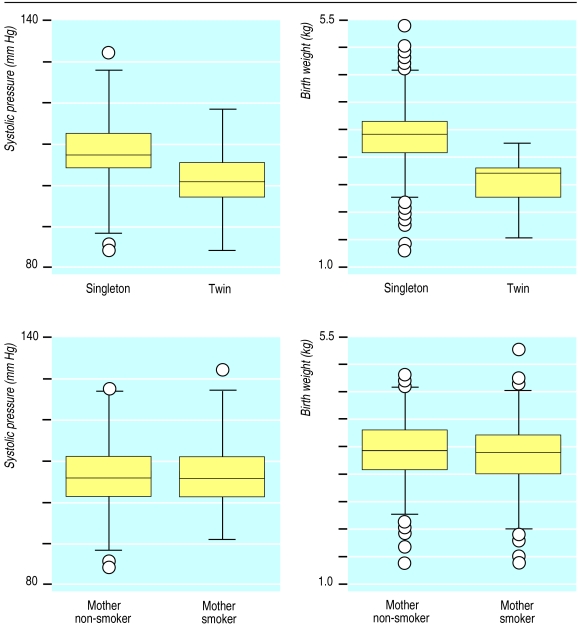
Results: Compared with singletons, twins had a systolic blood pressure 4.55 (95% confidence interval 1.57 to 7.52) mm Hg lower at age 9 after adjustment for direct and indirect effects of sex, maternal smoking, mother's height, socioeconomic status, and birth weight, as well as concurrent height and body mass index. Blood pressure in children whose mothers had smoked during pregnancy was 1.54 (0.46 to 2.62) mm Hg higher than in those whose mothers did not. The total effect of birth weight on systolic blood pressure at age 9 was -0.78 (-1.76 to 0.20) mm Hg and that for mother's height was 0.10 (0.06 to 0.14) mm Hg. Similar results were obtained for systolic blood pressure at age 18. The total effect of twins, maternal smoking, and birth weight on diastolic blood pressure was not significant at either age.
Conclusions: Twins had lower birth weight and lower systolic blood pressure at ages 9 and 18 than singletons. This finding challenges the fetal origins hypothesis. The effect of maternal smoking was consistent with the fetal origin hypothesis in that the infants of smokers were smaller and had higher blood pressure at both ages. This may be explained by pharmacological rather than nutritional effects. The total effect of birth weight on systolic blood pressure, after its indirect effect working through concurrent measures of height and body mass index was taken into account, was small.
Figures
Comment in
-
Ordeals for the fetal programming hypothesis. The hypothesis largely survives one ordeal but not another.BMJ. 1999 Apr 3;318(7188):885-6. doi: 10.1136/bmj.318.7188.885. BMJ. 1999. PMID: 10102828 Free PMC article. No abstract available.
-
Twins and the fetal origins hypothesis. Many variables differ between twins and singleton infants.BMJ. 1999 Aug 21;319(7208):517; author reply 517-8. BMJ. 1999. PMID: 10454414 Free PMC article. No abstract available.
-
Twins and the fetal origins hypothesis. Patterns of growth retardation differ in twins and singletons.BMJ. 1999 Aug 21;319(7208):517; author reply 517-8. BMJ. 1999. PMID: 10507859 No abstract available.
-
Twins and the fetal origins hypothesis. Fetal insult may cause vascular changes and growth retardation.BMJ. 1999 Aug 21;319(7208):517-8. BMJ. 1999. PMID: 10507860 No abstract available.
References
-
- Barker DJP. Mothers, babies, and disease in later life. London: BMJ; 1994.
-
- Williams SM, St George IM, Silva PA. Intrauterine growth retardation and blood pressure at age seven and eighteen. J Clin Epidemiol. 1992;45:1257–1263. - PubMed
Publication types
MeSH terms
LinkOut - more resources
Full Text Sources
Medical