. 1999 Feb;126(4):979-88.
doi: 10.1038/sj.bjp.0702387.

The effects of phosphodiesterase type 4 inhibitors on tumour necrosis factor-alpha and leukotriene B4 in a novel human whole blood assay

Affiliations

The effects of phosphodiesterase type 4 inhibitors on tumour necrosis factor-alpha and leukotriene B4 in a novel human whole blood assay

C Brideau et al. Br J Pharmacol. 1999 Feb.

Abstract

1. The aim of this study was to assess the inhibitory activities of phosphodiesterase type 4 (PDE4) inhibitors on tumour necrosis factor-alpha (TNF-alpha) and leukotriene B4 (LTB4) production in a novel human whole blood assay. 2. Lipopolysaccharide (LPS) stimulation of human whole blood caused a time dependent increase in TNF-alpha and prostaglandin E2 (PGE2) plasma levels. Inhibition of LPS-induced TNF-alpha by the selective PDE4 inhibitor RP73401 was proportionally enhanced with endogenous PGE2 (maximal after 24 h). In contrast, blocking endogenous PGE2 production with indomethacin in blood stimulated with LPS for 24 h decreased the potency of RP73401 to that observed with a 4 h LPS incubation. 3. Non-selective and selective PDE4 inhibitors showed greater inhibition of LPS-induced TNF-alpha after 24 h compared to 4 h. Stereoselectivity was only achieved in the 24 h method. 4. LPS-stimulation of whole blood for either 30 min or 24 h followed by N-formyl-Met-Leu-Phe (fMLP) activation resulted in low plasma LTB4 levels. Combination of both treatments resulted in a greater than 7 fold increase in plasma LTB4 levels. Inhibition of the double LPS and fMLP-activated LTB4 production was observed with non-selective and PDE4-selective inhibitors. Their LTB4 inhibitory potencies were similar to that observed in the 24 h LPS-induced TNF-alpha assay. Thus, stimulation of human whole blood with two LPS stimulations followed by fMLP gives rise to both TNF-alpha and LTB4 and their inhibition by various compounds can be assessed in the same blood sample. 5. Calcium ionophore (A23187) stimulation of whole blood resulted in plasma LTB4 levels similar to the double LPS and fMLP method. Inhibition of A23187-induced LTB4 biosynthesis was also achieved by PDE4-selective inhibitors as well as the direct 5-lipoxygenase (5-LO) inhibitor L-739,010. 6. These results confirm the anti-inflammatory properties of PDE4 inhibitors. Thus, this novel human whole blood can be used to assess the biochemical efficacy of PDE4 inhibitors in human subjects.


Figures
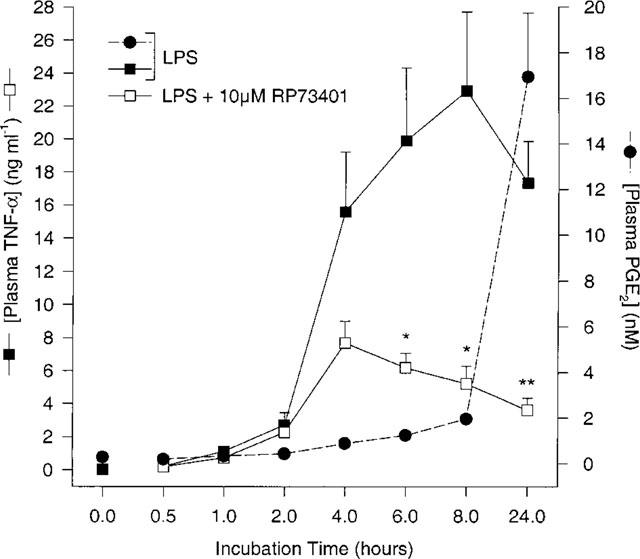
Figure 1
Figure 1
Time course of TNF-α and PGE2 production in human whole blood following LPS (1 μg ml−1) incubation in the presence or absence of a PDE4 inhibitor (10 μM RP73401). n=3 donors, *P<0.05 and **P<0.01 vs LPS-induced TNF-α alone.
Figure 2
Figure 2
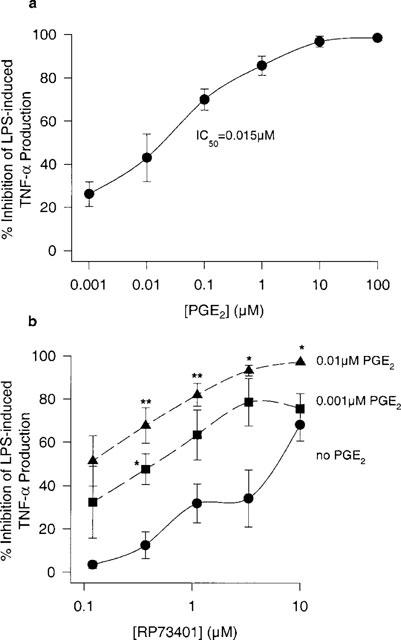
The potentiation of the inhibitory effect of a PDE4 inhibitor (RP73401) by exogenous PGE2 on LPS-induced TNF-α production (4 h incubation). (a) Effect of exogenous PGE2 alone. (b) Effect of RP73401 in the absence or presence of PGE2. n=3 donors. *P<0.05 and **P<0.01 vs RP73401 alone.
Figure 3
Figure 3
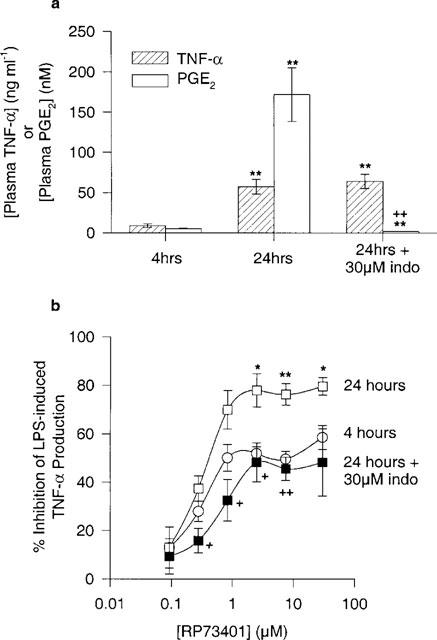
Comparison between 4 and 24 h incubation of human whole blood with 1 μg ml−1 LPS in addition to a 24 h LPS incubation in the presence of 30 μM indomethacin. (a) plasma TNF-α and PGE2 levels and (b) effect of RP73401 on LPS-induced TNF-α. Experiments performed in same blood sample. n=3 donors. *P<0.05 and **P<0.01 vs 4 h incubation and +P<0.05 and ++P<0.01 vs 24 h LPS only.
Figure 4
Figure 4
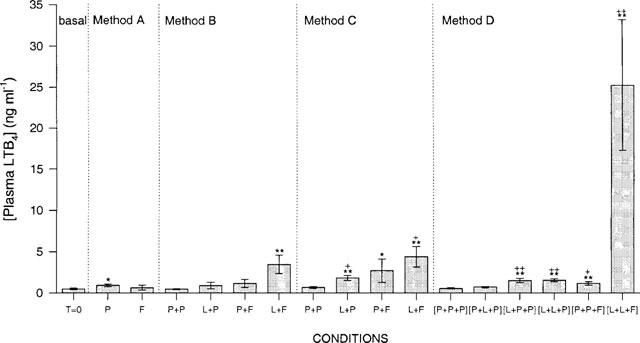
Plasma LTB4 levels from different conditions. Basal represents unstimulated blood plasma at time 0. P=PBS (blanks), L=LPS (1 μg ml−1) and F=fMLP (1 μM). Method A: human whole blood stimulated with fMLP for 15 min. Method B: pre-stimulation with either PBS or LPS (first letter on graph) for 30 min followed by incubation with either PBS or fMLP for 15 min (second letter on graph). Method C: pre-stimulation with either PBS or LPS for 24 h (first letter on graph) followed by incubation with either PBS or fMLP for 15 min (second letter on graph). Method D: pre-stimulation with either PBS or LPS (first letter on graph) for 24 h, then a 30 min stimulation with either PBS or LPS (second letter on graph) followed by incubation with either PBS or fMLP (third letter on graph) for 15 min. n=3–6 donor. *P<0.05 and **P<0.01 vs time 0 and +P<0.05 and ++P<0.01 vs PBS blank for each condition.
Figure 5
Figure 5
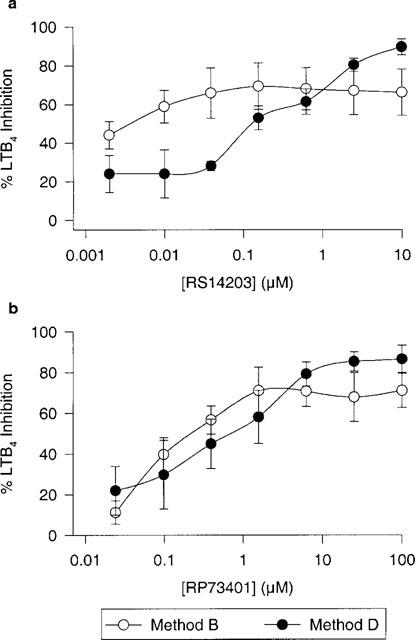
Comparison between two methods of fMLP-stimulated LTB4 human whole blood assays using two different PDE4 inhibitors (RS14203 and RP73401). Method B: whole blood pre-stimulated with LPS (1 μg ml−1) for 30 min followed by 15 min incubation with fMLP (1 μM) and Method D: whole blood pre-stimulated with LPS (1 μg ml−1) for 24 h followed by 30 min stimulation with LPS (1 μg ml−1) then a 15 min incubation with fMLP (1 μM). n=3 donors. Both methods were performed in the same donor sample.
Figure 6
Figure 6
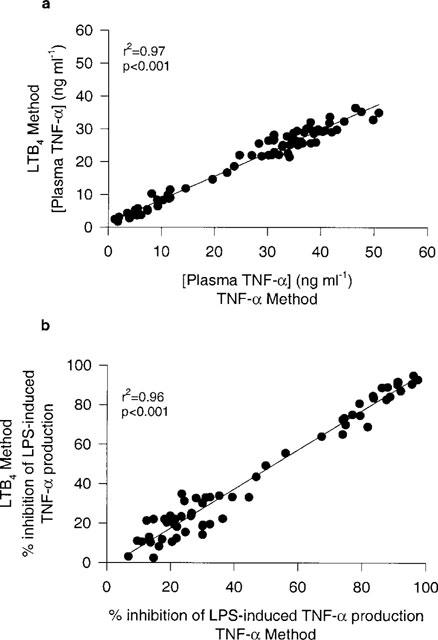
Linear correlation of results obtained from two methods of LPS-induced TNF-α in human whole blood. TNF-α Method: whole blood samples incubated with LPS (1 μg ml−1) for 24 h. LTB4 Method D: whole blood samples incubated with LPS (1 μg ml−1) for 24 h followed by 30 min incubation of LPS (1 μg ml−1) then a 15 min incubation with fMLP (1 μM). (a) represents plasma TNF-α levels from an experiment where both methods were done in the same blood sample in the presence and absence of varying concentrations of 10 different PDE4 inhibitors. n=71 data points. (b) represents the percentage inhibition of TNF-α of the same data points (except data points from positive no drug controls from which the percentage inhibition was calculated). n=61 data points. All data represented were blood samples from one donor.
Figure 7
Figure 7
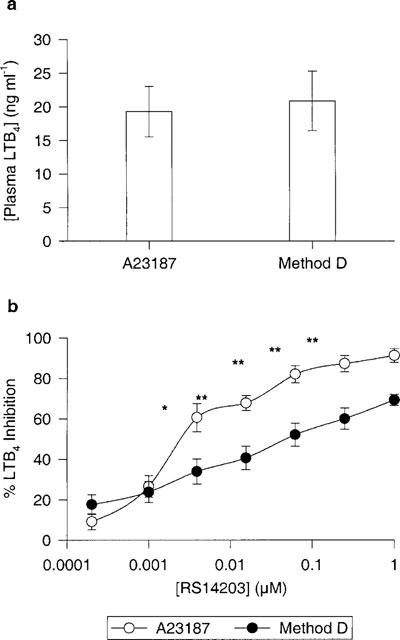
Comparison between two methods of LTB4 human whole blood assays. (a) represents plasma LTB4 levels for both assays and (b) represents the titration curve for RS14203 in both assays. A23187 method: whole blood challenged with 25 μM A23187 for 30 min. Method D: whole blood pre-stimulated with LPS (1 μg ml−1) for 24 h followed by 30 min stimulation with LPS (1 μg ml−1) then a 15 min incubation with fMLP (1 μM). n=3 donors. Both methods were performed in the same donor sample. *P<0.05 and **P<0.01.

References

    1. ARIAS-NEGRETE S., KELLER K., CHADEE K. Proinflammatory cytokines regulate cyclooxygenase-2 mRNA expression in human macrophages. Biochem. Biophys. Res. Commun. 1995;208:582–589. - PubMed
    1. BANNER K.H., MORIGGI E., DA ROS B., SCHIOPPACASSI G., SEMERARO C., PAGE C.P. The effect of selective phosphodiesterase 3 and 4 isoenzyme inhibitors and established anti-asthma drugs on inflammatory cell activation. Br. J. Pharmacol. 1996;119:1255–1261. - PMC - PubMed
    1. BATTEN P., YACOUB M.H., ROSE M.L. Effect of human cytokines (IFN-gamma, TNF-alpha, IL-1 beta, IL-4) on porcine endothelial cells: induction of MHC and adhesion molecules and functional significance of these changes. Immunology. 1996;87:127–133. - PMC - PubMed
    1. BEUTLER B., CERAMI A. The biology of cachectin/TNF-a primary mediator of the host response. Annu. Rev. Immunol. 1989;7:625–655. - PubMed
    1. BORGEAT P., SAMUELSSON B. Arachidonic acid metabolism in polymorphonuclear leukocytes: effects of ionophore A23187. Proc. Natl. Acad. Sci. U.S.A. 1979;76:2148–2152. - PMC - PubMed

MeSH terms

LinkOut - more resources