. 1999 May;73(5):3718-22.
doi: 10.1128/JVI.73.5.3718-3722.1999.

Activation of the grp78 and grp94 promoters by hepatitis C virus E2 envelope protein

Affiliations

Activation of the grp78 and grp94 promoters by hepatitis C virus E2 envelope protein

E Liberman et al. J Virol. 1999 May.

Abstract

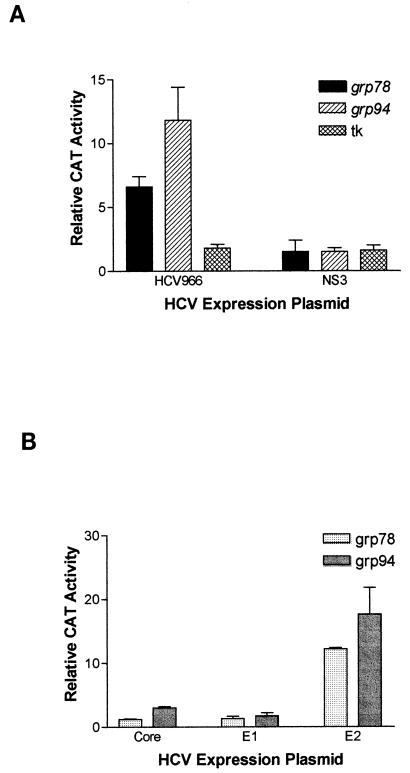
The hepatitis C virus E1 and E2 envelope proteins are targeted to the endoplasmic reticulum, but instead of being secreted, they are retained in a pre-Golgi compartment, at least partly in a misfolded state. Since secretory proteins which are retained in the endoplasmic reticulum frequently can activate the transcription of intraluminal chaperone proteins, we measured the effect of the E1 and E2 proteins on the promoters of two such chaperones, GRP78 (BiP) and GRP94. We found that E2 but not E1 protein activates these two promoters, as assayed by a reporter gene system. Furthermore, E2 but not E1 protein induces the synthesis of GRP78 from the endogenous cellular gene. We also found that E2 but not E1 protein expressed in mammalian cells is bound tightly to GRP78. This association may explain the ability of E2 protein to activate transcription, since GRP78 has been postulated to be a sensor of stress in the endoplasmic reticulum. Since overexpression of GRP78 has been shown to decrease the sensitivity of cells to killing by cytotoxic T lymphocytes and to increase tumorigenicity and resistance to antitumor drugs, this activity of E2 protein may be involved in the pathogenesis of hepatitis C virus-induced diseases.


Figures
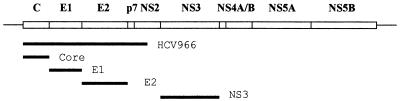
FIG. 1
FIG. 1
Map of the HCV genome, with the untranslated regions shown as lines and the open reading frame shown as a box divided into the final protein products. The thick lines indicate the regions included in the various expression plasmids used in this study.
FIG. 2
FIG. 2
(A) Effects of various HCV proteins on CAT expression driven by the grp78, grp94, or tk promoter in transient transfection into HuH-7 hepatoma cells. The results are normalized to CAT expression in the presence of pUC19 and are shown as the means and standard deviations from three transfections. (B) Effects of the individual HCV structural proteins on CAT expression driven by the grp78 or grp94 promoter in transient transfection into HuH-7 hepatoma cells. The results are normalized to CAT expression in the presence of pUC19 and are shown as the means and standard deviations from three transfections.
FIG. 3
FIG. 3
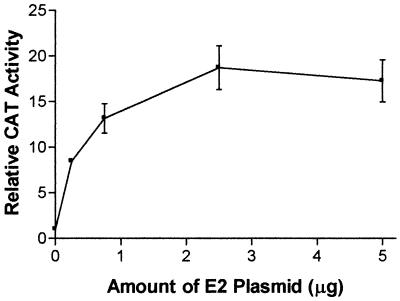
Titration of the amount of E2-expressing plasmid cotransfected with the CAT plasmid driven by the grp94 promoter into HuH-7 cells. The total amount of transfected plasmids was held constant by using pUC19. The results are normalized to CAT expression in the presence of pUC19 only and are shown as the means and standard deviations from three transfections.
FIG. 4
FIG. 4
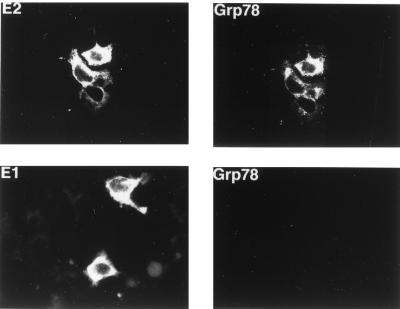
Immunofluorescence detection of GRP78 and E2 or E1 protein expression in HuH-7 cells transiently transfected with either the E2 (top) or E1 (bottom) expression plasmid. A low level of GRP78 is detectable in the untransfected cells, as revealed in the original photographs.
FIG. 5
FIG. 5
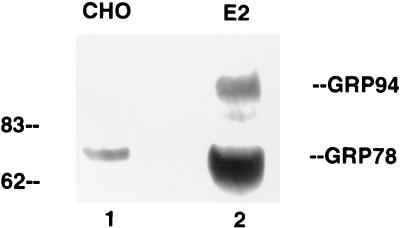
Western blot detection of GRP78 and GRP94 in CHO cells (lane 1) or CHO cells stably expressing E2 protein (lane 2). Equal amounts of total cell extracts were separated by SDS-polyacrylamide gel electrophoresis and transferred to a nitrocellulose membrane for Western blotting against GRP78. The monoclonal antibody against GRP78 (StressGen SPA826) cross-reacts with GRP94. Numbers on the left are molecular weights in thousands.
FIG. 6
FIG. 6
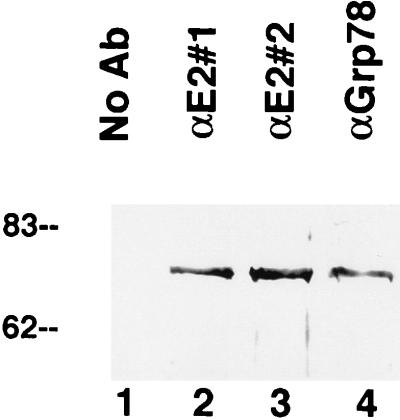
Coimmunoprecipitation of E2 protein and GRP78. Proteins were immunoprecipitated from lysates of E2-expressing CHO cells with either of two different antibodies (Ab) to E2 protein (lanes 2 and 3) or an antibody to GRP78 (αGrp78) (lane 4), electrophoresed on an SDS-polyacrylamide gel, and probed for GRP78 by Western blotting. GRP78 was precipitated by all three antibodies; in contrast, no GRP78 was precipitated when the antibody was omitted (lane 1). Numbers on the left are molecular weights in thousands.
FIG. 7
FIG. 7
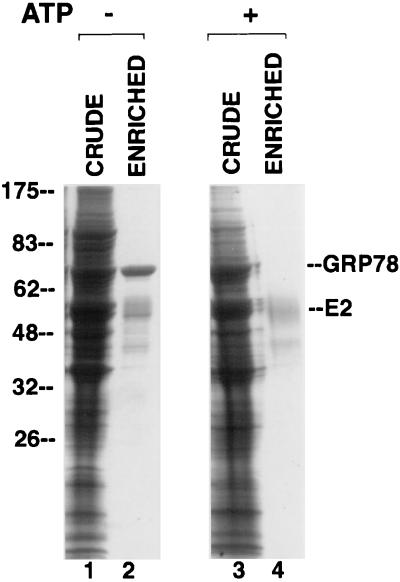
Copurification of E2 protein and GRP78 in the absence but not the presence of Mg-ATP. Lysates from E2-expressing CHO cells were electrophoresed on an SDS-polyacrylamide gel and stained with Coomassie blue, either before (lanes 1 and 3) or after (lanes 2 and 4) chromatography on a GNA lectin column. In lanes 3 and 4, the lysate was preincubated with Mg-ATP for 15 min. Numbers on the left are molecular weights in thousands.
FIG. 8
FIG. 8
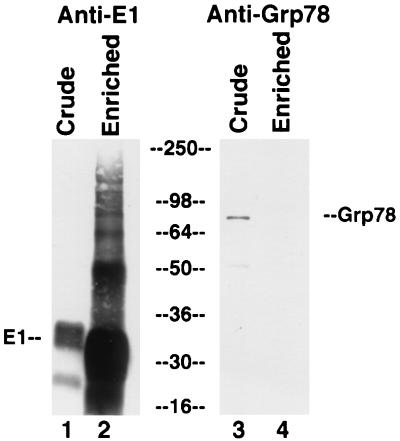
No evidence for copurification of E1 protein and GRP78. Lysates from E1-expressing CHO cells were electrophoresed on an SDS-polyacrylamide gel, transferred to a membrane, and probed for E1 protein (lanes 1 and 2) or GRP78 (lanes 3 and 4) by Western blotting, either before (lanes 1 and 3) or after (lanes 2 and 4) chromatography on a GNA lectin column. Numbers in the center are molecular weights in thousands.

References

    1. Burns K, Duggan B, Atkinson E A, Famulski K S, Nemer M, Bleackley R C, Michalak M. Modulation of gene expression by calreticulin binding to the glucocorticoid receptor. Nature. 1994;367:476–480. - PubMed
    1. Chapman B S, Thayer R M, Vincent K A, Haigwood N L. Effect of intron A from human cytomegalovirus (Towne) immediate-early gene on heterologous expression in mammalian cells. Nucleic Acids Res. 1991;19:3979–3986. - PMC - PubMed
    1. Chatterjee S, Cheng M F, Berger S J, Berger N A. Induction of M(r) 78,000 glucose-regulated stress protein in poly(adenosine diphosphate-ribose) polymerase- and nicotinamide adenine dinucleotide-deficient V79 cell lines and its relation to resistance to the topoisomerase II inhibitor etoposide. Cancer Res. 1994;54:4405–4411. - PubMed
    1. Choo Q L, Kuo G, Weiner A J, Overby L R, Bradley D W, Houghton M. Isolation of a cDNA clone derived from a blood-borne non-A, non-B viral hepatitis genome. Science. 1989;244:359–362. - PubMed
    1. Choukhi A, Ung S, Wychowski C, Dubuisson J. Involvement of endoplasmic reticulum chaperones in the folding of hepatitis C virus glycoproteins. J Virol. 1998;72:3851–3858. - PMC - PubMed

Publication types

MeSH terms

LinkOut - more resources