. 1999 Apr;10(4):875-90.
doi: 10.1091/mbc.10.4.875.

Distinct domains within Vps35p mediate the retrieval of two different cargo proteins from the yeast prevacuolar/endosomal compartment

Affiliations
Free PMC article

Distinct domains within Vps35p mediate the retrieval of two different cargo proteins from the yeast prevacuolar/endosomal compartment

S F Nothwehr et al. Mol Biol Cell. 1999 Apr.
Free PMC article

Abstract

Resident membrane proteins of the trans-Golgi network (TGN) of Saccharomyces cerevisiae are selectively retrieved from a prevacuolar/late endosomal compartment. Proper cycling of the carboxypeptidase Y receptor Vps10p between the TGN and prevacuolar compartment depends on Vps35p, a hydrophilic peripheral membrane protein. In this study we use a temperature-sensitive vps35 allele to show that loss of Vps35p function rapidly leads to mislocalization of A-ALP, a model TGN membrane protein, to the vacuole. Vps35p is required for the prevacuolar compartment-to-TGN transport of both A-ALP and Vps10p. This was demonstrated by phenotypic analysis of vps35 mutant strains expressing A-ALP mutants lacking either the retrieval or static retention signals and by an assay for prevacuolar compartment-to-TGN transport. A novel vps35 allele was identified that was defective for retrieval of A-ALP but functional for retrieval of Vps10p. Moreover, several other vps35 alleles were identified with the opposite characteristics: they were defective for Vps10p retrieval but near normal for A-ALP localization. These data suggest a model in which distinct structural features within Vps35p are required for associating with the cytosolic domains of each cargo protein during the retrieval process.


Figures
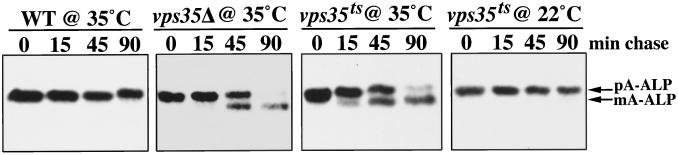
Figure 1
Figure 1
A-ALP is processed rapidly in a vps35-ts strain after shifting to the nonpermissive temperature. Wild-type (SNY36–9A), vps35Δ (SNY79), and vps35-ts (PBY4) yeast strains carrying a CEN plasmid directing expression of A-ALP (pSN55) were analyzed. The strains were grown for several doublings at 22°C, preincubated at 35°C for 10 min, and then pulsed with [35S]methionine/cysteine for 10 min before unlabeled amino acids were added to initiate the chase. At the indicated times A-ALP was immunoprecipitated from the cultures and analyzed by SDS-PAGE and fluorography. The positions of unprocessed pro-A-ALP (pA-ALP) and mature A-ALP (mA-ALP) are indicated.
Figure 2
Figure 2
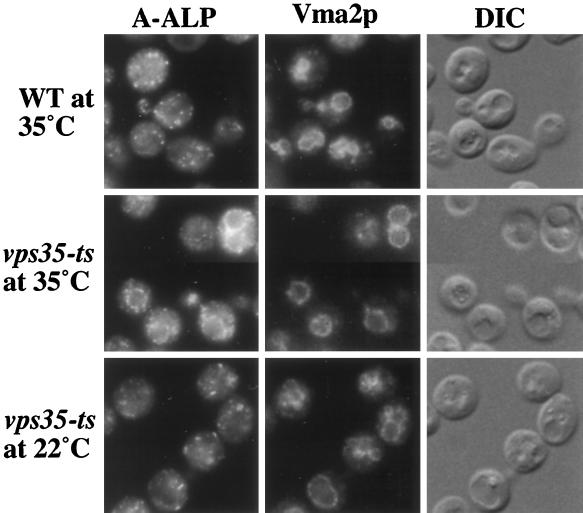
A-ALP is mislocalized to the vacuole in vps35-ts mutant cells. Wild-type (SNY17) and vps35-ts (PBY4) strains carrying a CEN plasmid directing expression of A-ALP (pSN55) were propagated for several doublings at 22°C before being shifted to 35°C for 40 min or incubated at 22°C for 40 min (as indicated). The cells were then fixed, spheroplasted, and costained with antibodies against ALP and Vma2p. After subsequent treatment with fluorochrome-conjugated secondary antibodies, the cells were viewed by DIC optics and by epifluorescence through filters specific for FITC and Texas Red.
Figure 3
Figure 3
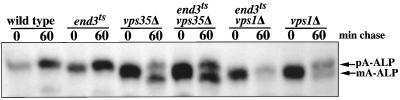
The delivery of A-ALP to the vacuole in vps35Δ cells does not require the early endocytic pathway. Wild-type (SNY36–9A), end3-ts (SNY94), vps35Δ (SNY79), end3-ts vps35Δ (LSY9–5B), vps1Δ (SNY38), and end3-ts vps1Δ (SNY96–9D) cells carrying a plasmid expressing A-ALP (pSN55) were analyzed. Each strain was propagated at 22°C for several doublings before being preincubated at 37°C for 10 min, and then pulsed with [35S]methionine/cysteine for 10 min and chased by the addition of unlabeled amino acids. At the indicated times A-ALP was immunoprecipitated from the cultures and analyzed by SDS-PAGE and fluorography. The positions of unprocessed pro-A-ALP (pA-ALP) and mature A-ALP (mA-ALP) are indicated.
Figure 4
Figure 4
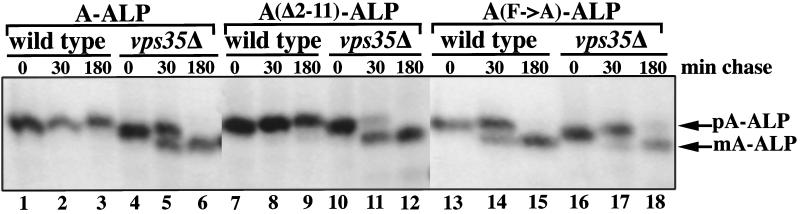
Phenotypes resulting from a loss of Vps35p function combined with a retrieval-defective, or static retention-defective, A-ALP mutant indicate a role for Vps35p in retrieval. Wild-type (SNY17) and vps35Δ (SNY79) strains carrying plasmids expressing A-ALP (pSN55; lanes 1–6), A(Δ2–11)-ALP (pAH49; lanes 7–12), or A(F85A; F87A)-ALP (pSN100; lanes 13–18) were propagated at 30°C, radioactively pulsed for 10 min and chased, and at the indicated times wild-type or mutant A-ALP was immunoprecipitated. Samples were analyzed using SDS-PAGE and fluorography.
Figure 5
Figure 5
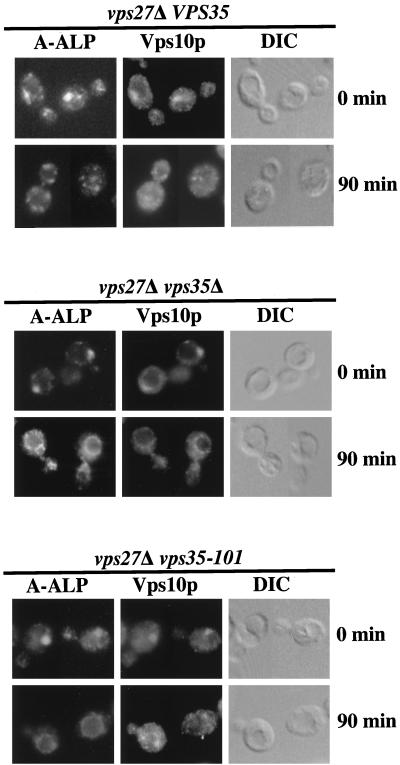
Vps35p is required for retrieval of A-ALP and Vps10p from the prevacuolar compartment to the Golgi. vps27Δ (AHY65), vps27Δ vps35Δ (AHY68), and vps27Δ vps35–101 (AHY69) strains containing CEN plasmids directing expression of A-ALP (pAH16) and containing the VPS27 gene under GAL1 promoter control (pHY5) were propagated in media containing raffinose as a carbon source. At the 0-min time point the cultures were adjusted to 2% galactose to induce expression of VPS27. After 0 and 90 min after galactose addition, cells were fixed, spheroplasted, and costained with antibodies against ALP and Vps10p. After subsequent treatment with fluorochrome-conjugated secondary antibodies, the cells were viewed by DIC optics and by epifluorescence through filters specific for FITC and Texas Red.
Figure 6
Figure 6
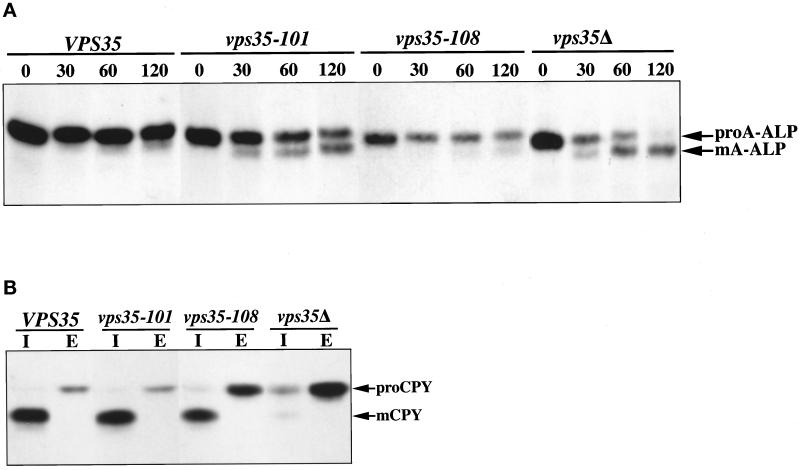
The vps35–101 and vps35–108 alleles exhibit specific defects in A-ALP and Vps10p trafficking, respectively. The VPS35, vps35–101, vps35–108, and vps35Δ yeast strains correspond to the following strain/plasmid combinations, respectively: SNY79/pSN54/pLS13, SNY79/pSN54/pLS12, SNY79/pSN54/pPB7–010.4, and PBY3/pSN54 (please refer to Tables 1 and 2 for strain and plasmid information). (A) The strains were pulsed for 10 min, chased for the indicated times, and subjected to A-ALP immunoprecipitation as detailed in the legend of Figure 4. (B) The strains were pulsed with [35S]methionine/cysteine for 10 min, and then chased for 45 min with unlabeled amino acids. CPY was immunoprecipitated from intracellular (I) and extracellular (E) fractions and analyzed by SDS-PAGE and fluorography. The positions of precursor (proCPY) and mature (mCPY) forms of CPY are indicated.
Figure 7
Figure 7
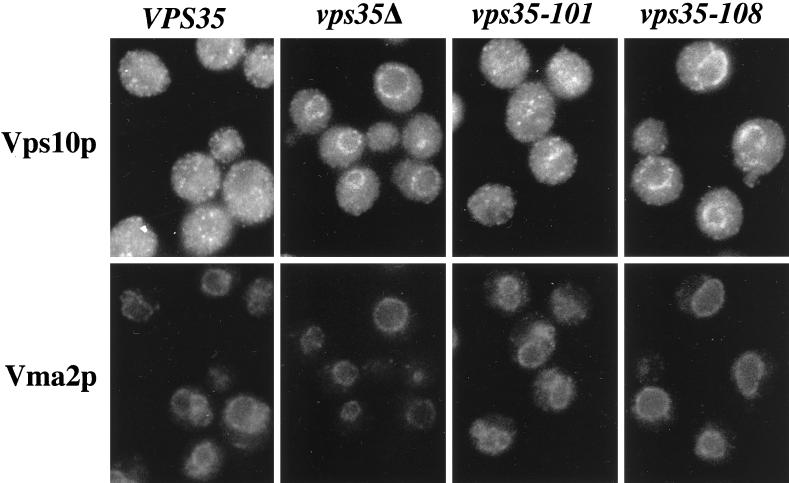
Vps10p is properly localized in a vps35–101 strain but is mislocalized to the vacuole in a vps35–108 strain. VPS35 (LSY6–2A/pLS13), vps35Δ (LSY6–2A), vps35–101 (LSY6–2A/pLS12), and vps35–108 (LSY6–2A/pPB7–010.4) strains were fixed, spheroplasted, and costained with antibodies against Vps10p and Vma2p. After subsequent treatment with fluorochrome-conjugated secondary antibodies, the cells were viewed by DIC optics and by epifluorescence through filters specific for FITC and Texas Red.
Figure 8
Figure 8
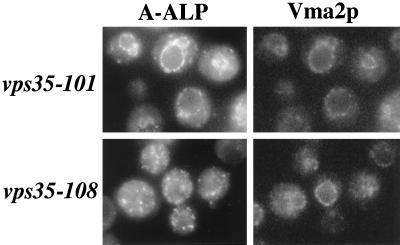
A-ALP is mislocalized to the vacuole in a vps35–101 strain but exhibits Golgi staining in a vps35–108 strain. vps35–101 (SNY79/pLS12/pAH16) and vps35–108 (SNY79/pPB7–010.4/pAH16) strains were fixed, spheroplasted, and costained with antibodies against A-ALP and Vma2p. After treatment with fluorochrome-conjugated secondary antibodies, the cells were viewed by DIC optics and by epifluorescence through filters specific for FITC and Texas Red.
Figure 9
Figure 9
Membrane association of wild-type and mutant Vps35 proteins. Spheroplasts from a vps35Δ strain (PBY1) carrying plasmids encoding either the wild-type (pLS13), vps35–101 (pLS12), vps35–103 (pPB7–9.7), vps35–104 (pPB7–10.1), vps35–107 (pPB7–108.5), or vps35–108 (pPB7–010.4) alleles were pulsed for 45 min with [35S]methionine/cysteine and chased for 15 min with unlabeled amino acids. The spheroplasts were then lysed, and lysates were centrifuged at 13,000 × g to generate a pellet fraction (P13). The supernatant was then centrifuged at 150,000 × g to generate pellet (P150) and supernatant (S150) fractions. Wild-type and mutant Vps35p were immunoprecipitated from each fraction and analyzed by SDS-PAGE and fluorography. The relative percentage of Vps35p present in each fraction as determined by Phosphorimager analysis is indicated below each panel.
Figure 10
Figure 10
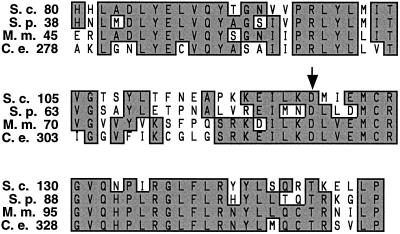
The mutation responsible for the vps35–101 phenotype eliminates a conserved Asp residue. A comparison of the most conserved region of the S. cerevisiae Vps35p (S.c.) sequence with its S. pombe (S.p.), M. musculus (M.m.), and C. elegans (C.e.) homologues is shown. The numbers refer to the amino acid residue number of each sequence. The shaded boxes indicate the most highly conserved residues. The arrowhead indicates the conserved D123 residue that was mutated to N in the vps35–101 allele.

References

    1. Abeliovich H, Grote E, Novick P, Ferronovick S. Tlg2p, a yeast syntaxin homolog that resides on the Golgi and endocytic structures. J Biol Chem. 1998;273:11719–11727. - PubMed
    1. Becherer KA, Rieder SE, Emr SD, Jones EW. Novel syntaxin homologue, Pep12p, required for the sorting of lumenal hydrolases to the lysosome-like vacuole in yeast. Mol Biol Cell. 1996;7:579–594. - PMC - PubMed
    1. Bednarek SY, Ravazzola M, Hosobuchi M, Amherdt M, Perrelet A, Schekman R, Orci L. COPI- and COPII-coated vesicles bud directly from the endoplasmic reticulum in yeast. Cell. 1995;83:1183–1196. - PubMed
    1. Bénédetti H, Raths S, Crausaz F, Riezman H. The END3 gene encodes a protein that is required for the internalization step of endocytosis and for actin cytoskeleton organization in yeast. Mol Biol Cell. 1994;5:1023–1037. - PMC - PubMed
    1. Boeke JD, LaCroute F, Fink GR. A positive selection for mutants lacking orotidine-5′-phosphate decarboxylase activity in yeast: 5-fluoroorotic acid resistance. Mol Gen Genet. 1984;197:345–346. - PubMed

Publication types

MeSH terms

LinkOut - more resources