. 1999 May 1;19(9):3423-9.
doi: 10.1523/JNEUROSCI.19-09-03423.1999.

Regulation of calcitonin gene-related peptide secretion by a serotonergic antimigraine drug

Affiliations

Regulation of calcitonin gene-related peptide secretion by a serotonergic antimigraine drug

P L Durham et al. J Neurosci. .

Abstract

We have investigated the regulation of calcitonin gene-related peptide (CGRP) release from trigeminal neurons by the serotonergic antimigraine drug sumatriptan. Serum levels of the neuropeptide CGRP are elevated during migraine. Treatment with the drug sumatriptan returns CGRP levels to normal coincident with the alleviation of headache. However, despite this clinical efficacy, the cellular target and mechanism of sumatriptan action are not well understood beyond the pharmacology of its recognition of the 5-HT1 class of serotonin receptors. We have used cultured trigeminal neurons to demonstrate that sumatriptan can directly repress CGRP secretion from sensory neurons. The stimulated secretion in response to depolarization or inflammatory agents was inhibited, but not the basal secretion rate. Unexpectedly, sumatriptan did not lower cAMP levels, in contrast to the classical role ascribed to the 5-HT1 receptors. Instead, activation of 5-HT1 receptors caused a slow and remarkably prolonged increase in intracellular calcium. The inhibition of CGRP secretion is attenuated by the phosphatase inhibitor okadaic acid, suggesting that sumatriptan action is mediated by calcium-recruited phosphatases. These results suggest that 5-HT1 agonists may block a deleterious feedback loop in migraine at the trigeminal neurons and provide a general mechanism by which this class of drugs can attenuate stimulated neuropeptide release.


Figures
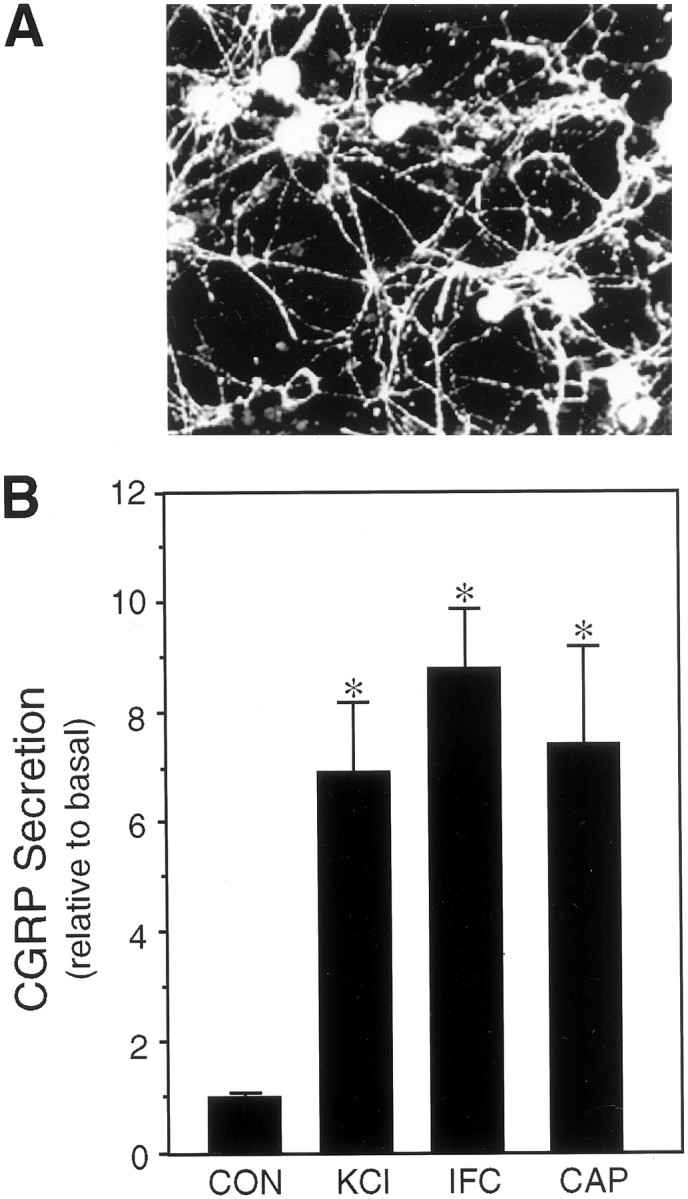
Fig. 1.
Fig. 1.
Expression and regulated release of CGRP from cultured trigeminal ganglia neurons. A, Fluorescent micrograph of CGRP-immunoreactive trigeminal neurons 7 d after plating on poly-d-lysine and laminin. B, The relative amount of CGRP secreted in 1 hr from untreated control cells (CON) or cells treated with 60 mmpotassium chloride (KCl), a cocktail of inflammatory agents (IFC), or 10 μmcapsaicin (CAP) is shown. The mean basal rate of CGRP release was 148 ± 5 pg/hr per dish (SE, n = 36). The secretion rate for each condition was normalized to the basal rate for each dish. The means and the SE from at least four independent experiments are shown. *p < 0.001 when compared with control levels.
Fig. 2.
Fig. 2.
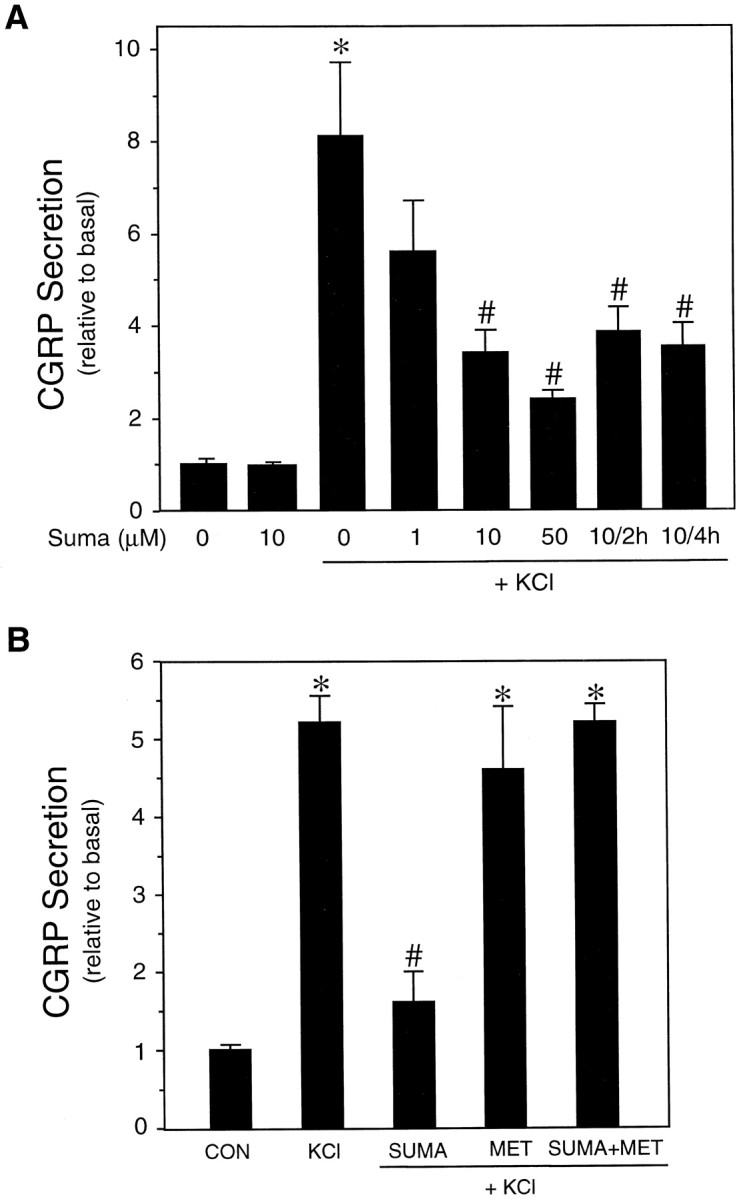
Effect of 5-HT1 receptor agonists on CGRP release. A, CGRP secretion as a function of sumatriptan concentration and treatment time. The effect of sumatriptan was determined on unstimulated and KCl-stimulated trigeminal neurons (cultured for 4–7 d). The amount secreted per hour was normalized to the basal rate determined before addition of buffer, 60 mmKCl, or sumatriptan (Suma) for 1 hr. Where indicated, 10 μm sumatriptan was added for 2 or 4 hr, and the amount per hour was normalized to basal. The mean basal CGRP secretion rate was 131 ± 4 pg/hr per dish. The means and the SE from at least three independent experiments are shown. *p < 0.001 when compared with control values.# p < 0.05 when compared with KCl-only values. B, The 5-HT1 receptor antagonist methiothepin blocks inhibitory effect of sumatriptan on KCl-stimulated CGRP release. The relative rates after addition of buffer (CON), KCl, KCl plus 10 μmsumatriptan (SUMA) and/or 20 μmmethiothepin (SUMA+MET) are shown. The mean basal rate was 122 ± 5 pg/hr per dish. The means and the SE from the two independent experiments are shown for each study. *p < 0.01 when compared with control values or sumatriptan values. # p < 0.05 when compared with KCl values.
Fig. 3.
Fig. 3.
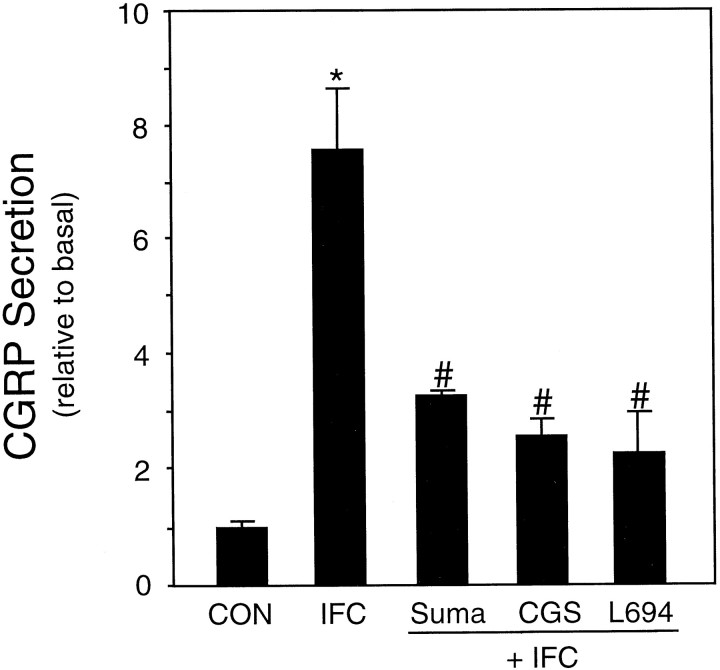
Effect of 5-HT1 agonists on stimulated CGRP release. 5-HT1 repression of CGRP release after stimulation by inflammatory agents. The amount of CGRP secreted per hour was normalized to the basal rate determined for 1 hr before addition of 60 mm KCl or 5-HT1 agonists. The relative rates after addition of buffer (CON), inflammatory cocktail (IFC), and IFC plus 10 μm sumatriptan (Suma), 10 μmCGS, or 10 μm L-694,247 (L694) are shown. The mean basal rate was 137 ± 2 pg/hr per dish. The means and the SE from at least three independent experiments are shown. *p < 0.001 when compared with control values.# p < 0.05 when compared with IFC values.
Fig. 4.
Fig. 4.
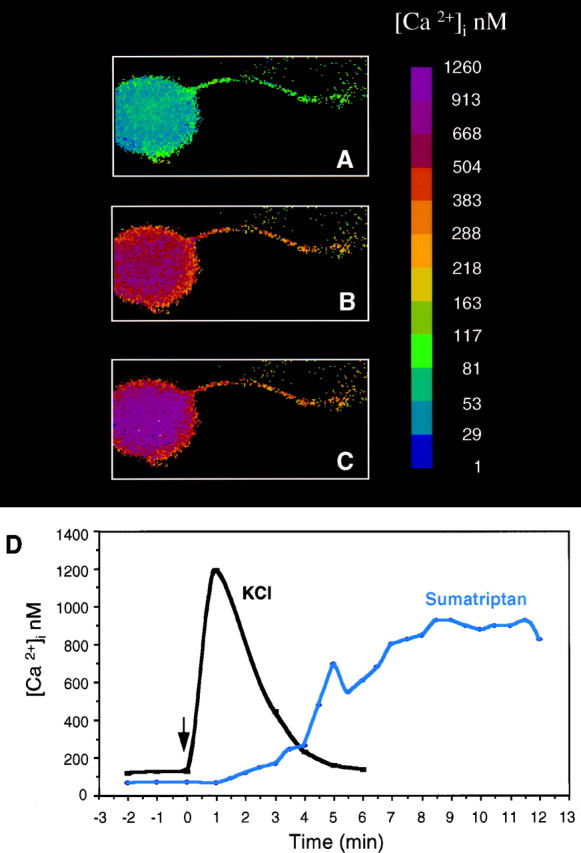
Sumatriptan increases the concentration of intracellular calcium in trigeminal neurons. A, Intracellular calcium concentrations, [Ca2+]i, from day 4 cultures were measured using fura-2 and a microscopic digital imaging system. The pseudo-color scale indicates the [Ca2+]i. Basal levels are in a single neuron with a neurite. B, The same cell 6 min after addition of 10 μm sumatriptan. C, The same cell after 12 min. D, A graphic representation of the change in [Ca2+]i as a function of time after sumatriptan treatment of a representative cell (same cell as above). For comparison, a trace of a different cell treated with only KCl (60 mm) is superimposed.
Fig. 5.
Fig. 5.
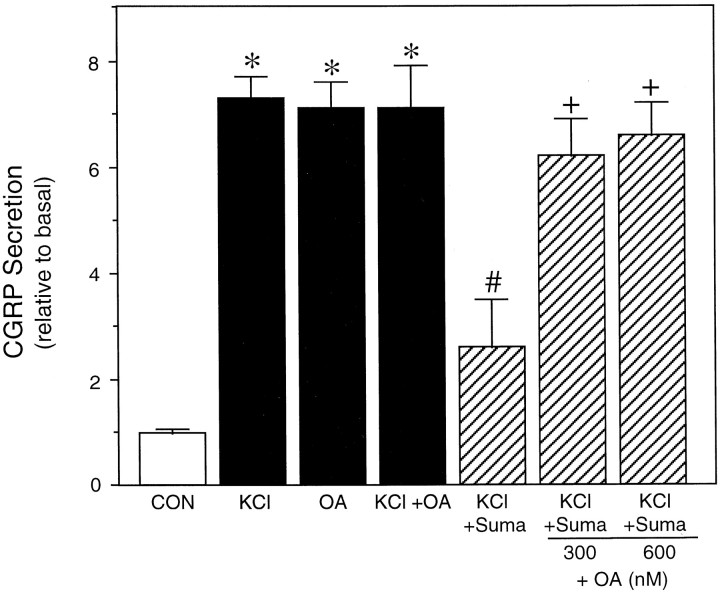
Okadaic acid treatment blocks sumatriptan-mediated inhibition of potassium-stimulated CGRP release. The relative amount of CGRP secreted from trigeminal neurons stimulated with 60 mmKCl, 600 nm (unless indicated as 300 nm) okadaic acid (OA), or the combination of KCl and OA, with or without cotreatment with 10 μm sumatriptan (Suma) is shown. The mean basal rate of CGRP secretion was 99 ± 4 pg/hr per dish. The means and SE from at least three independent experiments are shown. *p < 0.001 when compared with control values. # p < 0.05 when compared with KCl values.+ p < 0.05 when compared with KCl plus sumatriptan values.
Fig. 6.
Fig. 6.
Model of 5-HT1 receptor-mediated inhibition of CGRP release from trigeminal neurons. A depolarizing stimulus causes the initial release of CGRP from trigeminal nerves, leading to neurogenic inflammation, which then further stimulates the release of CGRP. Activation of 5-HT1 receptors blocks this cycle by inhibiting CGRP release via an increase in phosphatase activity that is likely mediated by a sustained elevated level of intracellular calcium.

References

    1. Blier P. Terminal serotonin autoreceptor function in the rat hippocampus is not modified by pertussis and cholera toxins. Naunyn Schmiedebergs Arch Pharmacol. 1991;344:160–166. - PubMed
    1. Boess FG, Martin IL. Molecular biology of 5-HT receptors. Neuropharmacology. 1994;33:275–317. - PubMed
    1. Bouchelet I, Cohen Z, Case B, Seguela P, Hamel E. Differential expression of sumatriptan-sensitive 5-hydroxytryptamine receptors in human trigeminal ganglia and cerebral blood vessels. Mol Pharmacol. 1996;502:219–223. - PubMed
    1. Buchman VL, Davies AM. Different neurotrophins are expressed and act in a developmental sequence to promote the survival of embryonic sensory neurons. Development. 1993;118:989–1001. - PubMed
    1. Buzzi MG, Bonamini M, Moskowitz MA. Neurogenic model of migraine. Cephalagia. 1995;15:277–280. - PubMed

Publication types

MeSH terms