Is recruitment more difficult with a placebo arm in randomised controlled trials? A quasirandomised, interview based study
- PMID: 10213724
- PMCID: PMC27847
- DOI: 10.1136/bmj.318.7191.1114
Is recruitment more difficult with a placebo arm in randomised controlled trials? A quasirandomised, interview based study
Abstract
Objective: To investigate whether including a placebo arm in a clinical trial of hormone replacement therapy influenced women's stated willingness to participate.
Design: Quasirandomised, interview based study.
Setting: 10 group practices in the Medical Research Council's General Practice Research Framework.
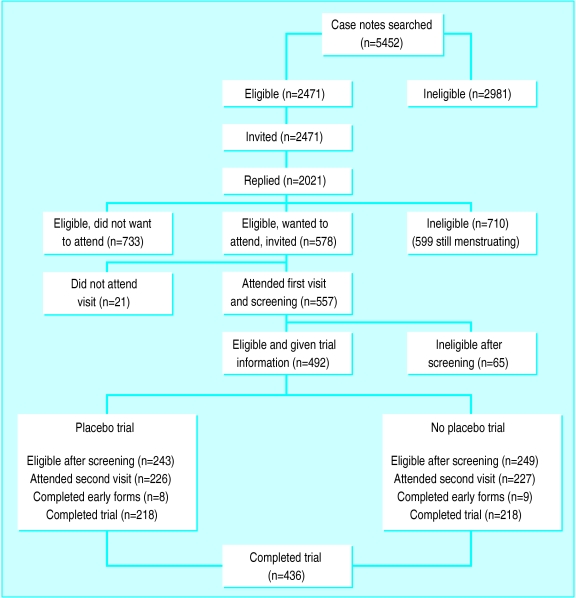
Participants: 436 postmenopausal women aged 45-64 who had not had a hysterectomy.
Main outcome measures: Stated willingness to enter a trial and reasons for the decisions made.
Results: Of 218 women told about the trial without a placebo arm, 85 (39%) indicated their willingness to enter compared with 65 (30%) of the 218 women told about the trial with the placebo arm (P=0.06). Part of this difference was due to explicit reluctance to take a placebo. Altruism and personal benefit were the reasons most frequently given for wanting to take part in a trial. The reasons most frequently cited for not wanting to take part were reluctance to restart periods, not wanting to take unknown or unnecessary tablets, or not wanting to interfere with present good health.
Conclusion: For preventive trials the inclusion of a placebo arm may reduce patients' willingness to participate.
Comment in
-
Is recruitment more difficult with a placebo arm in RCTs? Methodological issues will have affected results.BMJ. 1999 Sep 25;319(7213):853-4. doi: 10.1136/bmj.319.7213.853b. BMJ. 1999. PMID: 10496847 Free PMC article. No abstract available.
References
-
- Henderson BE, Pike MC, Ross RK, Mack TM, Lobo RA. Re-evaluating the role of progestogen therapy after the menopause. Fert Steril. 1988;49:9–15S. - PubMed
-
- Grady D, Rubin SM, Petitti DB, Fox CS, Black D, Ettinger B, et al. Hormone therapy to prevent disease and prolong life in postmenopausal women. Ann Intern Med. 1992;117:1016–1041. - PubMed
-
- Writing Group for the PEPI trial. Effects of estrogen/progestin regimens on heart disease risk factors in postmenopausal women: the postmenopausal estrogen/progestin interventions (PEPI) trial. JAMA. 1995;273:199–208. - PubMed
-
- Stampfer MJ, Colditz GA, Willett WC, Manson JE, Rosner B, Speizer FE, et al. Postmenopausal estrogen therapy and cardiovascular disease: ten-year follow-up from the nurses’ health study. N Engl J Med. 1991;325:756–762. - PubMed
Publication types
MeSH terms
Substances
Grants and funding
LinkOut - more resources
Full Text Sources