. 1999 Apr 27;96(9):5280-5.
doi: 10.1073/pnas.96.9.5280.

Age-related defects in spatial memory are correlated with defects in the late phase of hippocampal long-term potentiation in vitro and are attenuated by drugs that enhance the cAMP signaling pathway

Affiliations

Age-related defects in spatial memory are correlated with defects in the late phase of hippocampal long-term potentiation in vitro and are attenuated by drugs that enhance the cAMP signaling pathway

M E Bach et al. Proc Natl Acad Sci U S A. .

Abstract

To study the physiological and molecular mechanisms of age-related memory loss, we assessed spatial memory in C57BL/B6 mice from different age cohorts and then measured in vitro the late phase of hippocampal long-term potentiation (L-LTP). Most young mice acquired the spatial task, whereas only a minority of aged mice did. Aged mice not only made significantly more errors but also exhibited greater individual differences. Slices from the hippocampus of aged mice exhibited significantly reduced L-LTP, and this was significantly and negatively correlated with errors in memory. Because L-LTP depends on cAMP activation, we examined whether drugs that enhanced cAMP would attenuate the L-LTP and memory defects. Both dopamine D1/D5 receptor agonists, which are positively coupled to adenylyl cyclase, and a cAMP phosphodiesterase inhibitor ameliorated the physiological as well as the memory defects, consistent with the idea that a cAMP-protein kinase A-dependent signaling pathway is defective in age-related spatial memory loss.


Figures
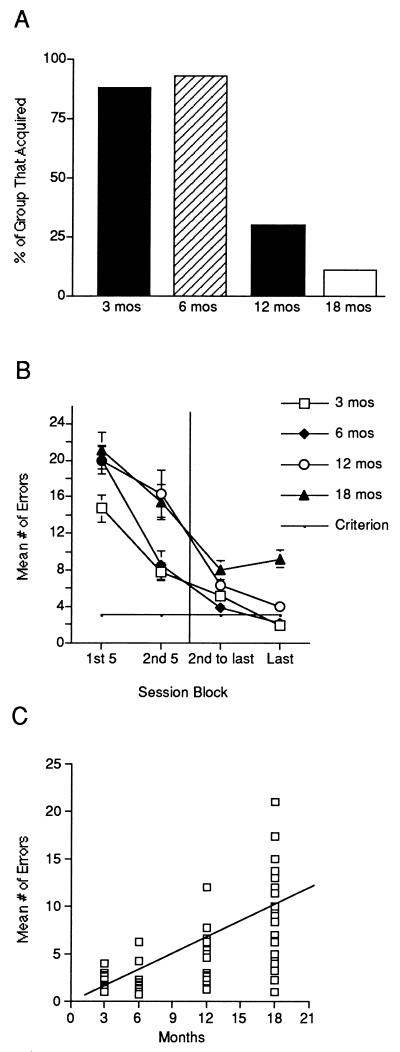
Figure 1
Figure 1
Spatial memory is impaired in aged C57BL/B6 mice. (A) Percentage of 3- (n = 17), 6- (n = 16), 12- (n = 20), and 18- (n = 25) mo-old mice that acquired the spatial version of the Barnes maze. (B) A significant age-related defect was observed in mean number of errors made across 5 session blocks (age × session block interaction F9,175 = 3.14, P = 0.0016). Post hoc analysis revealed that 18-mo-old mice were significantly different from 3-, 6- and 12-mo-old mice during the last session block (P < 0.001 in each case). (C) Spatial memory errors significantly and positively correlated with age (r = 0.66, P < 0.0001). There were greater individual differences in the older cohorts.
Figure 2
Figure 2
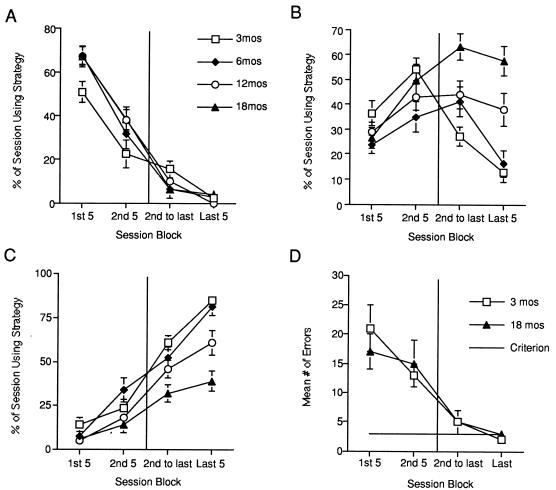
Age-related differences in spatial memory performance can be explained by differences in search strategy use, whereas cued performance is normal. (A) Aged and young cohorts use the random search strategy similarly across session blocks. (B) Aged mice used the serial search strategy significantly more often than younger cohorts (age × session block interaction F9,175 = 4.92, P < 0.0001). Post hoc analysis revealed that 18-mo-old mice were significantly different from 3- and 6-mo-old mice during the last 2 session blocks (P < 0.05 in each case). (C) Young mice used the spatial search strategy significantly more than aged cohorts (age × session block interaction F9,175 = 3.84, P < 0.0005). Post hoc analysis revealed that 18-mo-old mice were significantly different from 3- and 6-mo-old mice during the last session block (P < 0.001 in each case). (D) On the cued version, 3- (n = 6) and 18- (n = 11) mo-old mice made a similar number of errors across session blocks (main effect of age F1,15 = 0.0242, P > 0.05, age × session block interaction F3,13 = 0.3773, P > 0.05).
Figure 3
Figure 3
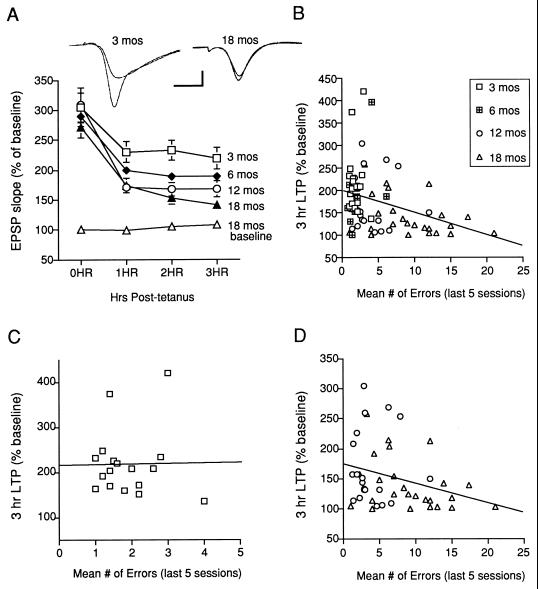
L-LTP is impaired in aged C57BL/B6 mice and correlates with spatial memory. (A) A significant age-related defect was observed in L−LTP (main effect of age F3,74 = 4.03, P < 0.01). Post hoc analysis revealed that 18-mo-old animals were significantly different from 3-mo-old mice 1 hr, 2 hr, and 3 hr after tetanization (P < 0.05 in each case). The baseline was stable for 3 hours in 18-mo-old mice (n = 4). (B) Across age cohorts, spatial memory errors and L-LTP are significantly and negatively correlated (r = −0.334, P < 0.005). (C) Within the 3-mo-old cohort, spatial memory errors during the last 5 sessions and L-LTP at 3 hrs are not correlated (r = −0.13, P > 0.05). (D) Within the aged cohorts (12- and 18-mo-old), spatial memory errors and L-LTP are significantly and negatively correlated (r = −0.294, P < 0.05).
Figure 4
Figure 4
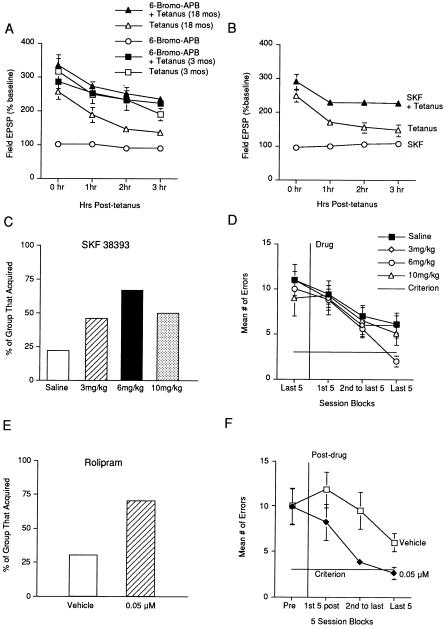
Drugs that enhance the cAMP signaling pathway attenuate both the L-LTP and spatial memory defects in aged C57BL/B6 mice. (A) 6-Bromo-ApB application paired with four train stimulation (n = 5) significantly enhanced L-LTP in slices from 18-mo-old mice compared with tetanus only (n = 5) (main effect drug F1,8 = 25.1, P < 0.001). 6-Bromo-ApB applied alone to slices from 18-mo-old mice had no effect on baseline values. 6-Bromo-ApB application paired with four train stimulation (n = 5) had no effect on L-LTP in slices from 3-mo-old mice compared with tetanus only (n = 5) (main effect of drug F1,8 = 0.0054, P > 0.05). (B) SKF 38393 application paired with four train stimulation (n = 6) significantly enhanced L-LTP in slices from 18-mo-old mice compared with tetanus only (n = 5) (main effect of drug F1,9 = 10.9, P = 0.0092). (C) Percentage of 18-mo-old mice receiving saline (n = 31), 3 (n = 13), 6 (n = 18) or 10 (n = 8) mg/kg SKF 38393 that acquired the spatial version of the Barnes maze. (D) SKF 38393 significantly decreased the number of errors made by 18-mo-old mice (main effect drug F4,58 = 2.788, P = 0.0471). Mice receiving 6 mg/kg SKF 38393 were significantly different from mice receiving saline. (E) Percentage of 18-mo-old mice receiving vehicle (n = 10) or 0.05 μM (n = 10) rolipram that acquired the spatial version of the Barnes maze. (F) Rolipram significantly decreased the number of errors made by 18-mo-old mice (t = 2.204, P = 0.041).

References

    1. Barnes C A. J Comp Physiol Psychol. 1979;93:74–104. - PubMed
    1. Bartus R T, Dean R L, Beer B. Neurobiol Aging. 1980;1:145–152. - PubMed
    1. Gallagher M, Pelleymounter M A. Neurobiol Aging. 1988;9:363–369. - PubMed
    1. Uttl B, Graf P. Psychol Aging. 1993;8:257–273. - PubMed
    1. Perlmutter M, Metzger R, Nezworski T, Miller K. J Gerontol. 1981;36:59–65. - PubMed

Publication types