


doi: 10.1128/AAC.43.5.1307.
Distribution and antimicrobial activity of ciprofloxacin in human soft tissues
Affiliations
- PMID: 10223961
- PMCID: PMC89268
- DOI: 10.1128/AAC.43.5.1307
Item in Clipboard
Distribution and antimicrobial activity of ciprofloxacin in human soft tissues
Antimicrob Agents Chemother.
1999 May.
Abstract
Interstitial ciprofloxacin concentrations in soft tissues were measured by microdialysis following intravenous administration of 200 mg to each of eight healthy volunteers. Interstitial ciprofloxacin concentrations were significantly lower than corresponding total serum drug concentrations; the interstitium-to-serum concentration ratios ranged from 0.55 to 0.73. An in vitro simulation based on interstitial pharmacokinetics showed a substantially lower antimicrobial activity than did the simulation based on serum pharmacokinetics. Thus, ciprofloxacin concentrations at the site of effect may be subinhibitory although effective concentrations are attained in serum.
Figures
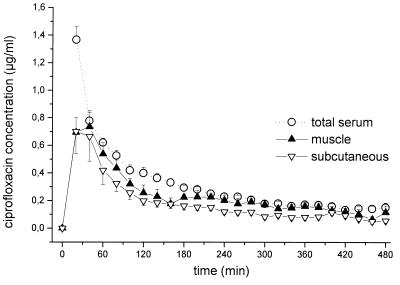
Time-concentration profiles for drug concentrations in total serum and interstitial space fluids of skeletal muscle and subcutaneous adipose tissue following administration of ciprofloxacin to healthy volunteers (single intravenous dose of 200 mg administered over 10 min; n = 8). Results are presented as means ± SEs. 0 to 10 min, time of administration.
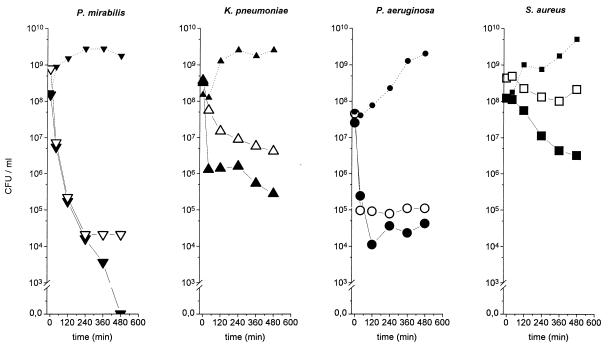
Mean time-kill curves for the in vitro simulation model, in which the in vivo time course of ciprofloxacin concentration, obtained by measuring antibiotic concentrations in serum and the interstitial space fluid in the experiments shown in Fig. 1, was simulated in vitro for Proteus mirabilis, Klebsiella pneumoniae, Pseudomonas aeruginosa, and Staphylococcus aureus. Solid symbols indicate time-kill data for serum drug concentrations; open symbols indicate time-kill data for interstitial subcutaneous concentrations; the dotted lines (small solid symbols) are the growth control curves.
References
-
- Arcieri G, August R, Becker N, Doyle C, Griffith E, Gruenwaldt G, Heyd A, O’Brien B. Clinical experience with ciprofloxacin in the USA. Eur J Clin Microbiol. 1986;5:220–225. - PubMed
-
- Capecchi P L, Blardi P, De Lalla A, Ceccatelli L, Volpi L, Pasini F L, Di Perri T. Pharmacokinetics and pharmacodynamics of neutrophil-associated ciprofloxacin in humans. Clin Pharmacol Ther. 1995;57:446–454. - PubMed
-
- Dalla Costa T, Nolting A, Rand K, Derendorf H. Pharmacokinetic-pharmacodynamic modelling of the in vitro antiinfective effect of piperacillin-tazobactam combinations. Int J Clin Pharmacol Ther. 1997;35:426–433. - PubMed
-
- Daschner F D, Westenfelder M, Dalhoff A. Penetration of ciprofloxacin into kidney, fat, muscle and skin tissue. Eur J Clin Microbiol. 1986;5:212–213. - PubMed
Publication types
MeSH terms
Substances
LinkOut - more resources
Full Text Sources
Other Literature Sources
