. 1999 May;65(5):1826-33.
doi: 10.1128/AEM.65.5.1826-1833.1999.

Contribution of methanotrophic and nitrifying bacteria to CH4 and NH4+ oxidation in the rhizosphere of rice plants as determined by new methods of discrimination

Affiliations

Contribution of methanotrophic and nitrifying bacteria to CH4 and NH4+ oxidation in the rhizosphere of rice plants as determined by new methods of discrimination

PL Bodelier et al. Appl Environ Microbiol. 1999 May.

Abstract

Methanotrophic and nitrifying bacteria are both able to oxidize CH4 as well as NH4+. To date it is not possible to estimate the relative contribution of methanotrophs to nitrification and that of nitrifiers to CH4 oxidation and thus to assess their roles in N and C cycling in soils and sediments. This study presents new options for discrimination between the activities of methanotrophs and nitrifiers, based on the competitive inhibitor CH3F and on recovery after inhibition with C2H2. By using rice plant soil as a model system, it was possible to selectively inactivate methanotrophs in soil slurries at a CH4/CH3F/NH4+ molar ratio of 0.1:1:18. This ratio of CH3F to NH4+ did not affect ammonia oxidation, but methane oxidation was inhibited completely. By using the same model system, it could be shown that after 24 h of exposure to C2H2 (1,000 parts per million volume), methanotrophs recovered within 24 h while nitrifiers stayed inactive for at least 3 days. This gave an "assay window" of 48 h when only methanotrophs were active. Applying both assays to model microcosms planted with rice plants demonstrated a major contribution of methanotrophs to nitrification in the rhizosphere, while the contribution of nitrifiers to CH4 oxidation was insignificant.


Figures
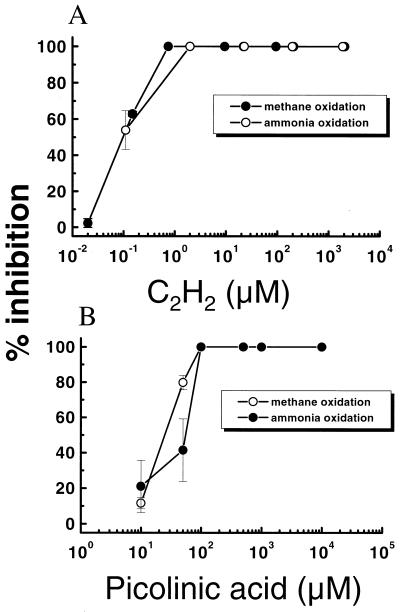
FIG. 1
FIG. 1
Effects of C2H2 (A) and picolinic acid (B) on CH4 and NH4+ oxidation in preincubated rice plant soil slurries. Each value is the arithmetic mean from three replicate assays ± standard deviation (SD). The percent inhibition is relative to the activity without the presence of the inhibitor. The control activities for CH4 oxidation were 0.85 ± 0.04 and 0.92 ± 0.02 μmol · g (dry weight)−1 · h−1 for C2H2 and picolinic acid, respectively. Corresponding NH4+ oxidation rates were 30.98 ± 9.41 and 30.27 ± 2.31 nmol of NO3 plus NO2 · g (dry weight)−1 · h−1.
FIG. 2
FIG. 2
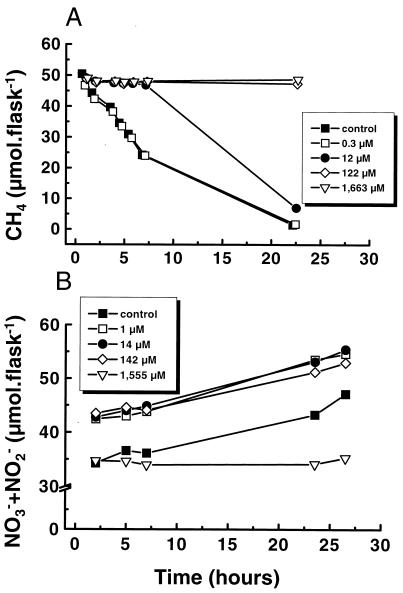
Effects of different CH3F mixing ratios on CH4 oxidation at a concentration of 10 μM CH4 (A) and on NH4+ oxidation at a concentration of 2.68 mM NH4+ (B), in preincubated rice plant soil slurries. Each value is the arithmetic mean from three replicate assays. CH3F concentrations are given in the keys.
FIG. 3
FIG. 3
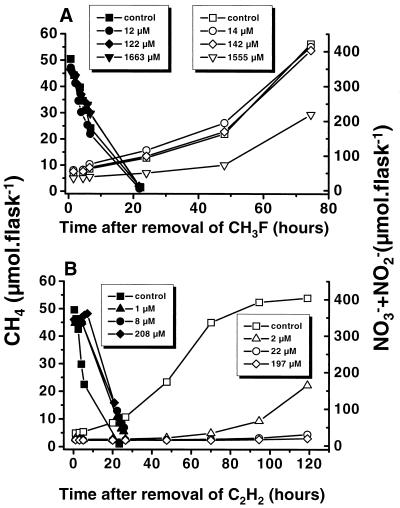
Recovery of CH4 (solid symbols) and NH4+ (open symbols) oxidation after 24 h of exposure to different mixing ratios of CH3F (A) or C2H2 (B). Each value represents the arithmetic mean from three replicate assays. CH3F and C2H2 concentrations are given in the keys.
FIG. 4
FIG. 4
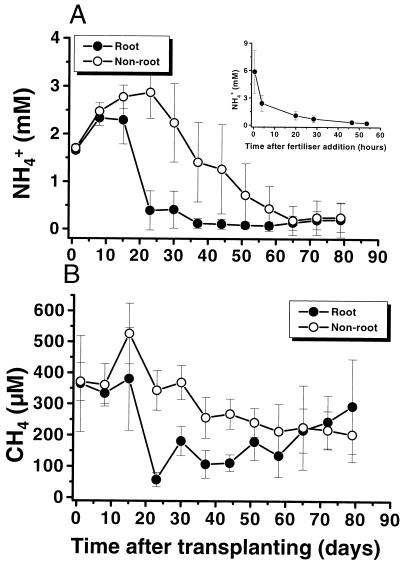
Porewater NH4+ (A) and CH4 (B) concentrations in the root and nonroot compartments of compartmented microcosms planted with rice plants. Each value represents the arithmetic mean (± SD) from four replicate microcosms. The inset in panel A depicts NH4+ concentrations in the root compartment during the first 55 h after fertilizer was added at day 44.
FIG. 5
FIG. 5
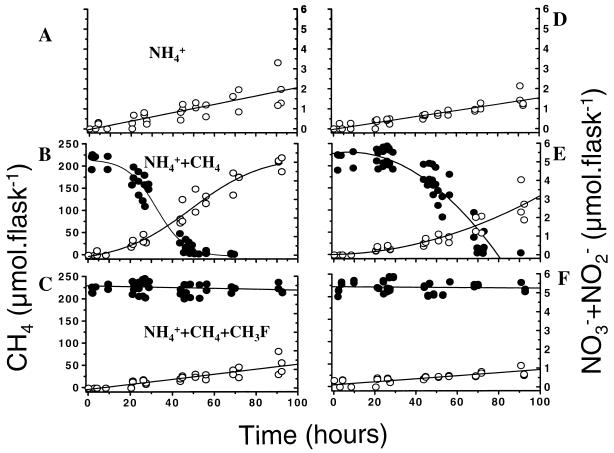
CEAs using CH3F applied to NH4+ (2 mM)-supplemented slurries from the root (A through C) and nonroot (D through F) compartments of four compartmented microcosms planted with rice plants. The scatter diagram depicts the assay values of all four microcosms. (A and D) NH4+ oxidation in the absence of CH4 and CH3F, putatively caused by the activities of both methanotrophs and nitrifiers. (B and E) Oxidation of CH4 (solid circles) and NH4+ (open circles) in the presence of CH4 (10,000 ppmv), putatively caused by both methanotrophs and nitrifiers. (C and F) Oxidation of CH4 (solid circles) and NH4+ (open circles) in the presence of CH4 (10,000 ppmv) and CH3F (300 ppmv), putatively allowing for activity of nitrifiers only. The respective conversion rates are displayed in Table 1.
FIG. 6
FIG. 6
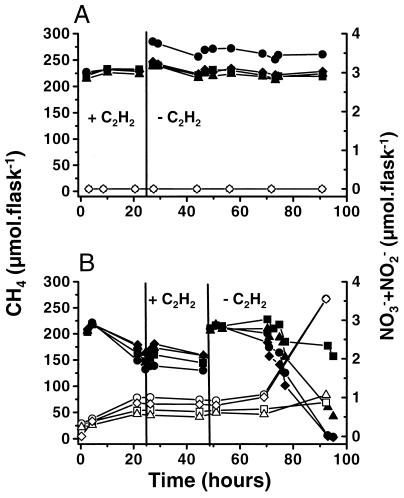
Differential recovery of CH4 (solid symbols; left axis) and NH4+ (open symbols; right axis) oxidation after 24-h exposure to C2H2 applied to slurries from the root compartments of four replicate microcosms planted with rice plants. (A) C2H2 was added at the start of the incubation period. (B) C2H2 was added 24 h after the start of the incubation period.

References

    1. Amaral J A, Ekins A, Richards S R, Knowles R. Effect of selected monoterpenes on methane oxidation, denitrification, and aerobic metabolism by bacteria in pure culture. Appl Environ Microbiol. 1998;64:520–525. - PMC - PubMed
    1. Armstrong W, Brändle R, Jackson M B. Mechanisms of flood tolerance in plants. Acta Bot Neerl. 1994;43:307–358.
    1. Arth I, Frenzel P, Conrad R. Denitrification coupled to nitrification in the rhizosphere of rice. Soil Biol Biochem. 1998;30:509–515.
    1. Arth, I. 1998. Personal communication.
    1. Bèdard C, Knowles R. Physiology, biochemistry, and specific inhibitors of CH4, NH4+, and CO oxidation by methanotrophs and nitrifiers. Microbiol Rev. 1989;53:68–84. - PMC - PubMed

LinkOut - more resources