


Levels of antibody to conserved parts of Plasmodium falciparum merozoite surface protein 1 in Ghanaian children are not associated with protection from clinical malaria
- PMID: 10225865
- PMCID: PMC115948
- DOI: 10.1128/IAI.67.5.2131-2137.1999
Levels of antibody to conserved parts of Plasmodium falciparum merozoite surface protein 1 in Ghanaian children are not associated with protection from clinical malaria
Abstract
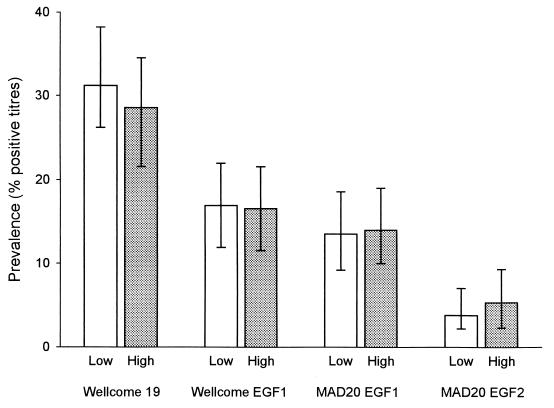
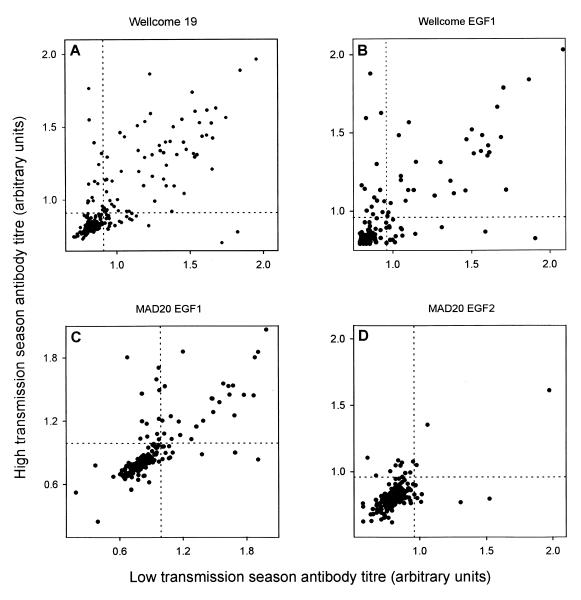
The 19-kDa conserved C-terminal part of the Plasmodium falciparum merozoite surface protein 1 (PfMSP119) is a malaria vaccine candidate antigen, and human antibody responses to PfMSP119 have been associated with protection against clinical malaria. In this longitudinal study carried out in an area of stable but seasonal malaria transmission with an estimated parasite inoculation of about 20 infective bites/year, we monitored 266 3- to 15-year-old Ghanaian children clinically and parasitologically over a period of 18 months. Blood samples were collected at the beginning of the study before the major malaria season in April and after the season in November. Using enzyme-linked immunosorbent assay, we measured antibody responses to recombinant gluthathione S-transferase-PfMSP119 fusion proteins corresponding to the Wellcome and MAD20 allelic variants in these samples. Prevalence of antibodies recognizing the Wellcome 19 construct containing both epidermal growth factor (EGF)-like motifs in Wellcome type PfMSP119 was about 30%. Prevalence of antibodies to constructs containing only the first EGF domain from either Wellcome or MAD20 type PfMSP119 was about 15%, whereas antibodies recognizing a construct containing only the second EGF domain of MAD20 type PfMSP119 was found in only about 4% of the donors. Neither the prevalence nor the levels of any of the antibody specificities varied significantly with season, age, or sex. Significantly, and in contrast to previous reports from other parts of West Africa, we found no evidence of an association between antibody responses to PfMSP119 and clinical protection against malaria.
Figures
References
-
- Afari E A, Appawu M, Dunyo S, Baffoe-Wilmot A, Nkrumah F K. Malaria infection, morbidity and transmission in two ecological zones in southern Ghana. Afr J Health Sci. 1995;2:312–316. - PubMed
-
- Al-Yaman F, Genton B, Kramer K J, Chang S P, Hui G S, Baisor M, Alpers M P. Assessment of the role of naturally acquired antibody levels to Plasmodium falciparum merozoite surface protein-1 in protecting Papua New Guinean children from malaria morbidity. Am J Trop Med Hyg. 1996;54:443–448. - PubMed
-
- Anders R F. Multiple cross-reactivities amongst antigens of Plasmodium falciparum impair the development of protective immunity against malaria. Parasite Immunol. 1986;8:529–539. - PubMed
-
- Aribot G, Rogier C, Sarthou J L, Trape J F, Balde A T, Druilhe P, Roussilhon C. Pattern of immunoglobulin isotype response to Plasmodium falciparum blood-stage antigens in individuals living in a holoendemic area of Senegal (Dielmo, West Africa) Am J Trop Med Hyg. 1996;54:449–457. - PubMed
-
- Baird J K, Jones T R, Danudirgo E W, Annis B A, Bangs M J, Basri H, Purnomo, Masbar S. Age-dependent acquired protection against Plasmodium falciparum in people having two years exposure to hyperendemic malaria. Am J Trop Med Hyg. 1991;45:65–76. - PubMed
Publication types
MeSH terms
Substances
LinkOut - more resources
Full Text Sources
Research Materials
Miscellaneous
