. 1999 May;67(5):2233-40.
doi: 10.1128/IAI.67.5.2233-2240.1999.

Replication of Toxoplasma gondii, but not Trypanosoma cruzi, is regulated in human fibroblasts activated with gamma interferon: requirement of a functional JAK/STAT pathway

Affiliations

Replication of Toxoplasma gondii, but not Trypanosoma cruzi, is regulated in human fibroblasts activated with gamma interferon: requirement of a functional JAK/STAT pathway

I P Cerávolo et al. Infect Immun. 1999 May.

Abstract

To study the role of tryptophan degradation by indoleamine 2, 3-dioxygenase (INDO) in the control of Trypanosoma cruzi or Toxoplasma gondii replication, we used human fibroblasts and a fibrosarcoma cell line (2C4). The cells were cultured in the presence or absence of recombinant gamma interferon (rIFN-gamma) and/or recombinant tumor necrosis factor alpha (rTNF-alpha) for 24 h and were then infected with either T. cruzi or T. gondii. Intracellular parasite replication was evaluated 24 or 48 h after infection. Treatment with rIFN-gamma and/or rTNF-alpha had no inhibitory effect on T. cruzi replication. In contrast, 54, 73, or 30% inhibition of T. gondii replication was observed in the cells treated with rIFN-gamma alone, rIFN-gamma plus rTNF-alpha, or TNF-alpha alone, respectively. The replication of T. gondii tachyzoites in cytokine-activated cells was restored by the addition of extra tryptophan to the culture medium. Similarly, T. gondii tachyzoites transfected with bacterial tryptophan synthase were not sensitive to the microbiostatic effect of rIFN-gamma. We also investigated the basis of the cytokine effect on parasite replication by using the three mutant cell lines B3, B9, and B10 derived from 2C4 and expressing defective STAT1alpha (signal transducer and activator of transcription), JAK2 (Janus family of cytoplasmic tyrosine kinases), or JAK1, respectively, three important elements of a signaling pathway triggered by rIFN-gamma. We found that rTNF-alpha was able to induce low levels expression of INDO mRNA in the parental cell line, as well as the cell line lacking functional JAK2. In contrast to the parental cell line (2C4), rIFN-gamma was not able to induce the expression of INDO mRNA or microbiostatic activity in any of the mutant cell lines. These findings indicate the essential requirement of the JAK/STAT pathway for the induction of high levels of INDO mRNA, tryptophan degradation, and the anti-Toxoplasma activity inside human nonprofessional phagocytic cells.


Figures
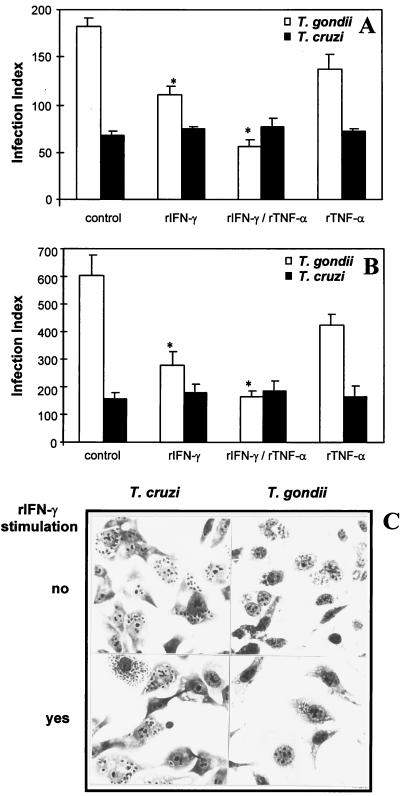
FIG. 1
FIG. 1
(A) Effect of rIFN-γ (900 IU/ml) and/or rTNF-α (60 IU/ml) on intracellular parasite replication in human foreskin fibroblasts. The replication was evaluated 48 h postinfection. An asterisk indicates a result statistically different from the control group (P < 0.05). Results indicate the means ± the standard errors of the means from two independent experiments done in duplicate. (B) Effect of rIFN-γ (900 IU/ml) and/or rTNF-α (60 IU/ml) on intracellular parasite replication in 2C4 cells. The replication was evaluated at 48 h postinfection. An asterisk indicates a result statistically different from the control group (P < 0.05). Results indicate the means ± the standard errors of the means from three independent experiments done in duplicate. (C) Illustration of rIFN-γ effect on intracellular replication of T. gondii tachyzoites and T. cruzi amastigotes. Note that, in contrast to T. gondii, T. cruzi growth was observed in the presence or absence of rIFN-γ.
FIG. 2
FIG. 2
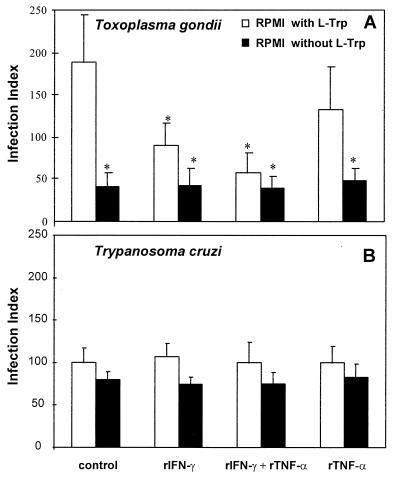
Effect of the absence of l-tryptophan (L-Trp) in 2C4 cells stimulated with rIFN-γ (900 IU/ml) and/or rTNF-α (60 IU/ml) and infected with (A) T. gondii or (B) T. cruzi. The cells and parasites were maintained without l-tryptophan as described in Materials and Methods. The replication was evaluated 24 h postinfection. An asterisk indicates a result statistically different from the control group (P < 0.05). Results indicate the means ± the standard errors of the means from three independent experiments done in duplicate.
FIG. 3
FIG. 3
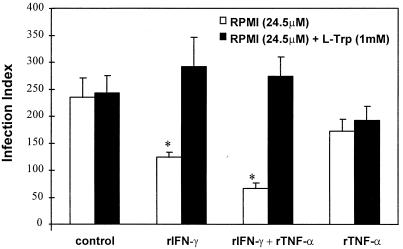
Effect of the addition of l-tryptophan (L-Trp) on the intracellular replication of T. gondii tachyzoites in 2C4 cells activated with rIFN-γ (900 IU/ml) and/or rTNF-α (60 IU/ml). Tryptophan was added to the culture medium at a final concentration of 1 mM immediately after the parasite infection, and the replication was evaluated 24 h later. An asterisk indicates a result statistically different from the control group (P < 0.05). Results indicate the means ± the standard errors of the means from three independent experiments done in duplicate.
FIG. 4
FIG. 4
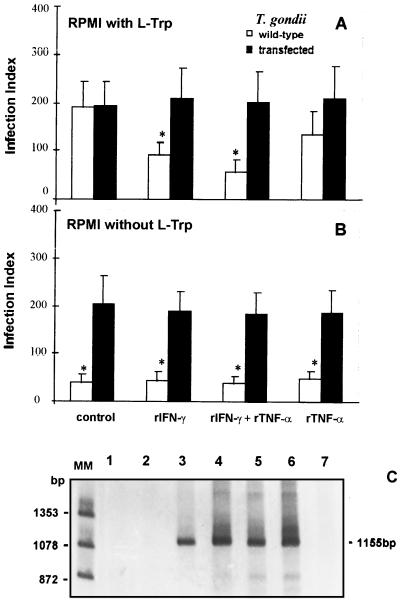
Comparison of effects of rIFN-γ (900 IU/ml) and/or rTNF-α (60 IU/ml) on 2C4 human fibroblasts infected with wild-type or transfected strains of T. gondii and maintained in the presence (A) or in the absence (B) of l-tryptophan (L-Trp). Both strains were maintained in tryptophan-free medium. RPMI was supplemented with 3% dialyzed heat-inactivated fetal bovine serum and 100 μM indole. The replication was evaluated 24 h after infection. An asterisk indicates a result statistically different from the control group (P < 0.05). Results indicate the means ± the standard errors of the means from three independent experiments done in duplicate. (C) PCR products of TS from E. coli. PCR was performed as described in Materials and Methods. The PCR product (3 μl) was electrophoresed in 6% polyacrylamide gel and silver stained. DNA of bacteriophage φX digested by endonuclease HaeIII was used as a molecular size marker. Lanes: 1 and 2, DNA from T. gondii RH wild-type strain, 1 and 10 ng, respectively; 3 and 4, T. gondii TS-transfected strain, 1 and 10 ng, respectively; 5 and 6, E. coli, 1 and 10 ng, respectively; 7, negative control (no DNA added). An 1,155-bp fragment was expected.
FIG. 5
FIG. 5
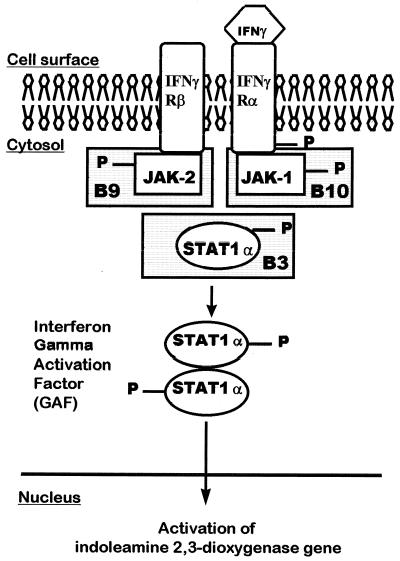
IFN-γ signaling pathway showing the defects in the human fibroblast mutants B3, B9, and B10.
FIG. 6
FIG. 6
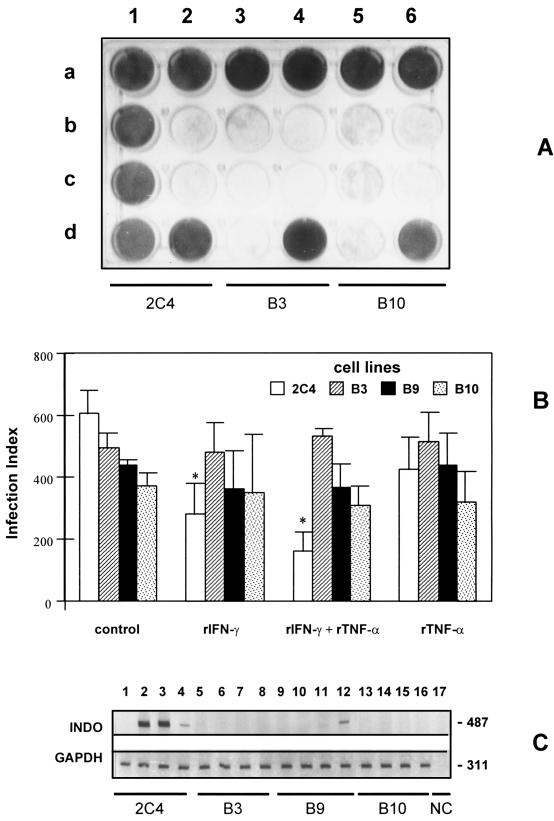
(A) Cytophatic effect of vaccinia virus infectivity assay in parental 2C4 and mutant B3 and B10 cells. Row a shows the controls, in duplicate, with the three cell lines without vaccinia virus and rIFN-γ. b1, c1, and d1 show the protective effect of rIFN-γ (500 IU/ml) against vaccinia virus in 2C4 cells. b2 and c2 show the viral effect on 2C4 cells without rIFN-γ. d2 shows rIFN-γ plus 2C4 cells. b3, c3, and d3 show the viral effect on the B3 mutant cell line plus rIFN-γ. b4 and c4 show the effect of the virus on the mutant B3 cells. d4 shows rIFN-γ plus B3 cells. b5, c5, and d5 show the viral effect on the B10 mutant cell line plus rIFN-γ. b6 and c6 show the viral effect on the B10 cells. d6 shows rIFN-γ plus B10 cells. (B) Effect of rIFN-γ (900 IU/ml) and/or rTNF-α (60 IU/ml) on the parental (2C4) and mutant (B3, B9, and B10) cells infected with T. gondii. The replication was evaluated 48 h after infection. An asterisk indicates a result statistically different from control group (P < 0.05). Results indicate the means ± the standard errors of the means from three independent experiments done in duplicate. (C) Effect of rIFN-γ (900 IU/ml) and/or rTNF-α (60 IU/ml) on the induction of INDO mRNA. The parental (2C4) and mutant (B3, B9, and B10) cells were incubated with rIFN-γ and/or rTNF-α for 14 to 16 h. Lanes 1, 5, 9, and 13 are controls without cytokine; lanes 2, 6, 10, and 14 are rIFN-γ; lanes 3, 7, 11, and 15 are rIFN-γ plus rTNF-α; lanes 4, 8, 12, and 16 are rTNF-α; and lane 17 is the negative control (no cDNA added). Expression of INDO and GAPDH mRNA was detected by RT-PCR. PCR products (3 μl) were electrophoresed in 6% polyacrylamide gel and silver stained. The expected fragment sizes were 487 bp for the INDO and 311 bp for the GAPDH genes.

References

    1. Adams L B, Hibbs J B, Taintor R R, Krahenbuhl J L. Microbiostatic effect of murine activated macrophages for Toxoplasma gondii: role for synthesis of inorganic nitrogen oxides from l-arginine. J Immunol. 1990;144:2725–2729. - PubMed
    1. Andrews N W. Living dangerously: how Trypanosoma cruzi uses lysosomes to get inside host cells, and then escapes into the cytoplasm. Biol Res. 1993;26:65–67. - PubMed
    1. Beatty W L, Belanger T A, Desai A A, Morrison R P, Byrne G I. Tryptophan depletion as a mechanism of gamma interferon-mediated chlamydial persistence. Infect Immun. 1994;62:3705–3711. - PMC - PubMed
    1. Bertelli M S M, Golgher R R, Brener Z. Intraspecific variation in Trypanosoma cruzi: effect of temperature on the intracellular differentiation in tissue culture. J Parasitol. 1977;63:434–437. - PubMed
    1. Bonjardim C A. JAK/STAT deficient cell lines. Braz J Med Biol Res. 1998;31:1389–1395. - PubMed

Publication types

MeSH terms