. 1999 May;67(5):2433-40.
doi: 10.1128/IAI.67.5.2433-2440.1999.

Identification of virulence genes of Helicobacter pylori by random insertion mutagenesis

Affiliations

Identification of virulence genes of Helicobacter pylori by random insertion mutagenesis

J J Bijlsma et al. Infect Immun. 1999 May.

Abstract

The complete genome of the gram-negative bacterial pathogen Helicobacter pylori, an important etiological agent of gastroduodenal disease in humans, has recently been published. This sequence revealed that the putative products of roughly one-third of the open reading frames (ORFs) have no significant homology to any known proteins. To be able to analyze the functions of all ORFs, we constructed an integration plasmid for H. pylori and used it to generate a random mutant library in this organism. This integration plasmid, designated pBCalpha3, integrated randomly into the chromosome of H. pylori. To test the capacity of this library to identify virulence genes, subsets of this library were screened for urease-negative mutants and for nonmotile mutants. Three urease-negative mutants in a subset of 1,251 mutants (0.25%) and 5 nonmotile mutants in a subset of 180 mutants (2.7%) were identified. Analysis of the disrupted ORFs in the urease-negative mutants revealed that two had disruptions of genes of the urease locus, ureB and ureI, and the third had a disruption of a unrelated gene; a homologue of deaD, which encodes an RNA helicase. Analysis of the disrupted ORFs in the nonmotile mutants revealed one ORF encoding a homologue of the paralyzed flagellar protein, previously shown to be involved in motility in Campylobacter jejuni. The other four ORFs have not been implicated in motility before. Based on these data, we concluded that we have generated a random insertion library in H. pylori that allows for the functional identification of genes in H. pylori.


Figures
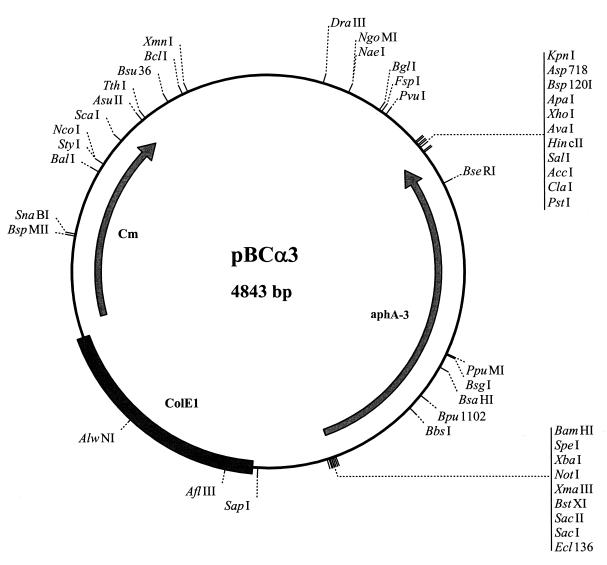
FIG. 1
FIG. 1
Schematic representation of pBCα3. ColE1, origin of replication (not functional in H. pylori); aphA-3, kanamycin cassette (functional in H. pylori and E. coli); Cm, chloramphenicol cassette (not functional in H. pylori). Only unique restriction sites are indicated. The AluI sites used in the plasmid rescue strategy are not indicated because there are 29 AluI sites in the plasmid.
FIG. 2
FIG. 2
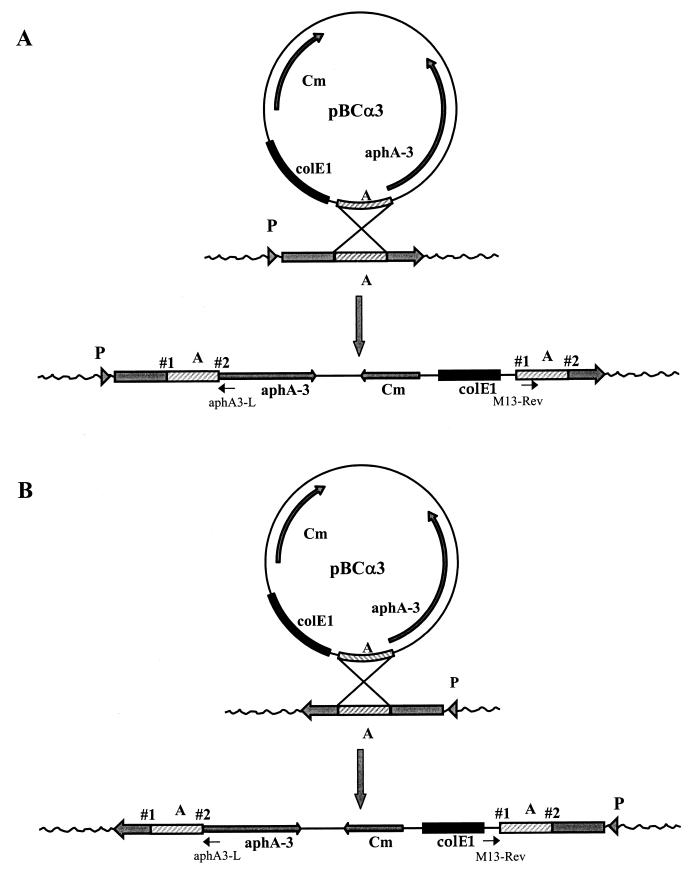
Schematic representation of the integration of pBCα3 in the chromosome. A hypothetical DNA fragment (fragment A) cloned into the plasmid mediates the integration of the plasmid into the H. pylori chromosome via a Campbell-like mechanism. Integration of pBCα3 results in a duplication of fragment A at both sites of insertion and a subsequent disruption of the gene in which fragment A is present. (A) Integration of pBCα3 is in the same direction as the ORF. In this case, point 2 is the actual insertion site. (B) Integration of pBCα3 is in the direction opposite that of the ORF. In this case, point 1 is the actual insertion site. P, hypothetical promoter. The positions of the primers used to sequence the rescued plasmids, the M13 reverse primer (M13-Rev) and aphA3-L, are indicated.
FIG. 3
FIG. 3
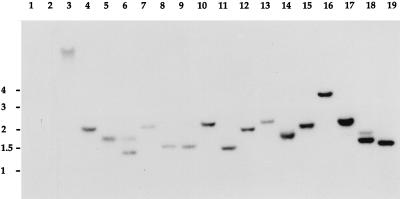
Southern blot of 16 randomly selected mutants probed with the kanamycin cassette. Lane 1, plasmid DNA without the kanamycin cassette; lane 2, wild-type chromosomal DNA; lane 3, positive control; lanes 4 to 19, chromosomal DNA of the 16 mutants. Chromosomal DNA was digested with HinfI in all cases. The positions of marker DNA fragments, in kilobase pairs, are given to the left of the autoradiogram.
FIG. 4
FIG. 4
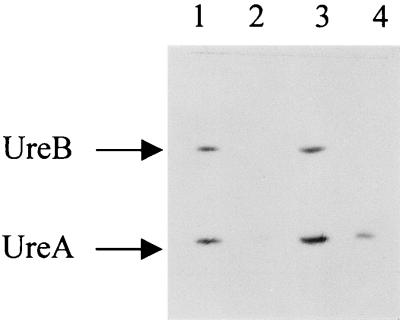
Immunoblot of whole-cell preparations with anti-urease (1:1,000). Lane 1, parental strain 1061; lanes 2 through 4, mutants with disruptions of ureB, ureI, and deaD, respectively. Approximately 11 μg of protein was loaded in each lane.
FIG. 5
FIG. 5
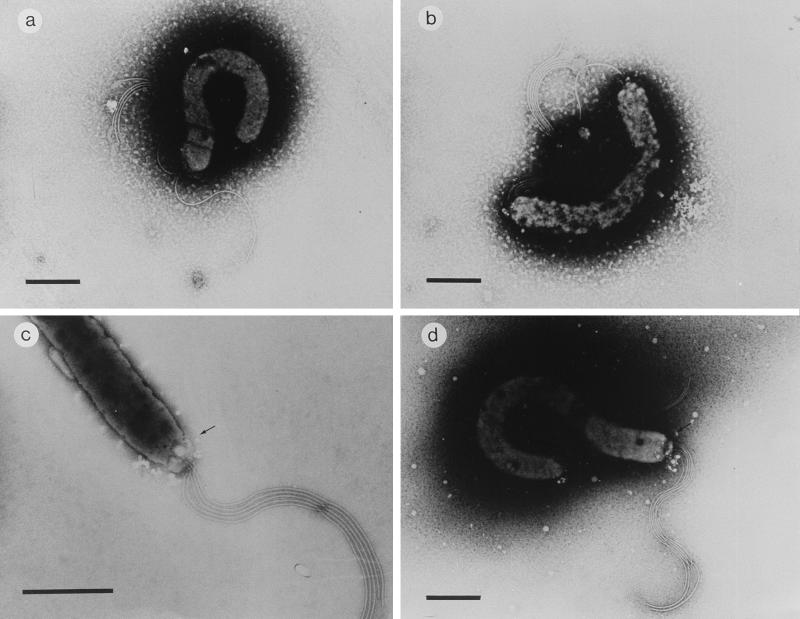
Negatively stained electron micrographs of H. pylori nonmotile mutants. Representative results are shown for the wild type (a), mutant 3 (b), mutant 4 (c), and mutant 1 (d). Bar in panel a, 500 nm; bars in panels b through d, 1 μm. Arrow in panel c points to the cap-like structure at the site where the flagella protrude from the bacterium.

References

    1. Andrutis K A, Fox J G, Schauer D B, Marini R P, Li X, Yan L, Josenhans C, Suerbaum S. Infection of the ferret stomach by isogenic flagellar mutant strains of Helicobacter mustelae. Infect Immun. 1997;65:1962–1966. - PMC - PubMed
    1. Bauerfeind P, Garner R M, Mobley L T. Allelic exchange mutagenesis of nixA in Helicobacter pylori results in reduced nickel transport and urease activity. Infect Immun. 1996;64:2877–2880. - PMC - PubMed
    1. Berg D E, Hoffman P S, Appelmelk B J, Kusters J G. The Helicobacter pylori genome sequence: genetic factors for long life in the gastric mucosa. Trends Microbiol. 1997;5:468–474. - PubMed
    1. Boynton Z L, Bennett G N, Rudolph F B. Cloning, sequencing, and expression of genes encoding phosphotransacetylase and acetate kinase from Clostridium acetobutylicum ATCC 824. Appl Environ Microbiol. 1996;62:2758–2766. - PMC - PubMed
    1. Clyne M, Labigne A, Drumm B. Helicobacter pylori requires an acidic environment to survive in the presence of urea. Infect Immun. 1995;63:1669–1673. - PMC - PubMed

Publication types

LinkOut - more resources