


Insertional inactivation of genes responsible for the D-alanylation of lipoteichoic acid in Streptococcus gordonii DL1 (Challis) affects intrageneric coaggregations
- PMID: 10225909
- PMCID: PMC115992
- DOI: 10.1128/IAI.67.5.2464-2474.1999
Insertional inactivation of genes responsible for the D-alanylation of lipoteichoic acid in Streptococcus gordonii DL1 (Challis) affects intrageneric coaggregations
Abstract
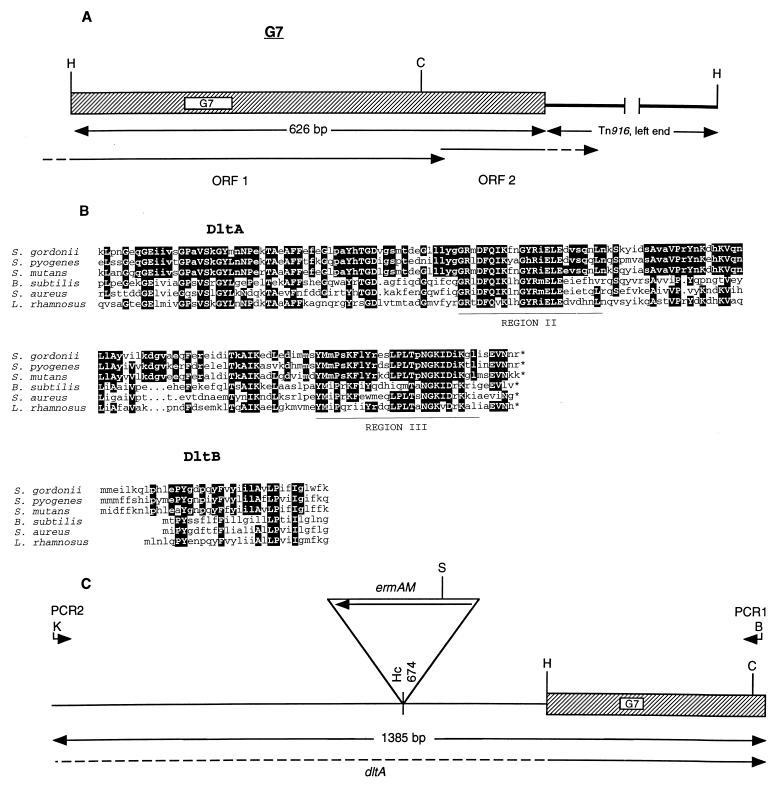
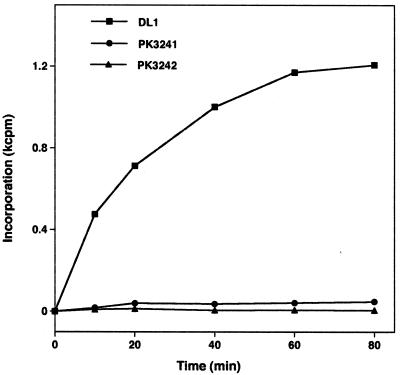
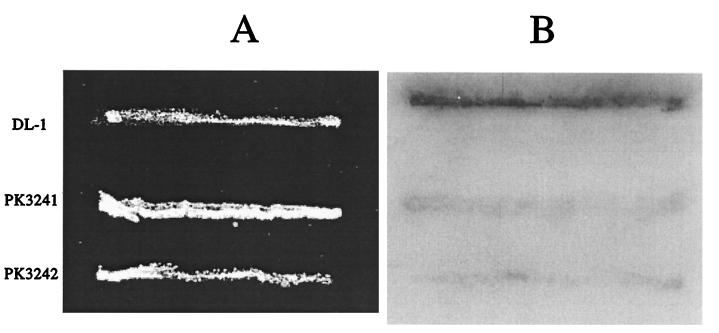
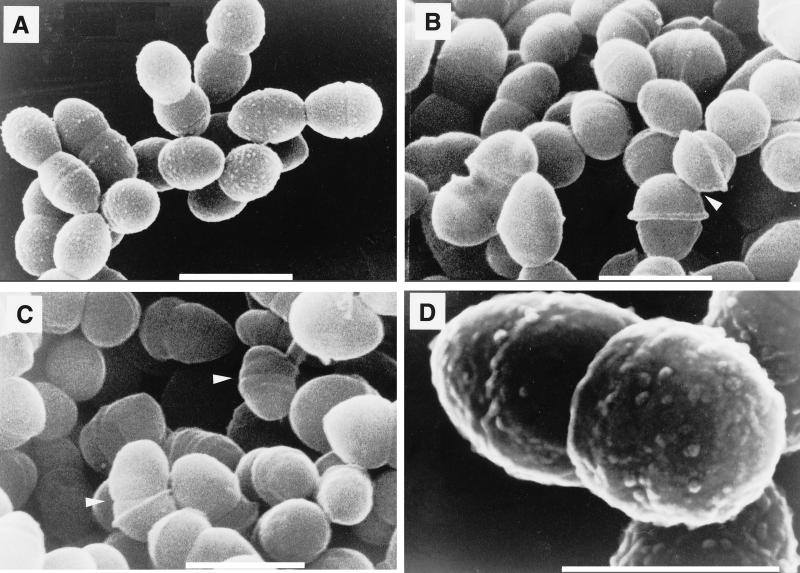
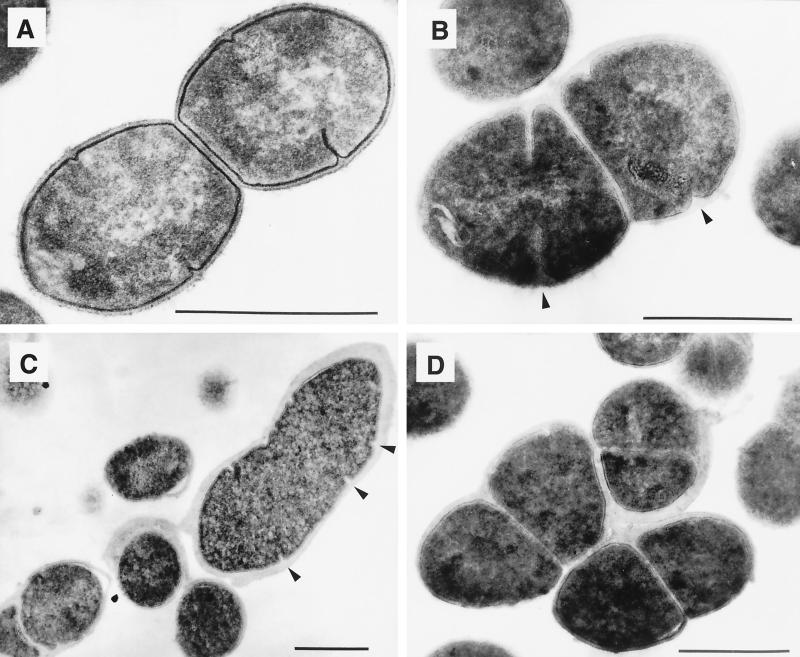
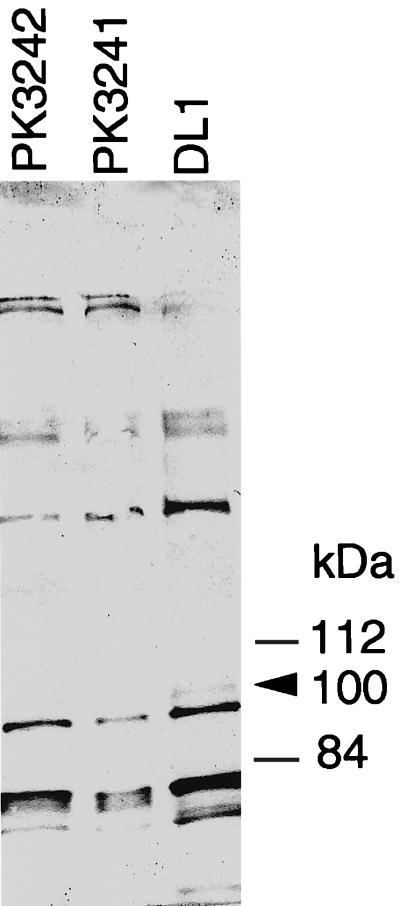
Most human oral viridans streptococci participate in intrageneric coaggregations, the cell-to-cell adherence among genetically distinct streptococci. Two genes relevant to these intrageneric coaggregations were identified by transposon Tn916 mutagenesis of Streptococcus gordonii DL1 (Challis). A 626-bp sequence flanking the left end of the transposon was homologous to dltA and dltB of Lactobacillus rhamnosus ATCC 7469 (formerly called Lactobacillus casei). A 60-kb probe based on this flanking sequence was used to identify the homologous DNA in a fosmid library of S. gordonii DL1. This DNA encoded D-alanine-D-alanyl carrier protein ligase that was expressed in Escherichia coli from the fosmid clone. The cloned streptococcal dltA was disrupted by inserting an ermAM cassette, and then it was linearized and transformed into S. gordonii DL1 for allelic replacement. Erythromycin-resistant transformants containing a single insertion in dltA exhibited a loss of D-alanyl esters in lipoteichoic acid (LTA) and a loss of intrageneric coaggregation. This phenotype was correlated with the loss of a 100-kDa surface protein reported previously to be involved in mediating intrageneric coaggregation (C. J. Whittaker, D. L. Clemans, and P. E. Kolenbrander, Infect. Immun. 64:4137-4142, 1996). The mutants retained the parental ability to participate in intergeneric coaggregation with human oral actinomyces, indicating the specificity of the mutation in altering intrageneric coaggregations. The mutants were altered morphologically and exhibited aberrant cell septa in a variety of pleomorphs. The natural DNA transformation frequency was reduced 10-fold in these mutants. Southern analysis of chromosomal DNAs from various streptococcal species with the dltA probe revealed the presence of this gene in most viridans streptococci. Thus, it is hypothesized that D-alanyl LTA may provide binding sites for the putative 100-kDa adhesin and scaffolding for the proper presentation of this adhesin to mediate intrageneric coaggregation.
Figures
References
-
- Altschul S F, Gish W, Miller W, Myers E W, Lipman D J. Basic local alignment search tool. J Mol Biol. 1990;215:403–410. - PubMed
-
- Baltz R H, Norris F H, Matsushima P, DeHoff B S, Rockey P, Porter G, Burgett S, Peery R, Hoskins J, Braverman L, Jenkins I, Solenberg P, Young M, McHenney M A, Skatrud P L, Rosteck P R., Jr DNA sequence sampling of the Streptococcus pneumoniae genome to identify novel targets for antibiotic development. Microb Drug Resist. 1998;4:1–9. - PubMed
-
- Beachey E H, Simpson W A. The adherence of group A streptococci to oropharyngeal cells: the lipoteichoic acid adhesin and fibronectin receptor. Infection. 1982;10:107–111. - PubMed
-
- Behnke D. Plasmid transformation of Streptococcus sanguis (Challis) occurs by circular and linear molecules. Mol Gen Genet. 1981;183:490–497. - PubMed
Publication types
MeSH terms
Substances
Associated data
- Actions
Grants and funding
LinkOut - more resources
Full Text Sources
Other Literature Sources
Molecular Biology Databases
Research Materials
