


doi: 10.1128/IAI.67.5.2615-2618.1999.
The siderophore 2,3-dihydroxybenzoic acid is not required for virulence of Brucella abortus in BALB/c mice
Affiliations
- PMID: 10225929
- PMCID: PMC116012
- DOI: 10.1128/IAI.67.5.2615-2618.1999
Item in Clipboard
The siderophore 2,3-dihydroxybenzoic acid is not required for virulence of Brucella abortus in BALB/c mice
Infect Immun.
1999 May.
Abstract
2,3-Dihydroxybenzoic acid (DHBA) is the only siderophore described for Brucella, and previous studies suggested that DHBA might contribute to the capacity of these organisms to persist in host macrophages. Employing an isogenic siderophore mutant (DeltaentC) constructed from virulent Brucella abortus 2308, however, we found that production of DHBA is not required for replication in cultured murine macrophages or for the establishment and maintenance of chronic infection in the BALB/c mouse model.
Figures
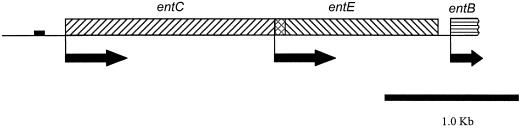
Genetic organization of the DHBA biosynthesis genes from B. abortus 2308. Arrows indicate the predicted direction of transcription, and the small closed box represents a putative Fur binding site. The entC and entE open reading frames overlap by 21 amino acids. Only the first 96 nucleotides of the entB open reading frame from B. abortus have been cloned.
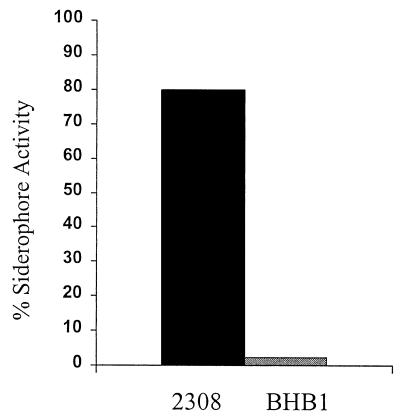
Siderophore activity of supernatants from cultures of B. abortus 2308 and BHB1 (ΔentC) as determined by the liquid CAS assay (23). Supernatants from 48-h cultures grown in low-iron modified minimal medium (14) were mixed with an equal volume of CAS reagent, and the percent siderophore activity was calculated for each supernatant by using the formula [(X−Y)/X] × 100, where X is the absorbance at 630 nm of uninoculated growth medium and Y is the absorbance at 630 nm of the culture supernatant.
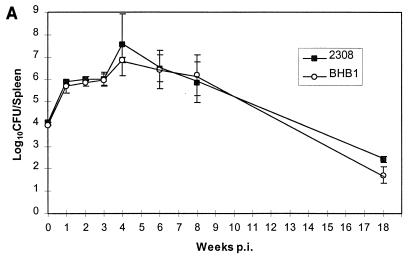
Viable brucellae enumerated from the spleens of mice infected with B. abortus 2308 and BHB1 (ΔentC) cultures grown under either iron-replete (A) or iron-restricted (B) conditions. Each symbol represents the average number of bacteria cultured from the spleens of five mice, and the corresponding error bars represent the standard deviation for each experimental group. p.i., postinfection.
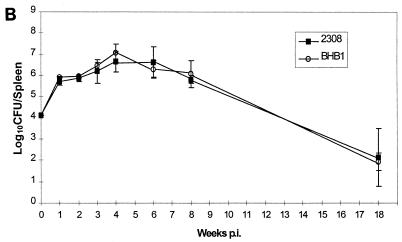
Viable brucellae enumerated from the spleens of mice infected with B. abortus 2308 and BHB1 (ΔentC) cultures grown under either iron-replete (A) or iron-restricted (B) conditions. Each symbol represents the average number of bacteria cultured from the spleens of five mice, and the corresponding error bars represent the standard deviation for each experimental group. p.i., postinfection.
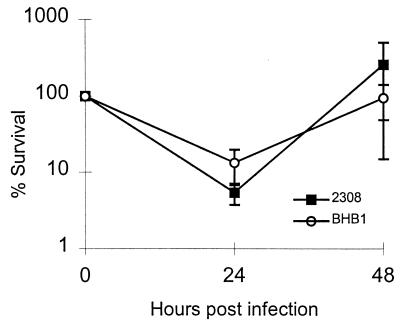
Killing of B. abortus 2308 and BHB1 (ΔentC) opsonized with hyperimmune murine serum by resident peritoneal macrophages from BALB/c mice in culture. Data presented are the results of a representative experiment. Percent survival was calculated based on the number of intracellular bacteria enumerated at 24 and 48 h compared to the number of internalized bacteria detected at time zero.
References
-
- Arnow L E. Colorimetric determination of the components of 3,4-dihydroxyphenyalanine-tyrosine mixtures. J Biol Chem. 1937;118:531–537.
-
- Bellaire B H, Baldwin C L, Elzer P H, Roop R M., II . Proceedings of the 79th Annual Conference of Research Workers in Animal Disease. 1998. Contribution of the Brucella abortus 2,3-dihydroxybenzoic acid (DHBA) biosynthesis operon to virulence in ruminants, abstr. 4; p. 43.
-
- Earhart C F. Uptake and metabolism of iron and molybdenum. In: Neidhardt F C, Curtiss III R, Ingraham J L, Lin E C C, Low K B, Magasanik B, Reznikoff W S, Riley M, Schaechter M, Umbarger H E, editors. Escherichia coli and Salmonella: cellular and molecular biology. 2nd ed. Washington, D.C: American Society for Microbiology; 1996. pp. 1075–1090.
Publication types
MeSH terms
Substances
LinkOut - more resources
Full Text Sources
