


Using diagnosis-related groups for studying variations in hospital admissions
- PMID: 10312632
- PMCID: PMC4192882
Item in Clipboard
Using diagnosis-related groups for studying variations in hospital admissions
Health Care Financ Rev.
1988 Summer.
Abstract
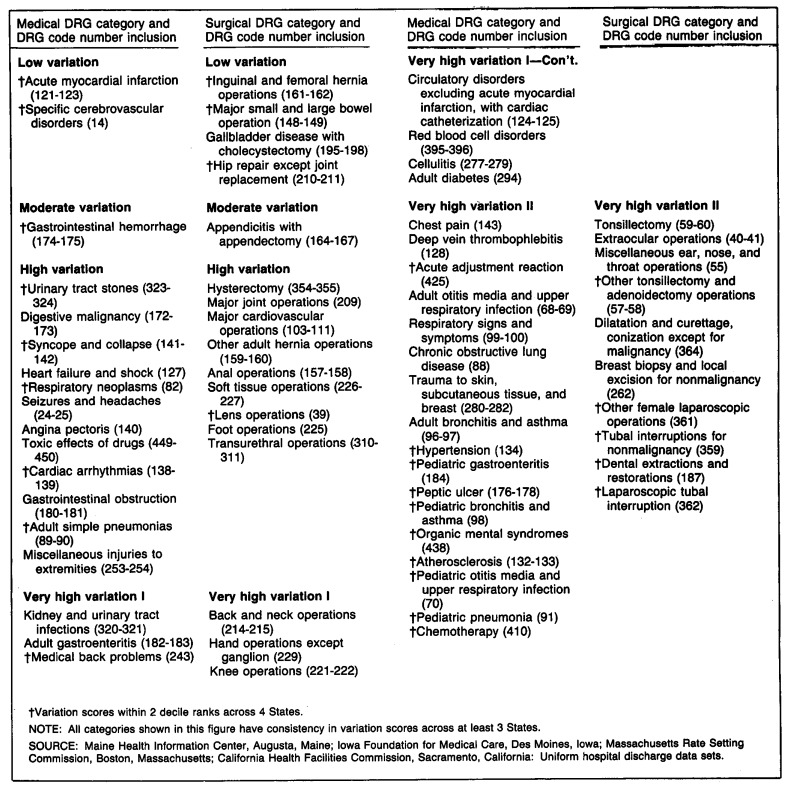
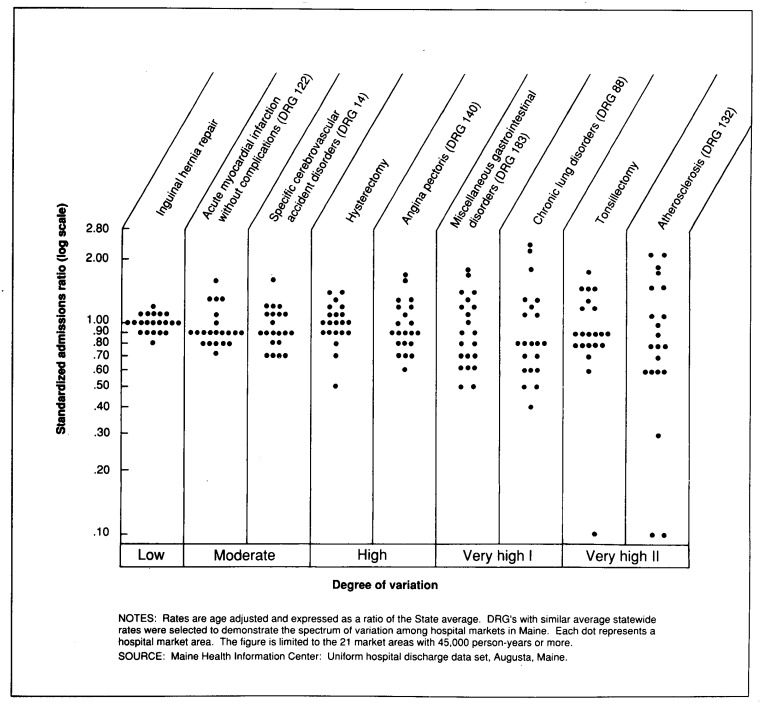
The diagnosis-related groups (DRG's) have classically focused on resources consumed during a hospital stay. DRG's can also be considered categories for describing cases admitted to a hospital. In this article, we illustrate how consistent patterns of variations in admission rates can be used to classify DRG categories according to the Index of Discretionary Admissions. The consistency of variation in admission rates for modified DRG categories across hospital service areas in Iowa, California, Massachusetts, and Maine was high. The proportion of hospital admissions in the DRG's judged to be most discretionary ranged from 22 percent in Iowa to 14 percent in California.
Figures
References
-
- Bolande RP. Ritualistic surgery—circumcision and tonsillectomy. New England Journal of Medicine. 1969;280(11):591–596. - PubMed
-
- Bunker JP, McPherson K, Henneman PL. Elective hysterectomy. In: Bunker JP, Barnes BA, Mosteller F, editors. Costs, Risks and Benefits of Surgery. New York: Oxford University Press; 1977.
-
- Carter GM, Ginsburg PB. The Medicare Case Mix Index Increase: Medical Practice Changes, Aging, and DRG Creep. Santa Monica, Calif.: The Rand Corporation; 1985.
-
- Deane RT, Ulene A. Hysterectomy or tubal ligation for sterilization: A cost-effectiveness analysis. Inquiry. 1977;14(1):73–86. - PubMed
-
- Department of Health Care Review. Confronting Regional Variations: The Maine Approach. Chicago: The American Medical Association; 1986.
Publication types
MeSH terms
Grants and funding
LinkOut - more resources
Full Text Sources
Medical