


Living arrangement choices of elderly singles: effects of income and disability
- PMID: 10317709
- PMCID: PMC4191527
Living arrangement choices of elderly singles: effects of income and disability
Abstract
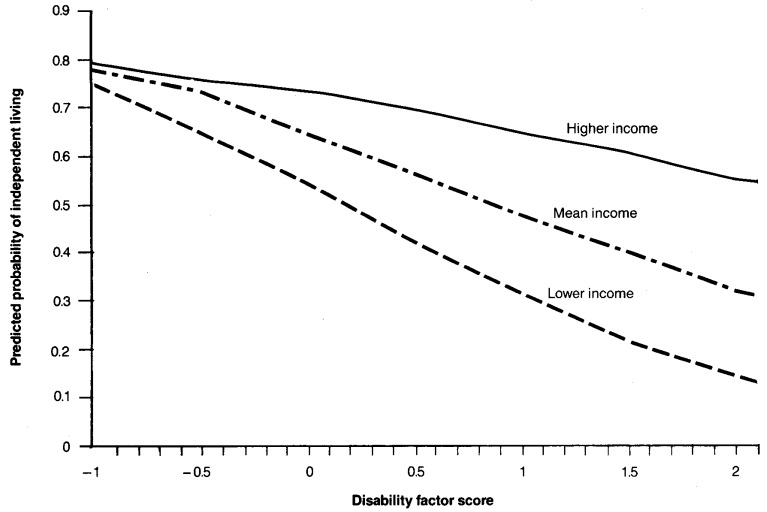
Logit regression is used to explain living arrangement choice of elderly single individuals. The propensity to live independently is found to increase with income and decrease with disability; an interaction effect for females suggests that income may lessen the impact of disability on the propensity to seek shared living arrangements. Independent living is less likely for people who are not white, foreign-born males, those with at least one adult child, and those in States with higher living costs; and more likely for the ever-married and those in States with high per capita nursing home use. If home care services are preferentially allocated to disabled elderly who live alone, resources may flow to higher income individuals who have been able to maintain independent households.
Figures
References
-
- Amemiya T. Qualitative response models: A survey. J Econ Literature. 1981;19(4):1483–1536.
-
- Bachrach CA. Childlessness and social isolation among the elderly. Journal of Marriage and the Family. 1980;42(3):627–637.
-
- Barron E. Survey of Low Income Aged and Disabled. Washington: U.S. Government Printing Office; 1979. Survey design, estimation, procedures, and sampling variability. Report No. 5. HEW Pub. No. (SSA) 79-11723. Social Security Administration.
-
- Beresford J, Rivlin A. Privacy, poverty and old age. Demography. 1966;3(1):247–258.
-
- Belcher JC. The one-person household: A consequence of the isolated nuclear family? Journal of Marriage and the Family. 1967 Aug.29:534–540.
Publication types
MeSH terms
LinkOut - more resources
Full Text Sources